Dehumidification Load Calculation in Air Conditioning System
Updated: 3 days ago
Introduction
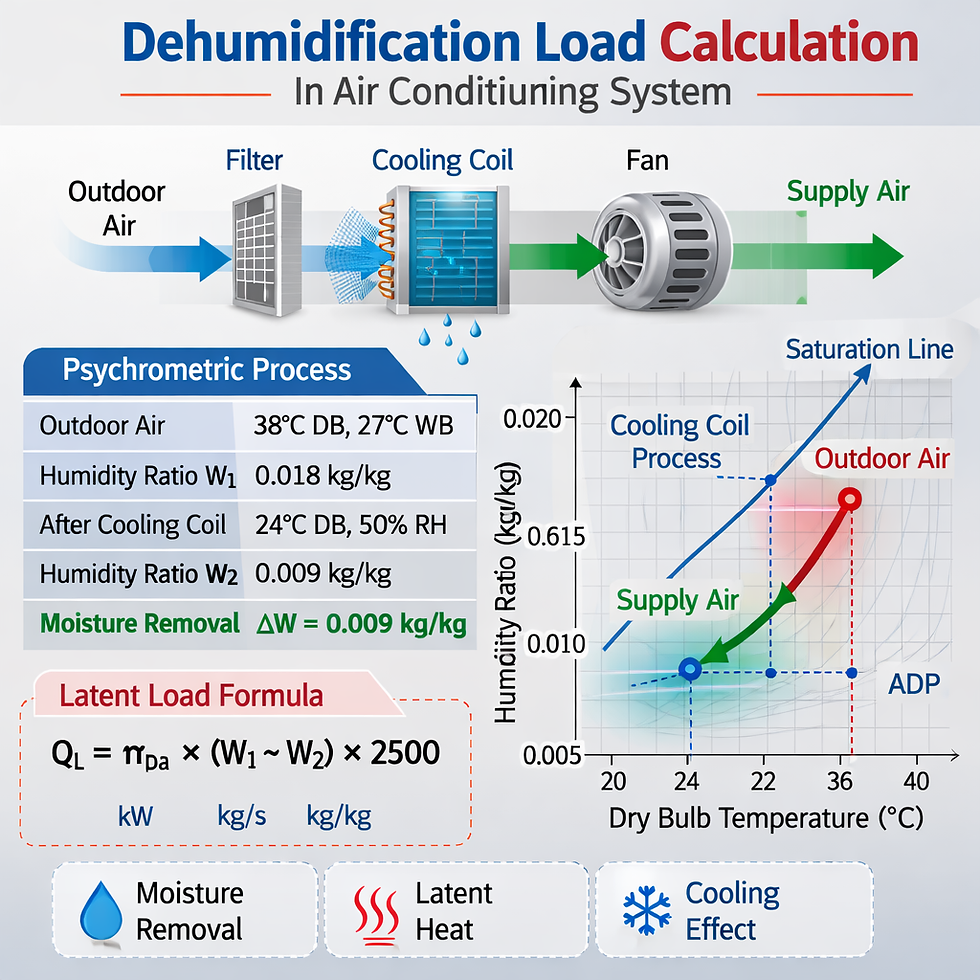
Dehumidification Load Calculation is one of the most important parts of HVAC design whenever indoor humidity control matters as much as dry-bulb temperature control. In real projects such as hospitals, laboratories, hotels, mosques, schools, office buildings, and high-occupancy commercial spaces, engineers often discover that a system sized only for sensible cooling cannot maintain indoor comfort or condensation control.
This happens because air conditioning systems do not just cool air. They also remove moisture. When outdoor ventilation air enters a building, when occupants breathe and perspire, and when processes generate vapor, the system must handle a latent load in addition to the sensible load. If this moisture load is underestimated, indoor relative humidity rises, coil performance becomes unstable, mold risk increases, and occupant comfort declines.
In practice, dehumidification load calculation is closely tied to psychrometrics, ventilation design, coil selection, and supply air condition. It is therefore not a side calculation. It is a core engineering step in designing air handling units, fan coil systems with dedicated outdoor air, packaged units, and chilled water systems. (Dehumidification Load Calculation in Air Conditioning System)
Definition:
Dehumidification load is the amount of heat equivalent associated with removing water vapor from air to maintain a desired indoor humidity level. In HVAC engineering, it is typically treated as the latent cooling load, and it depends on the difference in moisture content between entering air and conditioned supply or indoor design air.
What is Dehumidification Load Calculation
Dehumidification load calculation determines how much moisture an air conditioning system must remove from the air over a given time period.
Its purpose is to answer three practical design questions:
How much water vapor enters the conditioned space?
How much of that moisture must the system remove?
What cooling coil capacity is required to achieve that moisture removal?
Engineers apply this concept in systems where humidity must be controlled for:
occupant comfort
indoor air quality
condensation prevention
mold control
equipment protection
process stability
It is used in:
central air handling units
make-up air units
DOAS systems
chilled water AHUs
rooftop packaged units
precision cooling applications
Why engineers apply it is simple: a space may satisfy temperature setpoint and still fail humidity control. A room at 23°C with 70% RH is often uncomfortable and may cause surface condensation, while a room at the same temperature with 50% RH performs much better. That difference is driven by moisture removal, not just sensible cooling.

Engineering Principles
Dehumidification load is based on the physics of water vapor in air and the refrigeration effect needed to condense that vapor at the cooling coil.
1. Moist Air Behavior (Dehumidification Load Calculation in Air Conditioning System)
Atmospheric air is a mixture of dry air and water vapor. The amount of moisture it contains is expressed by:
humidity ratio, W in kg water/kg dry air
relative humidity, RH in %
dew point temperature
enthalpy
For accurate calculation, engineers normally use psychrometric charts or software.
2. Latent Heat
When water vapor condenses into liquid on a cooling coil, energy must be removed. This energy is the latent heat of vaporization. In HVAC calculations, latent load is typically expressed in kW, TR, or Btu/h.
A common equation is:
QL=m˙da × hfg × (W1−W2)Where:
QL = latent load (kW)
m˙da = mass flow rate of dry air (kg/s)
hfg = latent heat of vaporization of water (approximately 2500 kJ/kg near comfort conditions)
W1−W2 = humidity ratio difference
3. Coil Apparatus Dew Point
To remove moisture, the cooling coil surface must be below the entering air dew point. The lower the coil temperature, the more condensation occurs. This is why chilled water temperature, refrigerant evaporating temperature, and coil bypass factor directly affect dehumidification performance.
4. Sensible Heat Ratio
Dehumidification load also influences the Sensible Heat Ratio (SHR):
SHR=QS / (QS+QL)Where:
QS = sensible cooling load
QL = latent cooling load
A low SHR means a greater share of the total load is latent, which is common in humid climates and high-ventilation buildings.
Step-by-Step Engineering Process
Step 1 – Determine Indoor and Outdoor Design Conditions
Start by fixing:
indoor design dry-bulb temperature
indoor design relative humidity
outdoor design dry-bulb temperature
outdoor design wet-bulb or humidity ratio
Example indoor condition:
24°C DB
50% RH
Example outdoor condition:
38°C DB
27°C WB
These values define the moisture gradient the system must overcome.
Step 2 – Identify Moisture Sources
Moisture enters the building from several sources:
outdoor ventilation air
infiltration through doors and leakage
occupants
cooking or process loads
wet surfaces or open water sources
building startup after shutdown
In many comfort cooling projects, the ventilation air latent load is the dominant component.
Step 3 – Calculate Moisture Load
For each source, calculate the moisture gain in kg/s or kg/h.
A practical latent load equation for an air stream is:
QL=m˙da×(Wentering − Wleaving)×2500If air volume flow rate is known, first convert to dry air mass flow:
m˙air=ρ×V˙Where:
ρ = air density, approximately 1.2 kg/m³
V˙ = airflow rate in m³/s
For engineering approximation in SI units:
QL≈3000×V˙×ΔWWhere:
QL in kW
V˙ in m³/s
ΔW in kg/kg
Step 4 – Select Supply Air and Coil Conditions
After determining the required moisture removal, define:
supply air state
off-coil air condition
coil ADP
coil bypass factor
required chilled water temperature or DX coil condition
This step confirms whether the selected AHU can actually remove the required moisture, not just meet the total tonnage.
Practical Engineering Example
Consider a fresh air handling unit supplying 2.5 m³/s of outdoor air to a commercial building in a humid climate.
Assume:
entering outdoor air humidity ratio W1=0.018W_1 = 0.018W1=0.018 kg/kg
leaving supply air humidity ratio W2=0.009W_2 = 0.009W2=0.009 kg/kg
Step A – Air Mass Flow
m˙air=1.2×2.5=3.0 kg/s
For simplified engineering use, dry air mass flow is close enough to 3.0 kg/s here.
Step B – Moisture Removal Rate
ΔW=0.018−0.009=0.009 kg/kg
m˙water=3.0×0.009=0.027 kg/s
This means the coil removes:
0.027×3600=97.2 kg/h of water
Step C – Latent Load
QL=3.0×2500×0.009
QL=67.5 kW
So the system latent capacity required for this outdoor air stream is approximately 67.5 kW.
Design Interpretation
This result tells the engineer several things:
a standard comfort coil may not be sufficient unless off-coil air is cold enough
reheat may be needed if the supply air becomes too cold
ventilation air treatment should preferably be separated from zone sensible cooling
DOAS may perform better than relying only on fan coil units or VRF indoor units
This is why dehumidification load calculation directly influences system architecture, not only coil size.
Technical Comparison Table
Parameter | Sensible Cooling Load | Dehumidification Load |
Main effect | Reduces dry-bulb temperature | Removes moisture from air |
Driven by | Temperature difference | Humidity ratio difference |
Typical unit | kW or Btu/h | kW or Btu/h |
Coil requirement | Air cooled below room DB | Coil surface below dew point |
Psychrometric movement | Horizontal | Downward-left |
Common source | Solar gain, equipment, envelope | Ventilation air, people, infiltration |
Design risk if underestimated | Space too warm | Space too humid |
Typical control variable | Temperature sensor | RH sensor or dew point control |
Advantages
Accurate dehumidification load calculation provides major engineering benefits:
improves indoor comfort by controlling RH within acceptable limits
reduces condensation on diffusers, ducts, and glazed surfaces
limits microbial growth in ceilings and insulation
improves durability of finishes and furnishings
helps size cooling coils more accurately
supports correct chilled water temperature selection
improves zoning and ventilation strategy
prevents underperforming HVAC systems in humid climates
It also improves coordination between mechanical design, controls, and energy modeling.
Common Engineering Mistakes
Engineers often make the following errors when applying dehumidification calculations:
Ignoring Ventilation Latent Load
Outdoor air can carry more moisture than internal sources. Ignoring it leads to severe under sizing.
Using Only Dry-Bulb Temperatures
A cooling load estimate based only on temperature misses the moisture component entirely.
Selecting Equipment by Total Tonnage Alone
A unit with enough total capacity may still have inadequate latent capacity.
Overlooking Coil Leaving Condition
The actual off-coil state determines whether moisture is removed. Nominal catalog tonnage is not enough.
Ignoring Part-Load Humidity Control
Systems may satisfy sensible load quickly at part load and cycle off before enough moisture is removed.
Incorrect Occupancy Assumptions
High-density spaces such as prayer halls, meeting rooms, and classrooms often have strong latent peaks from people.
No Reheat or Humidity Control Strategy
When low coil temperatures are needed for dehumidification, supply air may require reheat to avoid overcooling the zone.
Future Trends
Dehumidification design is changing because buildings are becoming tighter, smarter, and more ventilation-driven.
Dedicated Outdoor Air Systems
DOAS separates ventilation latent treatment from sensible zone cooling, giving better humidity control.
Low Dew Point Control
More projects now specify dew point targets instead of only room temperature and RH.
AI-Assisted HVAC Optimization
Smart control sequences can adjust chilled water temperature, airflow, and reheat based on occupancy and outdoor enthalpy.
Digital Twin Integration
Operational data can be compared with the design model to detect humidity control failures early.
Energy Recovery for Humidity Control
Enthalpy wheels and run-around coils reduce the latent burden on cooling coils.
Variable-Speed and Modulating Systems
Better part-load control helps maintain humidity without excessive cycling.
These trends are especially relevant in hot-humid climates and high-outdoor-air projects.
FAQ Section
1. What is the difference between latent load and dehumidification load?
In comfort HVAC, they are usually treated as the same concept. Both refer to the load associated with moisture removal from air.
2. Why is dehumidification load high in ventilation systems?
Because outdoor air often has a much higher humidity ratio than indoor design air, especially in humid regions. Treating fresh air can dominate the latent load.
3. Can an AC unit meet temperature but fail humidity control?
Yes. This is common when equipment is selected by sensible or total cooling only, without verifying coil latent performance and part-load behavior.
4. What psychrometric property is most important in dehumidification calculations?
Humidity ratio is the key property because it directly indicates the mass of water vapor in the air.
5. Is reheat always required after dehumidification?
Not always, but it is common when air must be cooled deeply to remove moisture and would otherwise be supplied too cold to the space.
Conclusion
Dehumidification Load Calculation is a critical engineering task in any air conditioning system expected to control comfort, indoor air quality, and condensation risk. It is fundamentally a latent load problem driven by moisture sources, humidity ratio difference, and coil performance. Engineers must evaluate outdoor air, internal moisture generation, supply air condition, and psychrometric process together.
A well-designed HVAC system does not merely lower temperature. It maintains the right moisture balance. In practical design terms, that means correct latent load estimation, realistic coil selection, and a control strategy that works at both peak and part-load conditions.
Author Note:
Nexora Design Lab publishes engineering insights on HVAC design, MEP systems, and sustainable building technologies used in modern construction projects.
Related engineering guides:


Comments