How to Calculate Cooling Load for Villas in Middle East
Updated: Sep 29
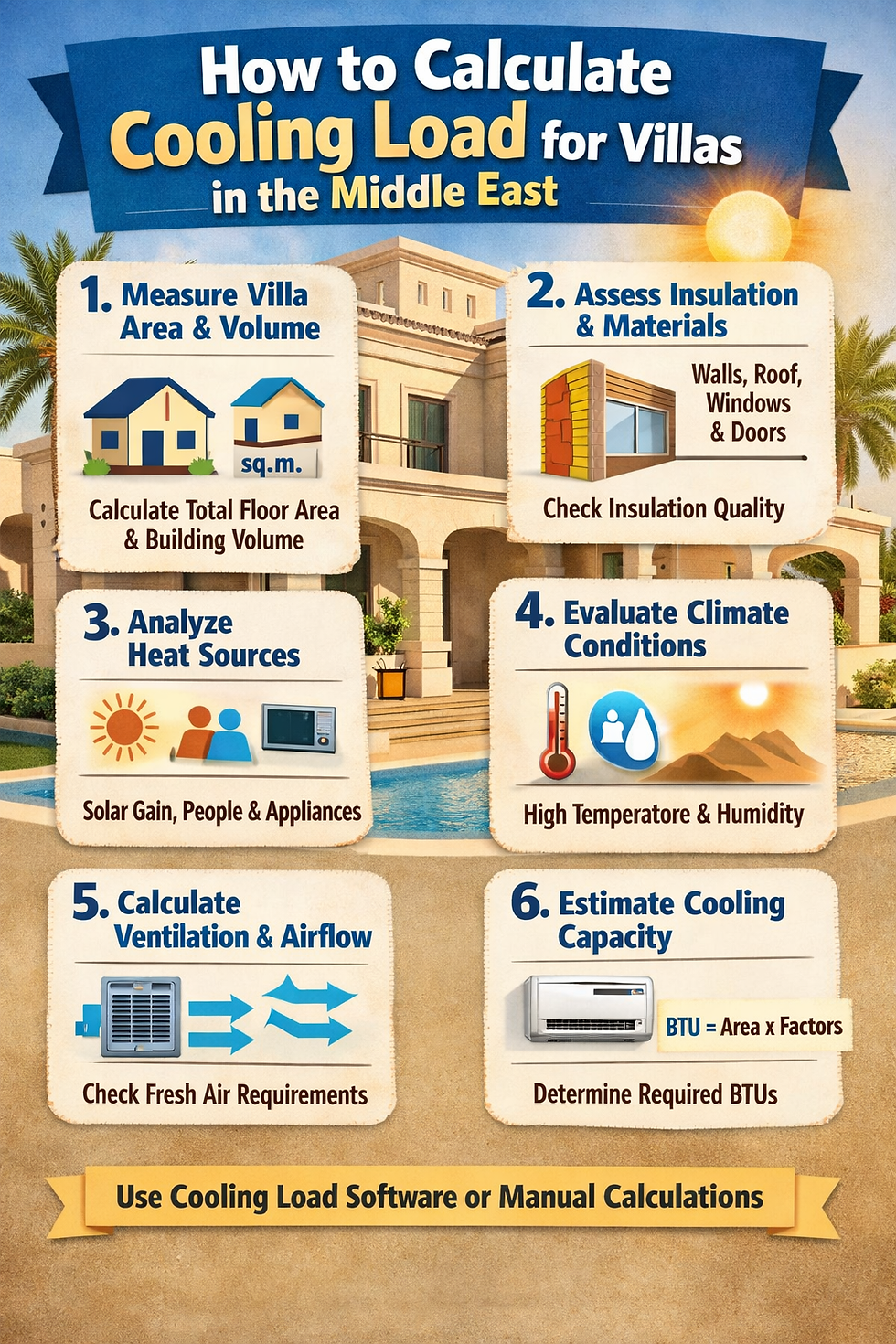
Designing HVAC systems for villas in the Middle East requires precision. With summer temperatures reaching 45–50°C, intense solar radiation, and high humidity in coastal regions, cooling load calculations must be detailed and climate-specific. Oversizing increases capital and energy costs, while under sizing leads to discomfort and system inefficiency.
This guide explains how professional HVAC engineers calculate cooling load for villas in UAE, Saudi Arabia, Qatar, Oman, Kuwait, and Bahrain. (How to Calculate Cooling Load for Villas in Middle East)
Climate Challenges in the Middle East
Villas in the Middle East are exposed to:
Outdoor design temperatures: 40–50°C
High solar heat gain
Large glazing areas
Flat reinforced concrete roofs
Dust infiltration
Coastal humidity (especially Qatar, UAE, Oman)
Because of these factors, solar and roof loads often form the largest portion of total cooling demand.
Main Components of Cooling Load
Cooling load consists of two major parts:
1. Sensible Heat Load (How to Calculate Cooling Load for Villas in Middle East)
Heat through walls and roof
Solar radiation through glass
Lighting
Equipment
Occupants (sensible portion)
2. Latent Heat Load (How to Calculate Cooling Load for Villas in Middle East)
Moisture from occupants
Outdoor fresh air
Infiltration
Humidity from coastal climates
In Gulf countries, latent load can represent 25–35% of total cooling capacity.
Step-by-Step Cooling Load Calculation
Step 1: Heat Gain Through Walls and Roof
Basic formula:
Q = U × A × ΔT
Where,
U = Overall heat transfer coefficient (W/m²·K)
A = Surface area (m²)
ΔT = Outdoor temperature – Indoor design temperature
Example:
Outdoor temperature = 46°C
Indoor temperature = 24°C
ΔT = 22°C
If wall area = 250 m² and U-value = 1.6 W/m²·K:
Q = 1.6 × 250 × 22 = 8,800 W (8.8 kW)
The same method is applied to roof, doors, and exposed floors.
Step 2: Solar Heat Gain Through Glass
Solar load through glazing depends on:
Orientation (west-facing glazing is critical)
SHGC (Solar Heat Gain Coefficient)
Glass type (double glazing, Low-E recommended)
Shading devices
Window-to-wall ratio
West-facing glazing can increase total cooling load by 15–25% if not properly shaded.
Step 3: Internal Heat Gains
Occupants
Each person contributes approximately:
75–100 W sensible
55–70 W latent
Lighting
Residential villas typically:8–12 W per m²
Equipment
Kitchen appliances, home theaters, and servers significantly increase load.
Step 4: Ventilation and Fresh Air Load
Fresh air is mandatory for indoor air quality.
Sensible ventilation load:
Q = 1.2 × CFM × ΔT
Latent ventilation load:
Q = 0.68 × CFM × ΔGrains
In humid coastal regions, latent load can be a major design factor.
Sample Cooling Load for a 450 m² Villa,
Component | Estimated Load (kW) |
Walls | 9 |
Roof | 14 |
Glass Solar | 18 |
Internal Gains | 8 |
Ventilation | 10 |
Total | 59 kW |
Conversion to Tons of Refrigeration (TR):
1 TR = 3.517 kW
59 / 3.517 ≈ 16.8 TR
Required system capacity ≈ 17 TR
Common Mistakes in Villa Cooling Load Design
Using rule-of-thumb (e.g., “1 ton per 400–600 sq.ft”)
Ignoring solar orientation
Not calculating latent load
Oversizing for safety
Neglecting roof insulation
Professional engineering calculation is always recommended.
Recommended Standards and Tools
For accurate villa cooling load calculations, engineers typically use:
ASHRAE CLTD Method
Radiant Time Series (RTS) Method
HAP Software
Manual J (Residential)
Design Recommendations for Middle East Villas
Use double-glazed Low-E glass
Provide high roof insulation (minimum R-30 equivalent)
Design zoning for large villas
Include fresh air systems with energy recovery
Consider VRF or chilled water systems for luxury properties
Conclusion
Cooling load calculation for villas in the Middle East cannot rely on simple area-based rules. It requires:
Detailed building envelope analysis
Solar orientation study
Internal heat gain assessment
Ventilation and humidity control evaluation
A properly calculated system ensures comfort, energy efficiency, and long equipment life.
Related engineering guides:


Comments