How to Reduce Fan Energy Consumption by 30% Without Changing Equipment
Updated: Sep 29
Executive Overview
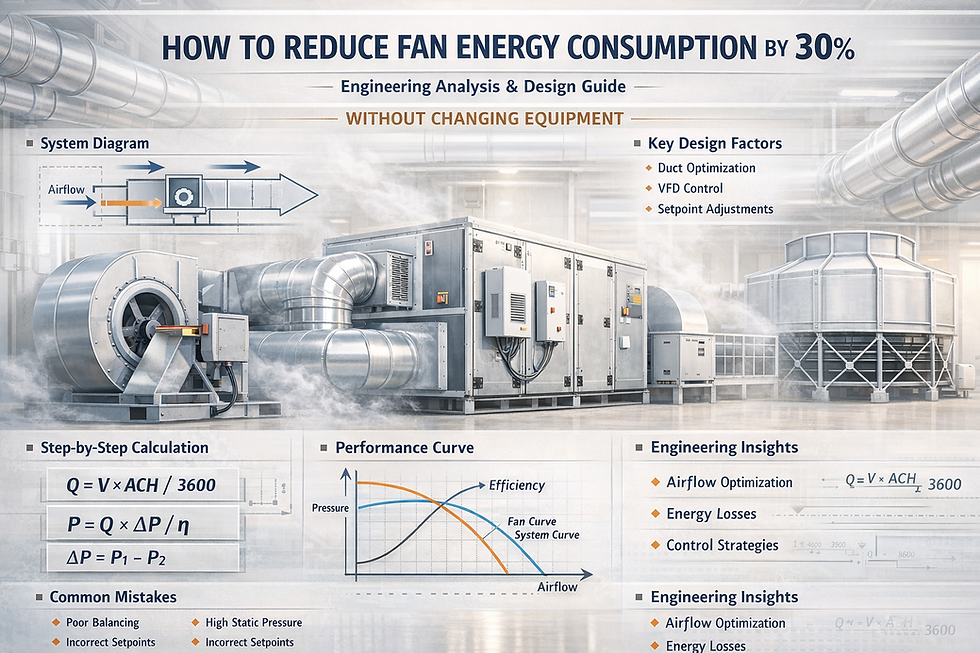
In many buildings, fan energy is treated as a fixed operating cost rather than an actively manageable engineering variable. That is a mistake. In a large proportion of commercial, healthcare, hospitality, mixed-use, and industrial buildings, fan systems consume far more energy than necessary, not because the fan or motor is fundamentally wrong, but because the system around the fan is imposing excess pressure, poor control logic, or avoidable operating hours.
The most important point is this: a 30% reduction in fan energy consumption is often achievable without replacing the fan, motor, or air handling unit. The reduction comes from correcting system resistance, improving control strategy, resetting static pressure, reducing unnecessary airflow, stabilizing balancing, eliminating bypass waste, improving filter and coil maintenance, and aligning operation with actual demand. In many projects, the fan hardware is capable of acceptable performance; the inefficiency lies in how the air system is designed, commissioned, controlled, and operated.
From an engineering perspective, fan energy reduction is not a single measure. It is a structured optimization exercise across five interacting domains:
Airflow demand
Many systems are moving more air than the load or ventilation requirement actually demands.
System pressure
Duct networks, fittings, coils, filters, dampers, silencers, fire/smoke devices, and terminal units often create excess total static pressure beyond what is truly required.
Control logic
Constant-volume or poorly tuned variable-volume sequences frequently keep fans operating at higher speed than necessary.
Operational profile
Fans often run during unoccupied periods, low-load periods, or partial-load periods without proper turndown.
Maintenance condition
Dirty filters, fouled coils, stuck dampers, failed sensors, and drifted balancing settings increase pressure and operating time.
Read related topics :
Most Common Mistakes in Jet Fan Ventilation System Design and Installation
Ducted vs Jet Fan Ventilation Systems for Basement Car Parks
The commercial significance is substantial. Because fan power scales approximately with the cube of fan speed under affinity-law conditions, modest reductions in speed can create major energy savings. A 10% speed reduction can produce approximately 27% power reduction, provided the system follows a stable variable-resistance profile and the control sequence is appropriate. In practice, actual savings may be lower or higher depending on duct static characteristics, terminal authority, minimum ventilation requirements, and operating diversity. But the strategic message remains: small operational corrections can unlock large energy gains.
For developers and asset owners, this is attractive because the measures are often low-capex or no-capex compared with equipment replacement. For consultants and MEP engineers, it is one of the clearest opportunities to deliver measurable operational value using engineering judgement rather than expensive retrofit hardware. For facility teams, it is one of the fastest routes to lower utility cost, lower noise, improved controllability, and better lifecycle performance.
This article addresses the problem from a consulting-grade perspective: what actually drives fan waste in real buildings, how to diagnose it, how to calculate the opportunity, how to implement reductions safely, and how to avoid compromising ventilation, comfort, smoke control, or tenant expectations. (How to Reduce Fan Energy Consumption by 30%)
Why This Topic Matters in Real Buildings
In theory, an HVAC air system should deliver exactly the airflow needed to satisfy sensible load, latent control strategy, ventilation requirement, pressurization objective, and code constraints. In reality, most buildings drift away from that condition shortly after handover.
Design margins stack up. Engineers add safety factors. Equipment suppliers add conservative selections. Contractors add balancing dampers. Operators override controls to address comfort complaints. Filters become dirty. Terminal boxes drift. Pressure setpoints remain fixed at design peak values throughout the year. Occupancy profiles change, but fan operation does not. The result is predictable: the system delivers acceptable air, but at excessive pressure and energy input.
This matters because fan energy is persistent. Unlike one-time capital overspend, fan inefficiency repeats every hour of operation over the entire asset life. A fan that wastes 15 kW continuously for 16 hours per day does not merely create a technical inefficiency; it creates a long-term cash leakage into the operating budget.
The issue is particularly important in the following building types:
Read related topics :
Office and mixed-use buildings
Variable air volume systems are often installed with the expectation of efficient turndown, yet many operate with fixed or poorly optimized static pressure setpoints, high minimum box flows, and simultaneous heating/cooling effects that keep airflow artificially elevated.
Hotels (How to Reduce Fan Energy Consumption by 30%)
Guestroom ventilation, corridor pressurization, kitchen makeup air, car park exhaust, and back-of-house systems frequently operate on conservative sequences. Occupancy diversity is rarely translated fully into fan turndown.
Hospitals and healthcare facilities
Critical pressure relationships and air change requirements are non-negotiable, but many non-critical areas still have optimization potential. The challenge is to distinguish systems that must remain conservative from systems where precise control can still produce significant savings.
Retail and high-footfall spaces
Load diversity across trading hours is substantial, but some systems continue operating close to full volume regardless of occupancy, tenant fit-out changes, or seasonal load variation.
Industrial and specialty facilities
High-pressure systems, process ventilation, and dust or fume extraction may have genuine duty requirements, but many systems accumulate pressure losses due to poor duct routing, clogged filtration, and outdated controls.
In engineering practice, one of the biggest misconceptions is that energy reduction requires hardware replacement. That is not always true. Before recommending fan replacement, an experienced consultant should first ask four questions:
Is the system moving more air than required?
Is the fan overcoming more pressure than necessary?
Is the control sequence maintaining more speed than necessary?
Is the fan running more hours than necessary?
If the answer to even two of those questions is yes, the energy-saving opportunity may be substantial without changing the fan itself.
Core Engineering Principles
The engineering basis for reducing fan energy begins with understanding that fan power is a function of both airflow and pressure.
For a fan system, the air power relationship may be expressed as:
Pair = Q×ΔP
Where:
Pair = air power in W
Q = airflow rate in m3/s
ΔP = fan total pressure in Pa
The electrical input power is:
Pin = (Q×ΔP) / (ηfan×ηmotor×ηdrive)
Where:
ηfan = fan efficiency
ηmotor = motor efficiency
ηdrive = drive efficiency, where applicable
If the equipment is unchanged, the engineer cannot improve the mechanical design efficiency of the fan itself. But the engineer can reduce the required airflow QQQ, reduce the required pressure ΔP\Delta PΔP, or reduce operating hours. That is exactly where the opportunity lies.
Affinity law effect
For geometrically similar operation of a fan on the same system:
Q ∝ N
ΔP ∝ N^2
P ∝ N^3
Where NNN is rotational speed.
This cubic relationship explains why speed control is so powerful. If speed reduces from 100% to 90%:
Pnew = (0.9)^3 = 0.729
So power reduces to 72.9% of original, meaning approximately 27.1% savings.
If speed reduces to 85%:
Pnew = (0.85)3
That is approximately 38.6% power reduction.
In real systems, the exact result depends on the system curve, control strategy, minimum flow constraints, and non-ideal effects. Still, the principle remains valid: small speed reductions can create large electrical savings.
System effect of pressure loss
Many fans are selected against a nominal external static pressure that later becomes inflated in actual operation by poorly coordinated accessories, abrupt duct transitions, undersized branches, dampers operating near closed position, dirty filters, or terminal devices set too aggressively. Excess pressure directly increases energy demand. Therefore, reducing fan pressure requirement is often the cleanest route to savings.
Demand versus design
Design airflow is typically based on peak load plus diversity assumptions, code ventilation, and engineering contingency. But buildings operate at design peak for only a fraction of annual hours. The control system should allow the air system to move away from design-point operation during most of the year. When it does not, fan energy is wasted.
Code, Standards, and Compliance Context
Reducing fan energy cannot be approached as a purely energy-driven exercise. It must be carried out within the constraints of applicable standards, life safety requirements, ventilation codes, and project-specific employer requirements.
From a practical MEP consulting viewpoint, the following standards and frameworks are commonly relevant depending on jurisdiction:
Ventilation and indoor air quality standards
Minimum outside air and air distribution performance must continue to satisfy applicable ventilation criteria. Any airflow reduction strategy must protect required outdoor air rates, room air distribution effectiveness, pressurization objectives, and contaminant control.
Energy codes and performance standards
Most modern energy frameworks encourage variable flow control, fan power limitation, demand-based ventilation, and static pressure reset. However, compliance must be verified against the local authority requirements, especially where design documentation has already established certain operating assumptions.
Fire and smoke control requirements
This is critical. Smoke extraction, stair pressurization, life safety purge, and other emergency fan systems are not ordinary comfort ventilation systems. Their emergency duty must never be compromised by energy-saving logic. Where a single fan serves both normal and emergency modes, the control philosophy must preserve compliant emergency operation irrespective of normal low-energy sequences.
Healthcare and specialty space requirements
In hospitals, laboratories, clean rooms, and similar facilities, air change rates, pressure cascades, and contamination control may constrain airflow reduction. Optimization must be applied selectively and only with full awareness of the room classification and infection/process control risk.
Acoustic and comfort implications
Energy reduction measures may alter terminal box behavior, diffuser throw, space sound levels, and pressure relationships. Engineering compliance is therefore not only about energy rules, but also comfort, operability, and maintainability.
The senior engineer’s judgement is not to reduce fan energy at any cost. It is to identify reducible waste while preserving code performance and operational resilience.
Design Methodology Step by Step
Step 1: Establish the actual baseline
Do not begin with design intent drawings alone. Establish actual fan electrical input, airflow, operating schedule, static pressure, filter pressure drop, coil condition, damper positions, and terminal diversity. Trending data from the BMS is invaluable here. If the BMS is unreliable, field measurements are necessary.
At minimum, gather:
Fan motor electrical power in kW
Supply or return airflow in m3/s
Fan speed or VFD frequency
Supply duct static pressure setpoint and trend
Terminal unit positions
Outside air fraction
Operating hours
Filter differential pressure
Occupancy profile
Without a reliable baseline, savings estimates are speculative.
Step 2: Verify whether airflow is genuinely required
Compare actual operating airflow against realistic load and ventilation demand. Many systems run at unnecessarily high minimum flow because of conservative VAV box settings, outdated balancing values, or comfort complaints that were solved by simply increasing air.
Check whether zones are overventilated, whether minimum terminal settings are excessive, and whether night or off-peak airflow could be reduced.
Step 3: Review pressure losses across the air path
Map pressure drop contributors from intake to terminal and back where relevant. Look at filters, coils, sound attenuators, duct friction, fittings, dampers, control devices, heat recovery sections, and terminal units. Excessive pressure almost always has a physical cause.
A useful engineering question is: where is the pressure being spent, and which part is not adding value?
Step 4: Optimize control sequence
This is often the largest no-equipment-change opportunity. Common actions include:
Static pressure reset
Instead of maintaining constant design static pressure, allow static setpoint to fall when downstream terminals are mostly open and rise only when needed.
Schedule optimization
Align operation with real occupancy and preconditioning requirements.
Demand-based ventilation integration
Where permitted, reduce outdoor air during lower occupancy periods using approved sensing logic.
Night setback and shutdown logic
Avoid full fan operation during non-critical hours.
Step 5: Reduce artificial resistance
Open locked balancing dampers only where rebalance permits. Correct crushed flexible ducts. Remove unnecessary throttling. Clean coils. Replace loaded filters at appropriate pressure drop rather than deferred intervals. Correct damper linkages. These are basic measures, but they are often where substantial savings begin.
Step 6: Rebalance the system intelligently
Many systems are balanced once, then drift. Rebalancing should not simply restore original wasteful settings. It should reflect the optimized sequence, verified load profile, and intended control philosophy.
Step 7: Trend, verify, and lock the sequence
After implementation, trend fan power, speed, static pressure, critical zone conditions, and complaints. Savings must be verified and the sequence documented. Otherwise the building will revert to high-energy operation after the first comfort issue.
Detailed Engineering Calculation Example
Consider a supply fan serving a variable air volume office floor.
Design data:
Design airflow = 12.0 m3/s
Original operating total pressure = 900 Pa
Combined fan, motor, and drive efficiency = 0.62
Measured average fan electrical input at normal occupied condition = 17.4 kW
Annual operating hours = 4,000 h
First, verify approximate input power from the basic formula:
Pin = (Q×ΔP)/η
Pin = (12.0×900)/0.62
Pin = 10,800 / 0.62 = 17,419 W
So approximately:
Pin=17.4 kW
This matches the measured baseline.
Now assume the following improvements are made without changing the fan:
Static pressure reset reduces average required pressure from 900 Pa to 720 Pa
Minimum VAV flows are optimized, reducing average airflow from 12.0 m3/s to 10.8 m3/s during typical occupied operation
Schedule optimization reduces annual hours from 4,000 h to 3,700 h
The new input power becomes:
Pnew = (10.8 × 720)/0.62
Pnew = 7,776/0.62 = 12,542 W
So:
Pnew = 12.54 kW
Power reduction:
ΔPelec = 17.4−12.54 = 4.86 kW
Percentage reduction:
4.86/17.4×100 = 27.9%
Now apply reduced hours.
Baseline annual energy:
Ebase = 17.4×4,000 = 69,600 kWh/year
Improved annual energy:
Enew = 12.54×3,700 = 46,398 kWh/year
Annual energy saving:
Esave = 69,600−46,398 = 23,202 kWh/year
Percentage annual energy saving:
(23,202 / 69,600) × 100=33.3%
This is the key lesson. The target 30% reduction was achieved not by replacing the fan, but by reducing average airflow, reducing average pressure, and eliminating unnecessary hours.
If electricity cost is 0.45 QAR/kWh, annual cost saving is:
23,202×0.45 = 10,440.9 QAR/year
For one fan, that may be moderate. Across ten similar fans, the annual saving becomes approximately 104,409 QAR/year. In a larger portfolio, the business case becomes highly material.
Real Project Scenario
Consider a mid-rise commercial building with two large air handling units serving open-plan offices and meeting areas. The facility team complained of high energy consumption, while tenants reported occasional noise and unstable temperature control. The first assumption from operations was that the AHUs were old and needed replacement. Field review showed otherwise.
The fans were mechanically sound. Motors and drives were serviceable. The real issues were systemic:
Static pressure setpoint was fixed at a conservative value based on initial design peak
Many VAV boxes had high minimum settings due to past comfort complaints
Several branch dampers were partly closed to correct poor balancing
Filters were being changed late, beyond reasonable clean-to-dirty pressure management
Occupied schedules included long pre-start and delayed shutoff periods
One problematic zone had driven a global increase in static pressure for the whole floor
The engineering approach was to isolate the root causes rather than default to capex.
First, the problem zone was investigated. The issue was not lack of available pressure, but a poorly calibrated room sensor and a diffuser arrangement causing poor local air distribution. Correcting that zone allowed the global static pressure setpoint to be reduced.
Second, VAV minimums were reviewed against realistic ventilation and load requirements. Several boxes were carrying unnecessary airflow during part-load periods.
Third, static pressure reset was implemented using a strategy based on the most-open terminal logic. Rather than holding a fixed pressure, the fan only generated what downstream demand required.
Fourth, schedules were tightened around actual occupancy, with special-event override retained.
Fifth, filter replacement logic was adjusted based on differential pressure rather than rough calendar intervals.
The measured result after stabilization was approximately 31% reduction in fan-related electrical consumption over a representative operating period, with no reduction in ventilation compliance and improved tenant comfort. Noise complaints also reduced because lower average fan speed reduced downstream duct velocity and terminal turbulence.
The commercial interpretation was important. The building owner originally expected a large retrofit budget. Instead, the consultant delivered savings through engineering diagnosis, controls optimization, and recommissioning. That is a stronger value proposition than merely recommending new equipment.
Design Risks, Failure Modes, and Common Mistakes
Reducing fan energy is not difficult conceptually. Doing it safely and sustainably is the challenge.
Mistake 1: Reducing airflow without validating ventilation requirement
This is the most serious error in comfort systems. Engineers must distinguish between excess supply air and necessary supply air. Lowering airflow below code minimum ventilation or below space pressurization requirement creates IAQ, odor, humidity, and compliance problems.
Mistake 2: Applying energy logic to life safety systems carelessly
Smoke control, stair pressurization, kitchen extract safety functions, and other emergency modes must remain fully compliant. Normal-mode savings logic must be segregated properly from emergency operation.
Mistake 3: Resetting static pressure too aggressively
If static pressure reset is poorly tuned, remote zones may starve, terminal boxes may lose control authority, and occupant complaints will rise. The goal is optimized pressure, not unstable pressure.
Mistake 4: Ignoring terminal minimums and reheating effects
Reducing fan speed while VAV minimums remain too high may not deliver expected savings. In some systems, excessive minimum airflow also drives reheating, creating a compound energy penalty.
Mistake 5: Focusing only on fan kW, not whole-system impact
A measure that reduces fan energy but increases chiller energy, humidity risk, or reheat energy may not be beneficial overall. Whole-system engineering judgement is essential.
Mistake 6: Assuming the BMS data is accurate
Pressure sensors drift. Flow stations are often unverified. Damper feedback can be misleading. An optimization strategy based on bad instrumentation will underperform or fail.
Mistake 7: One-time tuning without persistence
Many savings disappear because settings are not documented, locked, or embedded in operating procedure. Temporary improvement is not the same as operational transformation.
Optimization Strategies
A 30% energy reduction rarely comes from one action alone. It usually comes from a bundle of coordinated measures.
Static pressure reset based on terminal position
This is often the highest-value control measure in VAV systems. If most terminals are nearly closed, the fan is producing too much pressure. Resetting setpoint downward allows the fan to slow while maintaining control at critical zones.
Reduction of unnecessary minimum airflow
Revisit box minimums in light of actual ventilation calculations, occupancy, and zone behavior. This should be done carefully, particularly in perimeter zones, high latent zones, and special pressurization areas.
Cleaning and maintenance to reduce pressure drop
Dirty filters and fouled coils increase fan duty. This is not merely a maintenance issue; it is an energy issue. Differential pressure monitoring should be used intelligently.
Duct and terminal resistance correction
Crushed flex ducts, poor takeoff geometry, partly shut dampers, and excessive diffuser pressure drops all add resistance. Correcting these can reduce required fan pressure at system level.
Better scheduling
Fans should not run at full occupied sequence during lightly occupied periods, weekends, or after-hours cleaning unless justified. Schedule optimization is often low-cost and high-return.
Demand-controlled ventilation integration
Where applicable, reducing outside air during low occupancy reduces airflow burden and can also reduce thermal conditioning load. This requires careful compliance checking and reliable sensing.
Eliminating bypass waste
Some systems waste energy by bypassing air, holding dampers in poor positions, or maintaining pressure through artificial throttling. Recommissioning can often correct this without physical equipment replacement.
Cost, Energy, and ROI Perspective
From a client-value perspective, fan optimization is compelling because it often sits in the space between operations and capital works. The capex may be limited to controls refinement, TAB adjustment, minor duct corrections, sensor replacement, and commissioning effort. Yet the energy savings are recurring.
A typical investment package may include:
Site survey and engineering review
BMS trend analysis
Sensor validation
Controls reprogramming
Rebalancing and recommissioning
Minor corrective works
Compared with fan replacement, this is usually modest. Payback periods can therefore be short, particularly in buildings with long operating hours.
The financial calculation should include:
Annual kWh saved
Utility tariff
Maintenance savings from reduced wear
Extended belt and bearing life where applicable
Reduced complaint handling and comfort callouts
Potential reduction in chilled water or DX load if airflow and outside air are optimized properly
A practical consulting mistake is to present savings only in percentage terms. Clients respond more strongly to annual cash saving, simple payback, and lifecycle value. A 30% reduction sounds good technically. But “saving 180,000 QAR per year across the airside portfolio with a payback under 18 months” is what drives decisions.
Advanced Engineering Insights
The most mature approach to fan optimization is not “make the fan slower.” It is “identify the lowest safe operating pressure and airflow envelope that still satisfies the building’s real operating intent.”
That requires deeper engineering insight.
Design pressure is not operating pressure
Many engineers still treat design external static as a continuous requirement. It is not. It is a peak condition requirement. The building should spend most of its life below that point.
The critical zone shifts
The most demanding branch in a VAV system is not fixed. As loads shift, box positions shift, and the critical path moves. This is why static pressure reset based on the most-open or near-most-open terminal is more intelligent than fixed static operation.
Poor airside design often hides as controls inefficiency
Sometimes the control team is blamed for high fan energy when the underlying issue is high pressure drop from bad duct routing, poor fitting selection, or excessive accessory loss. Energy optimization must therefore bridge design, controls, TAB, and operations.
Fan savings can unlock secondary benefits
Lower average fan speed can reduce noise, improve controllability, reduce duct leakage at high pressure, lower terminal wear, and decrease maintenance burden. These non-energy benefits are commercially relevant.
Not every zone should be optimized equally
Critical rooms, high-latent areas, pressurized spaces, and tenant-sensitive zones may need more conservative treatment. Senior engineering judgement lies in selective optimization, not blanket reduction.
Specification and Coordination Considerations
For new projects and retrofits alike, specification language matters. If the consultant wants durable fan energy performance, the design documents must require more than equipment efficiency.
Specifications should address:
Controls sequences
Require static pressure reset, scheduling logic, occupied/unoccupied modes, alarm philosophy, and point trending.
Sensor quality and location
Bad pressure sensor placement destroys good control logic. The location, calibration range, tubing arrangement, and commissioning procedure should be defined properly.
TAB and recommissioning obligations
Testing and balancing should not be a one-time handover ritual. The specification should require verification after controls tuning and during seasonal operation where practical.
Duct pressure management
Excessive pressure class, leakage risk, and poor fitting selection should be reviewed early in design coordination.
Maintenance access
If filters, coils, dampers, and sensors are inaccessible, the system will drift into inefficiency. Maintainability is an energy design issue.
Life safety segregation
Emergency fan modes must be clearly separated in sequence narratives and controls interlocks from normal energy-saving logic.
For developers and technical decision-makers, this section is important because it determines whether the building will retain performance after practical completion or gradually lose it.
Doing this on a live project? The Nexora HVAC Duct Pressure Loss Design Suite (Excel) calculates duct friction, fitting losses, the critical path and the recommended fan external static pressure, so you don't rebuild the calculation for every job.
FAQ ( practical questions)
Can fan energy really be reduced by 30% without replacing the fan?
Yes, in many buildings it is realistic. The reduction usually comes from pressure reset, airflow optimization, scheduling, reduced resistance, and recommissioning rather than hardware replacement.
What is the fastest no-capex opportunity?
Usually schedule correction and controls tuning. In VAV systems, static pressure reset is often the most effective first measure.
Is reducing fan speed always safe?
No. It is only safe if ventilation, air distribution, pressurization, temperature control, humidity control, and code requirements remain satisfied.
How do I know if my static pressure setpoint is too high?
If most downstream terminal devices are consistently operating far from full open, the fan may be generating unnecessary pressure. Trend data is the best indicator.
Can dirty filters materially affect fan energy?
Yes. As filter pressure drop rises, fan input rises unless airflow is allowed to fall. Deferred replacement can significantly increase energy.
Will reducing airflow create hot and cold complaints?
It can, if done carelessly. The correct approach is to validate actual zone demand, diffuser performance, ventilation, and terminal authority before adjusting airflow.
Is this only relevant for VAV systems?
No. Constant-volume systems can also benefit from schedule optimization, pressure-loss reduction, and corrected operating logic. But VAV systems usually have the largest control-based opportunity.
Can outside air optimization reduce fan energy too?
Yes, where code permits and sensing is reliable. Lower outside air at low occupancy can reduce total airflow burden and associated fan energy, though IAQ compliance must be protected.
What building data should I trend first?
Fan kW, fan speed, static pressure, terminal positions, zone temperatures, filter differential pressure, and occupied hours.
Does lower fan energy always reduce total HVAC energy?
Often yes, but not automatically. The effect on coil load, humidity, reheating, and ventilation must be checked. Whole-system analysis is important.
Should balancing dampers be opened to save pressure?
Only after engineering review and rebalance. Opening dampers blindly may create over delivery in some zones and under delivery elsewhere.
What is the typical payback period?
For controls and recommissioning-focused measures, payback can often be within 1 to 3 years, sometimes faster in long-hour buildings.
Can these measures be implemented in occupied buildings?
Yes, but they should be staged carefully, with trending, complaint monitoring, and critical zone protection.
What is the biggest hidden reason fan energy stays high?
Design peak assumptions become permanent operating assumptions. The building is controlled as if every hour were peak hour.
Conclusion
Reducing fan energy consumption by 30% without changing equipment is not an optimistic slogan. In many real buildings, it is an achievable engineering outcome. The opportunity exists because fan waste is usually systemic rather than purely mechanical. Excess airflow, excess pressure, poor sequences, long schedules, avoidable resistance, and neglected maintenance create a continuous energy penalty that is often invisible until someone examines the system rigorously.
The strongest engineering approach is not to chase isolated savings measures. It is to understand the operating envelope of the air system, quantify where pressure and airflow are being wasted, and then implement a coordinated program of controls optimization, recommissioning, airflow correction, and operational discipline.
For MEP consultants, this is exactly the type of work that distinguishes premium engineering advisory from commodity design support. It requires field understanding, systems thinking, control logic awareness, and commercial judgement. For developers and technical asset owners, it offers a route to measurable savings without the disruption and capital burden of immediate equipment replacement. For facility teams, it delivers a more stable, quieter, and more controllable building.
In practical terms, the most important message is simple: before replacing the fan, fix the system that the fan is fighting against. That is where the 30% is usually hiding.
Author’s Note
This article is intended for engineering guidance only. Actual fan energy optimization must be based on project-specific system design, applicable local codes, control architecture, TAB data, room function, ventilation obligations, life safety requirements, and verified field conditions. No airflow or pressure reduction should be implemented without confirming compliance, operability, and building-specific risk.


Comments