HVAC Design for Retrofit Projects (System Replacement Strategy, Cost Optimization & ROI)
Updated: Sep 29
Introduction: Why Retrofit HVAC Design Is a Different Engineering Problem
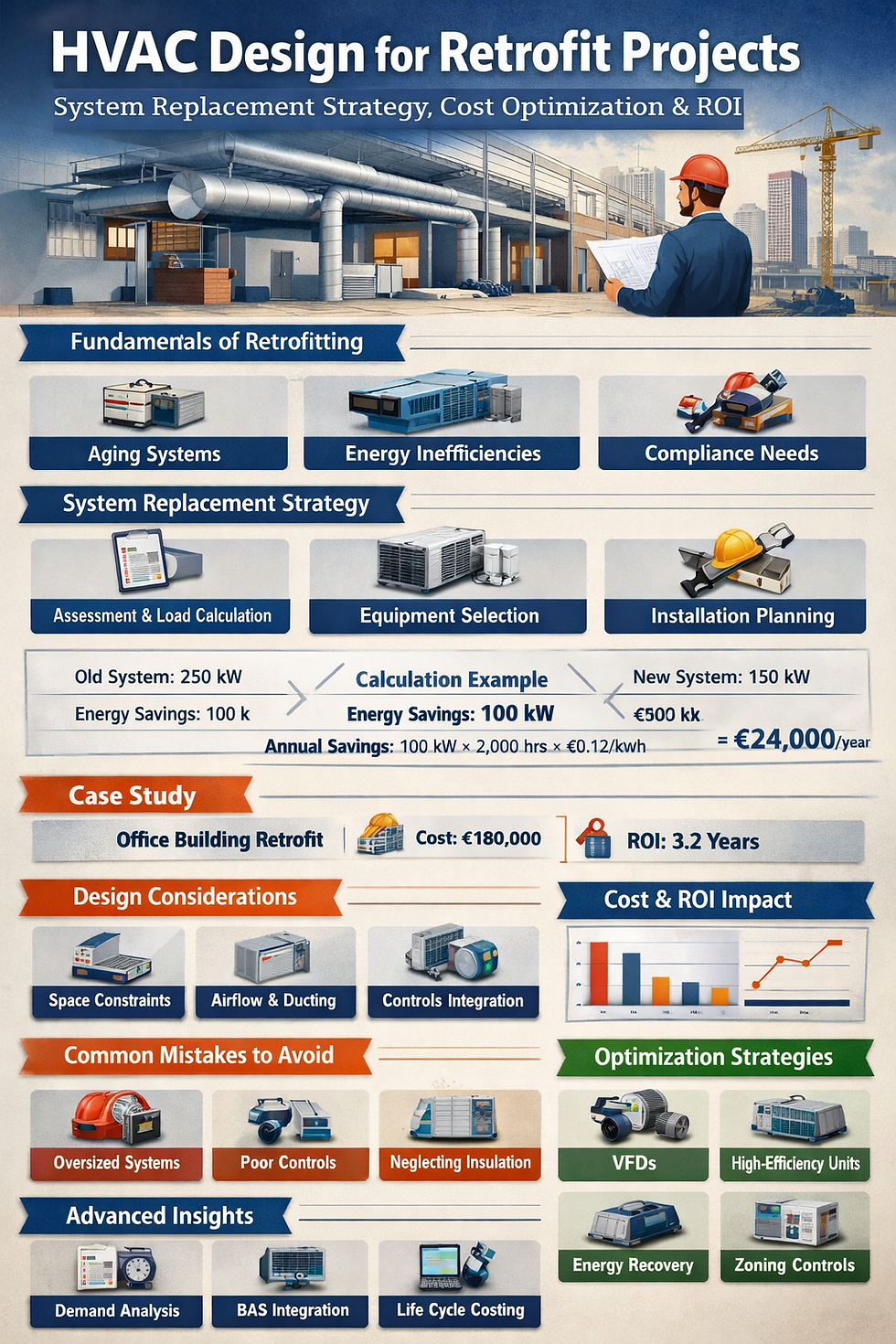
Retrofit HVAC projects are rarely about simply replacing old equipment with new equipment of the same nominal capacity. In real projects, retrofit design is an engineering decision chain involving uncertainty, existing building constraints, occupied operation, aging infrastructure, poor legacy documentation, energy performance targets, capital budget limits, and owner expectations that are often financially aggressive but technically vague.
In new construction, the engineer usually works with a relatively clean design environment. The architecture is coordinated around the building systems, plant spaces can be sized intentionally, shaft allowances are known, structural penetrations can be planned, and control logic can be integrated from the beginning. Retrofit work is the opposite. The HVAC engineer enters a building with inherited design mistakes, undocumented field modifications, degraded insulation, partially failed controls, inaccessible valves, undersized risers, tenant-driven layout changes, and a client who may say, “We want lower energy bills, minimal shutdown, better comfort, and fast payback.”
That combination is exactly why retrofit HVAC design is one of the most commercially important and technically demanding areas in MEP consulting.
A poor retrofit decision can lock an owner into 15–25 years of avoidable operating cost, maintenance burden, comfort complaints, and future replacement constraints. A good retrofit decision can reduce energy cost materially, extend asset life where appropriate, improve occupant satisfaction, reduce carbon exposure, and produce a measurable return on invested capital.
The central engineering question in retrofit is not, “What is the best HVAC system in theory?” It is:
What is the best replacement strategy for this specific building, under its specific operational, financial, spatial, and construction constraints?
That question must be answered through structured engineering judgement. The best retrofit solution for a hospital wing is not the best solution for a 20-year-old office tower. The best strategy for a hotel with occupied rooms is different from a school being renovated during a summer shutdown. A chilled water plant upgrade may be financially superior in one campus and completely irrational in a small mixed-use building where packaged or VRF replacement provides faster payback and less disruption.
This article explains retrofit HVAC design the way a senior consultant would evaluate it in practice: by integrating system condition, load profile, constructability, cost, risk, phasing, energy, maintainability, and owner ROI into one engineering framework. (HVAC Design for Retrofit Projects)
Fundamentals of HVAC Retrofit Design
What a Retrofit Project Actually Means
Retrofit does not always mean full system replacement. In professional practice, retrofit can fall into several categories:
1. Like-for-like replacement
This is the simplest approach. Existing equipment is replaced with new equipment of similar type and similar capacity, usually because of failure, age, refrigerant phaseout, or maintenance burden. Examples include replacing an air-cooled chiller with a new air-cooled chiller, or changing packaged rooftop units with equivalent units.
This approach reduces engineering complexity, but it often misses larger opportunities. It may preserve old distribution inefficiencies, bad zoning, poor control philosophy, and oversized legacy capacity.
2. Partial system modernization
Here, one layer of the HVAC system is upgraded while other layers remain. For example:
Replace chillers but retain chilled water piping and AHUs
Replace AHUs/VAVs but retain central plant
Replace pneumatic controls with BMS/DDC
Add VFDs, heat recovery, or demand control ventilation to an existing system
This is common when budgets are moderate and the owner wants energy improvement without full replacement.
3. Functional conversion
This occurs when the system concept changes. Examples:
DX split systems replaced by VRF
Constant volume AHUs converted to VAV
Electric reheats reduced through hydronic reheat retrofit
Air-cooled plant replaced with water-cooled central plant
Old fan coil + dedicated OA approach replaced by DOAS + terminal systems
This type of retrofit can produce strong ROI, but it introduces major coordination and construction risk.
4. Deep energy retrofit
This is broader than equipment replacement. It combines HVAC redesign with envelope improvement, lighting replacement, occupancy control, heat recovery, plant optimization, and sometimes decarbonization strategies. In such projects, HVAC design must be integrated with building performance modeling and capital planning.
Why Existing HVAC Systems Usually Perform Worse Than Owners Think
Owners often evaluate old systems only through visible symptoms:
Too many complaints
High electricity bill
Frequent maintenance
Spare parts unavailable
Indoor temperature instability
Poor ventilation
Equipment near end of life
But from an engineering standpoint, underperformance usually comes from a combination of issues:
Capacity drift
Installed capacity may no longer match the actual load. A system may be:
oversized because tenant density changed, lighting reduced, and envelope improved over time
undersized because space usage intensified, outside air requirements increased, or fresh air units are degraded
Efficiency drift
Old systems frequently operate below nameplate or design efficiency because of:
fouled coils
degraded heat transfer surfaces
leaking valves and dampers
low control accuracy
bad setpoints
simultaneous heating and cooling
failed sensors
constant-speed operation under part-load conditions
Distribution failure
Even when plant equipment is adequate, delivery systems often fail due to:
unbalanced ductwork
poor pump head distribution
clogged strainers
bypassing valves
bad VAV box calibration
duct leakage
insulation deterioration
poor static pressure reset strategy
Operational mismatch
Many legacy systems were designed for older occupancy assumptions. Buildings now have:
higher plug loads in some zones
lower lighting loads in others
variable schedules
new IT spaces
new ventilation code requirements
changed space planning
The result is that the original design basis is no longer valid.
This is why good retrofit work begins with diagnosis, not equipment selection.
Retrofit HVAC Design Philosophy: Start with the Right Question
The Core Strategic Question (HVAC Design for Retrofit Projects)
Before selecting equipment, the engineer must determine which of the following project paths is technically and financially justified:
Repair and extend life
Replace in kind
Partially modernize
Fully redesign the HVAC concept
Phase replacement over multiple budget cycles
The correct answer depends on a multi-variable assessment, not on a single issue like chiller age.
Decision Drivers
A robust replacement strategy usually evaluates:
Asset condition
Mechanical integrity
Failure frequency
Remaining useful life
Refrigerant availability
Controls obsolescence
Spare parts access
Building constraints
Plant room access
Roof loading
Shaft space
Ceiling void limitations
Occupied construction conditions
Electrical capacity
Water availability and quality
Performance targets
Comfort improvement
IAQ compliance
energy reduction
carbon reduction
noise control
resilience/redundancy
Commercial drivers
CapEx limit
simple payback target
NPV/IRR expectations
lease obligations
downtime tolerance
tenant retention risk
A strong consultant does not start with “VRF is efficient” or “water-cooled chillers save energy.” A strong consultant starts with: What value can actually be captured in this building without creating disproportionate construction risk?
Detailed Technical Explanation: How to Approach HVAC Retrofit Projects
1. Existing Condition Survey
No retrofit design should start from legacy drawings alone. Field verification is mandatory.
Survey scope should include:
Equipment inventory
type
model
serial number
age
refrigerant type
nominal capacity
power input
nameplate current
installation condition
service access
vibration/noise issues
Airside system survey
AHU/FAHU/FCU/RTU types and quantities
airflow if measurable
filter arrangement
coil condition
fan type and motor data
damper operation
outside air path
control components
duct routing and static issues
Waterside system survey
chiller and pump data
pipe sizes
pump head and flow conditions
balancing valves
control valves
strainers
expansion tank condition
air separators
insulation condition
water treatment condition
Controls survey
existing BMS/DDC/pneumatic setup
sequences of operation
sensor calibration condition
trending availability
alarming capability
night setback, reset strategies, occupancy schedules
Electrical and structural survey
available electrical capacity
MCC condition
feeder adequacy
roof structure for new equipment
lifting path and rigging constraints
Architecture and occupancy
ceiling void limitations
shaft access
tenant occupancy schedule
phasing restrictions
noise-sensitive zones
A large number of retrofit failures originate from insufficient survey. Engineers assume existing pipe sizes, assume pump head, assume ceiling space, or assume controls compatibility. Those assumptions later convert into variation orders, delays, and compromised system performance.
2. Load Reassessment
One of the most common errors in retrofit design is using old equipment capacity as the new design capacity.
That is poor practice.
Why original capacity cannot be trusted
old systems may have been oversized intentionally
space usage may have changed
lighting power density may have dropped significantly
glazing may have been upgraded
outside air requirements may have increased
diversity assumptions may be different now
Retrofit load study should evaluate:
envelope heat gains/losses
lighting loads
plug loads
occupant density
ventilation loads
infiltration
solar load by orientation
diversity by operating schedule
latent vs sensible balance
zoning changes
Where possible, the consultant should combine calculated load with measured operating data.
Examples of useful measured data:
utility trends
BMS trend logs
spot power measurements
supply/return temperatures
chilled water delta-T
actual occupancy pattern
room temperature complaint mapping
For retrofit, measured evidence is highly valuable because real building operation often differs from theoretical assumptions.
3. Determine Whether the Problem Is Capacity, Efficiency, Distribution, or Controls
Before recommending replacement, identify the dominant technical failure mode.
Scenario A: Capacity problem
Building cannot maintain setpoint under peak conditions.
Possible causes:
undersized plant
fouled coils
low flow
insufficient airflow
ventilation increase
degraded compressor performance
Scenario B: Efficiency problem
Comfort is acceptable, but utility cost is too high.
Possible causes:
poor IPLV/NPLV performance
constant-speed fans and pumps
poor control sequencing
low delta-T syndrome
simultaneous reheating
bad ventilation control
inefficient part-load operation
Scenario C: Distribution problem
Plant is adequate, but zones suffer discomfort.
Possible causes:
bad balancing
duct leakage
terminal unit failure
pump hydraulic issues
valve authority problems
dead legs
incorrect sensor locations
Scenario D: Controls problem
Equipment is mechanically usable, but performance is unstable.
Possible causes:
failed actuators
inaccurate sensors
overridden sequences
fixed setpoints
no scheduling
no reset logic
no trend-based optimization
In many retrofit projects, controls modernization alone produces a meaningful percentage of energy reduction at a lower cost than full mechanical replacement. That must be evaluated honestly.
4. Select the Retrofit Strategy
Once diagnosis is complete, the engineer can build options.
Typical options include:
Option 1: Minimal intervention
Repair, recommission, rebalance, and optimize controls.
Best for:
equipment with acceptable remaining life
budget-constrained owners
moderate performance gap
short holding period investors
Option 2: Equipment-only replacement
Replace major assets but retain distribution.
Best for:
failing chillers/RTUs/AHUs
acceptable piping/duct infrastructure
short shutdown windows
limited architectural disruption
Option 3: System reconfiguration
Change system type or major topology.
Best for:
severe comfort issues
poor zoning
high energy intensity
changed occupancy pattern
central plant no longer suitable
electrification/decarbonization goals
Option 4: Phased retrofit
Prioritize highest-value upgrades first.
Best for:
limited annual capital budget
occupied buildings
campus projects
owner preference for staged investment
A premium consulting approach usually presents at least three financially and technically differentiated options, not one single recommendation.
Step-by-Step Retrofit Design Methodology
Step 1: Establish the Owner’s Project Requirements for Retrofit
In retrofit work, the Owner’s Project Requirements (OPR) should be far more operational and financial than in standard new-build projects.
It should define:
acceptable shutdown duration
target energy reduction
comfort targets
ventilation/IAQ requirements
noise criteria
redundancy requirements
maintenance staffing capability
expected simple payback or investment horizon
future tenant flexibility
carbon or ESG targets if applicable
Without a clear OPR, engineers tend to optimize for technical elegance rather than owner value.
Step 2: Build the Existing System Baseline
The baseline should quantify:
annual energy consumption
operating hours
measured demand profile
current maintenance cost
current failure/risk exposure
temperature complaint history
equipment age profile
This baseline is essential because ROI cannot be calculated against vague assumptions.
Step 3: Recalculate Loads and Diversity
Use updated load modeling for the current building operation. Do not merely restate old values.
For example, in an office retrofit:
old installed cooling: 1,200 kW
recalculated diversified peak load: 860 kW
measured peak from trend and utility correlation: ~790–840 kW
This immediately reveals probable oversizing of the original system.
That matters because oversizing affects:
first cost
cycling losses
humidity control
part-load efficiency
plant staging strategy
pipe velocities
pump control
Step 4: Generate Technical Alternatives
A retrofit option study should compare alternatives on a structured basis.
For example:
Alternative A
Replace existing air-cooled chillers with new high-efficiency air-cooled chillers. Retain pumps, AHUs, and piping with selective valve/control upgrades.
Alternative B
Replace plant with water-cooled chillers and cooling towers. Upgrade pumps, condenser water system, treatment, and BMS.
Alternative C
Decentralize to VRF + DOAS for tenant floors, remove central chilled water dependence, retain only special area cooling where needed.
Alternative D
Retain plant, replace AHU/VAV controls, add VFDs, coil cleaning/restoration, and recommission full sequence.
These options differ not only technically, but in CapEx, phasing, disruption, and ROI.
Step 5: Perform Technical and Financial Screening
Each option should be screened against:
installed cost
annual energy cost
annual maintenance cost
replacement cycle implications
operational risk
downtime impact
occupant disruption
plant space implications
redundancy
future flexibility
Step 6: Prepare Lifecycle Cost Analysis
Basic formulas
Annual energy use
Annual Energy (kWh) = Average Power (kW)×Operating Hour
Annual energy cost
Annual Energy Cost = Annual Energy (kWh)×Tarif
Simple payback
Simple Payback = Incremental Capital Cost / Annual Savings
ROI
ROI = (Annual Net Savings / Capital Cost) × 100%
For higher-quality studies, the consultant should also consider:
maintenance savings
avoided failure cost
downtime avoidance
rent/occupancy risk reduction
residual asset life
future replacement deferral
Practical Retrofit Calculations
Example: Chiller Retrofit Comparison
Assume a commercial building has a required diversified peak cooling load of 900 kW.
Convert to refrigeration tons for reference:
1 TR=3.517 kW
Load in TR=9003.517=256 TR
Suppose the consultant compares two replacement options:
Option A: Air-cooled chiller plant
installed cooling capacity: 2 x 150 TR = 300 TR
full-load efficiency: 1.20 kW/TR
annual equivalent operating hours: 2,400 h
average annual loading factor: 0.58
electricity tariff: 0.12 USD/kWh
Approximate average plant electrical demand:
300×1.20×0.58=208.8 kW
Annual energy:
208.8×2400=501,120 kWh
Annual energy cost:
501,120×0.12=60,134.4 USD/year
Option B: Water-cooled plant
installed capacity: 2 x 150 TR = 300 TR
chiller efficiency: 0.62 kW/TR
cooling tower + condenser water + primary pumps equivalent added: 0.16 kW/TR
effective plant efficiency: 0.78 kW/TR
same loading factor and hours
Average electrical demand:
300×0.78×0.58=135.72 kW
Annual energy:
135.72×2400=325,728 kWh
Annual cost:
325,728×0.12=39,087.36 USD/year
Annual energy savings of water-cooled over air-cooled
60,134.4−39,087.36=21,047.04 USD/year
Now assume installed cost:
Option A = 420,000 USD
Option B = 610,000 USD
Incremental CapEx:
610,000−420,000=190,000 USD
Simple payback:
190,00021,047.04=9.03 years
This is the kind of calculation an owner understands. But a senior consultant should not stop here. The real decision must also include:
water treatment cost
cooling tower maintenance burden
water consumption
plant room space
legionella management implications
redundancy requirements
roof or yard availability
acoustics
shutdown complexity
So technically, water-cooled may be more efficient. Commercially, it may or may not be the better retrofit.
That is real engineering judgement.
Example: Fan Power Saving from VAV Retrofit
Suppose an old CAV AHU serves a floor at 20,000 L/s with a fan static of 900 Pa.
Fan power estimate:
P=Q×ΔPηWhere:
Q=20,000 L/s=20 m3/s
ΔP=900 Pa
overall efficiency =0.65
P=20×9000.65=27,692 W≈27.7 kW
If converted to VAV with effective average flow at 65% and fan speed adjusted through VFD, the fan affinity law suggests power varies approximately with cube of speed.
Approximate part-load power:
P2=P1×(0.65)^3
P2=27.7×0.2746=7.6 kW
Even if real system effects reduce the saving, the reduction is still substantial.
Assume 3,000 annual operating hours:
existing annual energy = 27.7×3000=83,100 kWh
retrofitted annual energy = 7.6×3000=22,800 kWh
Savings:
60,300 kWh/year
At 0.12 USD/kWh:
60,300×0.12=7,236 USD/year
If VAV retrofit and controls cost 38,000 USD:
Simple Payback = 38,000 / 7,236 = 5.25 years
This does not yet include improved comfort, reduced reheat, and better zoning flexibility.
Real Project Example: Mid-Rise Office Retrofit
Project Background
Consider an existing 12-storey office building with:
gross floor area: 18,000 m²
original construction age: 22 years
HVAC system: central chilled water with two air-cooled chillers, floor AHUs, VAV terminals on some floors, FCUs in executive areas
major problems:
high summer electricity cost
temperature complaints on west-facing zones
low chilled water delta-T
repeated chiller alarms
no meaningful trend logs from old controls
owner concerned about tenant retention
Existing Conditions
Installed plant:
2 x 200 TR air-cooled chillers = 400 TR total
2 primary chilled water pumps constant speed
floor AHUs with old constant-speed fans on several levels
mixed control quality; many dampers manually fixed
building occupied during retrofit
Engineering Findings
After survey and recalculation:
actual diversified peak cooling demand: ~930 kW = 264 TR
existing installed 400 TR plant significantly oversized
measured return water temperatures inconsistent
chilled water delta-T typically 3.5°C instead of design 5.5°C
multiple control valves passing
static pressure setpoints excessive
several perimeter zones suffering solar peak discomfort not because of total plant shortage, but because of poor zoning and air distribution
Options Developed
Option 1: Replace chillers only
new 2 x 170 TR air-cooled chillers
keep existing distribution
minor BMS integration
Option 2: Chiller + pump/control modernization
new 2 x 160 TR high-efficiency chillers
VFD pumps
valve replacement on critical AHUs
chilled water reset strategy
BMS upgrade
recommissioning
Option 3: Deep retrofit
new chillers
VFD pumps
selected AHU fan retrofits
terminal rebalance
perimeter zoning correction
CO2-based demand control ventilation
modern BMS with trend analytics
Cost Estimate
Option 1: 480,000 USD
Option 2: 640,000 USD
Option 3: 890,000 USD
Annual Savings Estimate vs Existing Operation
Option 1: 58,000 USD/year
Option 2: 96,000 USD/year
Option 3: 142,000 USD/year
Simple Payback
Option 1
480,000 / 58,000=8.28 years
Option 2
640,00096,000=6.67 years
Option 3
890,000142,000=6.27 years
At first glance, Option 3 appears strongest despite highest CapEx.
Why Option 3 Was Recommended
Not just because of energy savings. The actual recommendation considered:
reduced tenant complaints
better floor-by-floor controllability
lower comfort-related lease risk
improved plant staging
better future diagnostics through analytics
reduced low delta-T syndrome
lower emergency maintenance exposure
This is an important consulting point: in retrofit, the highest-value option is not always the lowest-cost or fastest-install option. The correct option is the one that best aligns technical risk reduction with measurable lifecycle value.
Design Considerations and Engineering Judgement
1. Should You Keep the Existing Distribution Network?
This is a major retrofit decision.
Reasons to keep it
pipe/duct condition acceptable
routing inaccessible to replace
budget limited
downtime minimal
hydraulic/airside losses manageable
Reasons to replace or heavily modify
severe leakage or corrosion
bad zoning structure
inadequate shaft distribution
high static or head penalties
poor insulation
layout fundamentally incompatible with new use
A distribution system can quietly destroy the benefits of efficient equipment. Engineers who focus only on chiller COP or equipment brochures often miss this.
2. Oversizing Is a Hidden Retrofit Cost
Legacy systems are frequently oversized. Repeating that oversizing in retrofit causes:
higher capital cost
poor part-load efficiency
unstable humidity control
short cycling
unnecessary electrical infrastructure cost
In retrofit projects, reducing installed capacity intelligently can be one of the strongest cost optimization measures. But that reduction must be defended with solid calculations and evidence.
3. Occupied Building Phasing Is Not a Side Issue
Retrofit design must include construction sequencing logic.
Questions that matter:
Can the replacement occur outside business hours?
Is temporary cooling required?
Can risers be isolated floor-by-floor?
Can one chiller remain operational during replacement?
Are ceiling works allowed in occupied areas?
Will the owner accept staged commissioning?
A technically good design that cannot be installed practically is a weak design.
4. Controls Strategy Is Usually the Highest-Leverage Upgrade
Many retrofit projects underinvest in controls. This is a mistake.
A new plant with old sequences can perform poorly. A moderately old plant with modern controls can sometimes perform surprisingly well.
High-value retrofit control upgrades include:
chilled water reset
condenser water reset where applicable
static pressure reset
supply air temperature reset
occupancy scheduling
demand control ventilation
optimized start/stop
fault detection and diagnostics
trend-based performance monitoring
Cost, Energy, and ROI Impact
CapEx vs OpEx Tradeoff
Retrofit owners often focus too much on first cost. Engineers must reframe the discussion.
Suppose Option A costs 500,000 USD and Option B costs 700,000 USD. If Option B saves an additional 45,000 USD/year and reduces major maintenance risk by another 10,000 USD/year, then net additional annual value is 55,000 USD/year.
Incremental cost:
700,000−500,000=200,000 USD
Incremental payback:
200,00055,000=3.64 years
That is often an excellent business case.
Include Maintenance in ROI
Too many HVAC ROI studies consider only electricity. That is incomplete.
Retrofit savings may come from:
lower annual service cost
fewer compressor failures
fewer tenant callouts
less emergency rental cooling
reduced spare parts inventory
lower water usage
lower filter or belt consumption
reduced labor time due to better controls visibility
For premium clients, ROI must be framed in total operating economics, not just kWh.
Common Mistakes to Avoid
1. Replacing old equipment with the same capacity without recalculating load
This is one of the most common and expensive mistakes in retrofit work.
2. Trusting old as-built drawings without field verification
Retrofit drawings are often inaccurate due to undocumented site modifications.
3. Ignoring part-load performance
Most commercial buildings operate far below peak load for much of the year. Full-load efficiency alone is not enough.
4. Underestimating controls and commissioning
Mechanical replacement without control modernization often underdelivers.
5. Forgetting constructability
If crane access, shutdown sequence, or plant room removal path is not resolved early, the design can fail commercially.
6. Ignoring ventilation compliance in older buildings
Retrofit projects often expose gaps in outside air provision, filtration, and pressurization.
7. Focusing only on plant efficiency while distribution remains poor
Bad valves, poor balancing, and low delta-T can erase plant efficiency gains.
8. No phasing plan for occupied operation
Occupied retrofit requires engineering sequencing, not just final-state design.
9. Overcomplicating the system beyond the owner’s maintenance capability
A sophisticated plant is not a good solution if the operating team cannot maintain it.
10. Selling payback without quantifying assumptions
Savings claims must be traceable, realistic, and transparent.
Optimization Strategies for Retrofit Projects
1. Fix load before adding capacity
Reduce unnecessary load through:
lighting upgrades
ventilation optimization
envelope solar control
schedule correction
zoning refinement
2. Optimize delta-T
Low delta-T is a common retrofit performance issue. Address:
valve selection
coil performance
sensor accuracy
bypassing
flow control logic
3. Use VFDs where real diversity exists
Especially for pumps and fans with variable flow potential.
4. Match system type to building use pattern
Not every retrofit should remain a central plant. Not every building should move to decentralized systems either. Use pattern drives value.
5. Prioritize controls visibility
A system that can be trended, diagnosed, and optimized is a system that keeps savings.
6. Phase by value
In budget-constrained portfolios, prioritize measures with:
high savings-to-cost ratio
low disruption
immediate reliability benefit
Advanced Insights for Experienced Engineers
Retrofit Is a Risk-Weighted Decision, Not Just an Energy Decision
Sophisticated clients increasingly care about:
downtime risk
tenant retention
ESG reporting
electrical infrastructure constraints
future refrigerant transitions
maintainability under limited staffing
decarbonization readiness
Therefore, retrofit design should be risk-weighted.
For example, an option with slightly longer payback may still be superior because it:
reduces dependence on obsolete refrigerants
provides N+1 reliability
minimizes summer failure exposure
supports future electrification strategy
improves asset attractiveness for leasing or sale
The Best Retrofit Scheme Often Combines “Keep, Replace, and Re-control”
In practice, pure full replacement is often not the best commercial answer. Many excellent retrofit strategies are hybrid:
keep serviceable piping
replace high-energy plant equipment
modernize controls
rebalance and recommission distribution
selectively replace terminal units in problematic zones
This mixed strategy often delivers the best ratio of improvement to CapEx.
Commissioning Is Not Optional in Retrofit
Retrofit systems fail quietly without proper commissioning because legacy interactions remain hidden. Functional testing, balancing verification, sequence validation, trend review, and post-occupancy tuning are all critical.
Pricing a project like this? The HVAC Estimation, BOQ & Job Costing Tool (Excel) builds selling prices from a reusable rate library, applies overheads and margin, and tracks budget against actual cost.
FAQ
1. Should retrofit HVAC design always start with equipment replacement?
No. It should start with diagnosis. Sometimes controls, balancing, and recommissioning solve a major portion of the problem at lower cost.
2. Is like-for-like replacement a bad approach?
Not always. It can be justified where downtime must be minimal and the existing system concept remains appropriate. But it should never be the default without reassessing loads and performance.
3. How do you know whether an old chiller is oversized?
Compare recalculated building load, measured plant operation, historical demand trends, and staging behavior. Oversizing is common in older commercial buildings.
4. What is more important in retrofit: full-load efficiency or part-load efficiency?
Part-load efficiency is usually more important because buildings spend much of their operating time below peak demand.
5. Can controls modernization alone deliver meaningful savings?
Yes. In many buildings, poor controls are a major cause of waste. However, savings depend on the existing condition and must be realistically assessed.
6. How do you justify higher CapEx to owners?
By showing lifecycle cost, maintenance savings, reliability gains, reduced disruption risk, and energy savings in financial terms.
7. Should old chilled water piping always be replaced?
No. If its condition, pressure integrity, insulation, routing, and hydraulic suitability are acceptable, retaining it may be a strong optimization measure.
8. What is the biggest mistake in retrofit plant selection?
Selecting equipment based on existing installed capacity instead of recalculated diversified load and real operating conditions.
9. How important is phasing in occupied retrofit projects?
Extremely important. A technically sound design can still fail if shutdown windows, temporary cooling, and installation sequencing are not addressed.
10. Is central plant always better than decentralized systems in retrofit?
No. The right answer depends on building size, occupancy pattern, riser availability, maintenance capability, redundancy needs, and lifecycle economics.
11. Should ROI include maintenance savings?
Yes. A credible retrofit business case should include energy, maintenance, reliability, and operational cost impacts wherever quantifiable.
12. How much detail is needed in the survey stage?
As much as necessary to eliminate dangerous assumptions. Retrofit survey quality strongly influences design accuracy and project risk.
13. Is recommissioning necessary after equipment replacement?
Yes. Without recommissioning, the new system may inherit old operational defects and fail to achieve expected performance.
14. How do you deal with incomplete as-built documentation?
Use field survey, measurements, photographs, spot verification openings where necessary, and conservative engineering judgement clearly documented in the design basis.
15. What makes a retrofit recommendation consulting-level rather than generic?
A consulting-level recommendation combines engineering calculations, field realities, phasing, risk, cost, maintenance, and owner strategy into one defendable decision framework.
Strong Conclusion: Engineering the Retrofit for Performance and Financial Returnrong Conclusion: Engineering the Retrofit for Performance and Financial Return
HVAC retrofit design is not a simplified version of new-build design. It is a more demanding discipline because the engineer must solve technical problems inside an imperfect, occupied, financially constrained existing asset.
The most successful retrofit projects do not begin with equipment brochures or replacement habits. They begin with disciplined engineering: survey the building properly, reassess actual loads, understand where performance is being lost, generate multiple upgrade paths, and evaluate each option through lifecycle value rather than first cost alone.
The correct replacement strategy may be:
a targeted controls and recommissioning project,
a plant-only modernization,
a phased hybrid upgrade,
or a full system redesign.
But whatever the outcome, the consultant’s role is to convert uncertainty into a defendable technical and financial roadmap.
For owners and developers, the ultimate value of retrofit HVAC design is not only reduced energy cost. It is also:
better occupant comfort,
lower operational risk,
more predictable maintenance,
improved asset performance,
and stronger long-term return on capital.
That is the real business case.
A strong retrofit engineer does not simply replace equipment. He or she redesigns the building’s performance economics.
Author’s Note
This article is for guidance only. Actual retrofit HVAC design decisions must be based on project-specific survey data, updated load calculations, local code requirements, operating conditions, utility tariffs, and the owner’s technical and financial objectives.


Comments