Low-GWP Refrigerants & Future Compliance
Updated: Sep 29
Executive Overview
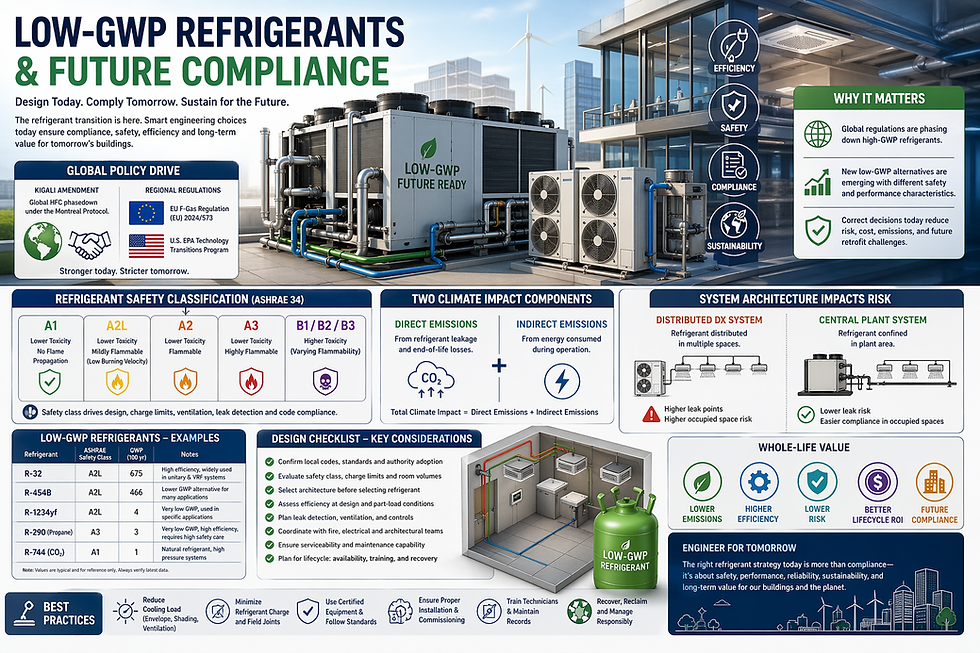
The refrigerant transition is no longer a specialist topic reserved for chiller manufacturers or environmental compliance teams. It is now a core building engineering issue that directly affects system selection, plantroom strategy, procurement timing, fire and life safety coordination, operating cost, serviceability, and asset risk. Internationally, the policy direction is clear: hydrofluorocarbon (HFC) use is being reduced through the Kigali Amendment framework, while regional rules such as the EU F-gas Regulation and the U.S. EPA Technology Transitions program are accelerating the shift away from high-GWP refrigerants in new equipment. At the same time, safety standards and product standards are evolving to accommodate mildly flammable and flammable alternatives, particularly A2L and A3 refrigerants.
For MEP consultants, developers, and technical decision-makers, the implication is straightforward: refrigerant choice is no longer a secondary equipment submittal matter. It is an early-stage design decision with downstream effects on architecture, authority approvals, ventilation, leak detection, electrical zoning, plant location, contractor competency, and lifecycle cost. A design team that delays this decision often discovers later that the preferred system architecture is either non-compliant, commercially exposed, or operationally fragile. That is especially true in hot-climate markets where the wrong refrigerant strategy can also undermine part-load efficiency, high-ambient performance, spare parts availability, and future retrofit flexibility.
A technically mature response to the low-GWP transition is not merely to ask for “an eco-friendly refrigerant.” That language is far too shallow for real projects. The correct engineering approach is to evaluate the complete operating and compliance envelope: direct versus indirect system architecture, refrigerant safety class, charge concentration risk, equipment listing, space classification, maintenance capability, commissioning requirements, and realistic end-of-life refrigerant management. The best design outcome is often the one that balances five variables simultaneously: low climate impact, acceptable safety profile, verified efficiency, practical constructability, and predictable long-term service support. That balance differs by project type. What is appropriate for a small split DX system may be inappropriate for a hospital, high-rise tower, educational campus, or public-sector development.
The market is therefore entering a more demanding period. High-GWP legacy refrigerants are becoming strategically weaker, but not every low-GWP alternative is automatically a good engineering answer. Some lower-GWP refrigerants introduce flammability considerations. Some “drop-in” narratives are overstated. Some solutions look compliant today but create risk for future maintenance, component replacement, or portfolio standardization. The consultant’s role is to distinguish between nominal compliance and resilient compliance. (Low-GWP Refrigerants & Future Compliance)
Read related topics.
Why This Topic Matters in Real Buildings
In real buildings, refrigerant decisions affect much more than environmental reporting. They influence system topology. If a developer adopts a direct-expansion strategy using an A2L refrigerant, room volumes, refrigerant charge limits, leak mitigation, equipment listing, and installation practice become central. If the project moves toward an indirect water-based system, the refrigerant charge may be concentrated in plant areas, which changes the risk profile and may simplify occupied-space compliance, but often at the expense of capital cost and plant complexity. The refrigerant issue therefore changes the entire conversation between architecture, HVAC design, and FM strategy.
The topic also matters because compliance is now time-linked. In the EU, Regulation (EU) 2024/573 entered into force on 11 March 2024 and accelerates the phasedown of fluorinated greenhouse gases while tightening product and equipment controls. In the U.S., EPA Technology Transitions rules impose sector-specific GWP restrictions and installation/manufacture timing requirements, including important deadlines affecting air-conditioning, heat pump, and VRF equipment. These timelines mean that a project’s tender date, equipment manufacturing date, installation date, and permit history can materially affect what is legally usable.
From an owner’s perspective, this is a financial issue. Selecting equipment on the basis of lowest first cost without regard to refrigerant trajectory can produce stranded asset risk. A system may remain operational, yet face rising service cost, restricted refrigerant availability, increased leakage compliance burden, or reduced resale attractiveness. In portfolio terms, refrigerant strategy increasingly affects ESG reporting, embodied and operational carbon narratives, and long-term capex planning.
From a field perspective, the transition matters because installation and service practice are changing. A2L refrigerants are classified by ASHRAE 34 as lower-toxicity, mildly flammable refrigerants. That sounds manageable, and in many cases it is, but only when the equipment design, code adoption, leak mitigation measures, and technician competency are aligned. The market problem is not that A2Ls are unusable. The problem is assuming they are identical to A1 legacy refrigerants from a design and service standpoint. They are not.
For hot-climate projects, the importance is amplified. Developers and consultants in the Gulf, Middle East, and other high-ambient regions often prioritize reliability under severe peak temperatures, long operating hours, and aggressive latent loads. Under these conditions, the wrong system-refrigerant combination can create poor part-load operation, high discharge temperatures, oil management stress, or difficult fault recovery. Therefore, low-GWP compliance must be integrated with thermodynamic suitability, not treated as a separate environmental checkbox.
Core Engineering Principles
GWP is necessary, but not sufficient
Global Warming Potential is a comparative metric indicating the climate impact of a refrigerant relative to carbon dioxide over a specified time horizon, commonly 100 years. It is central to policy, but GWP alone is not a design basis. A refrigerant with lower GWP may introduce different flammability characteristics, pressure levels, material compatibility issues, compressor discharge behavior, or volumetric capacity effects. Good design therefore evaluates:
Environmental impact
Safety classification
Thermodynamic performance
Operating envelope
Refrigerant charge magnitude
Leak consequence
Service ecosystem maturity
Lifecycle cost
A simplistic “lower GWP equals better” approach is not robust engineering.
Direct climate impact and indirect climate impact
The climate performance of a refrigerant strategy has two components:
Total Climate Impact ≈ Direct Emissions + Indirect Emissions
Direct emissions come from refrigerant leakage and end-of-life losses. Indirect emissions come from the electricity consumed by the system over its lifetime. The practical lesson is that a lower-GWP refrigerant can still underperform from a whole-life climate standpoint if the equipment is materially less efficient or if the chosen architecture increases annual energy use. This combined efficiency-and-refrigerant strategy is explicitly recognized in literature discussing the Kigali transition.
Safety classes matter to design (Low-GWP Refrigerants & Future Compliance)
ASHRAE Standard 34 assigns refrigerant designations and safety classifications. The common shorthand is:
A = lower toxicity
B = higher toxicity
1 = no flame propagation
2L = lower flammability with low burning velocity
2 = flammable
3 = higher flammability
For building HVAC, the industry’s present transition is heavily centered on A2L refrigerants. These are not “highly flammable,” but they are not nonflammable either. That distinction drives code consequences, charge limitation logic, ventilation requirements, refrigerant detection requirements in some product standards, and restrictions on ignition sources.
Charge concentration risk is fundamental
For occupied spaces, the relevant question is not only “what refrigerant is used?” but “what is the worst-case concentration if a leak occurs?” That depends on refrigerant charge, room volume, air distribution, leak location, and lower flammability limit (LFL) or refrigerant concentration limit (RCL), depending on the safety framework applied. Product standards such as UL 60335-2-40 require charge-limit logic tied to minimum occupied space volume and include safety factors intended to keep leaked concentration below hazardous thresholds.
System architecture changes the risk map
A refrigerant-based design should always ask where the refrigerant mass resides:
In multiple occupied zones via DX piping
In packaged equipment serving one space
In a plantroom via chiller or heat pump
In a rooftop packaged unit away from primary occupancy
This is why two systems with equal tonnage can have very different compliance and risk profiles. Concentrating refrigerant in a plantroom may simplify occupied-space exposure. Distributing smaller charges across many terminal systems may reduce single-point failure but increase maintenance interfaces and leak points. The correct answer depends on the building type and operator capability.
Code, Standards, and Compliance Context
The international policy anchor is the Kigali Amendment to the Montreal Protocol, which added HFC phasedown obligations to the global framework. Its significance is not just environmental. It creates long-term market pressure that affects manufacturing direction, investment in product platforms, and eventual availability of legacy refrigerants.
Within the EU, Regulation (EU) 2024/573 applies from 11 March 2024 and strengthens the previous F-gas regime. It covers fluorinated greenhouse gases and equipment relying on them, accelerating phasedown pressure and tightening restrictions in multiple sectors. The EU also openly promotes climate-friendlier alternatives for stationary air conditioning and heat pumps.
Within the U.S., EPA’s Technology Transitions rules establish sector-based GWP limits and timing restrictions. For example, EPA states that certain new systems with GWP above 700 face installation restrictions, with specific extensions in some cases for VRF and projects tied to earlier permits and manufacturing dates. This means procurement logistics matter; compliance is not solely a specification issue.
On the safety side, ASHRAE 34 provides designation and safety classification, while ASHRAE 15 addresses safe application of refrigeration systems in buildings. ASHRAE’s published refrigerant designation resources and addenda reflect the industry’s ongoing update cycle as new refrigerants enter the market.
Product safety and code adoption are equally important. UL 60335-2-40 includes requirements relevant to refrigerant charge limits based on minimum occupied volume and ignition-source mitigation. AHRI maintains an A2L code map precisely because regulatory readiness is geographically uneven; a refrigerant strategy that is technically sound may still face local code adoption barriers.
For consultants, the practical compliance lesson is this: do not write “contractor to comply with all applicable codes” and assume the matter is closed. Refrigerant compliance must be actively designed. It requires confirmation of local authority adoption, equipment listing, manufacturer-certified application limits, and coordination with fire protection and electrical disciplines.
Read related topics.
Design Methodology Step by Step
1. Define the project compliance horizon
Establish not only the construction date, but the realistic equipment manufacturing, import, commissioning, and handover windows. For regulated markets, this can determine whether a particular refrigerant platform is still viable. On long projects, also consider what happens if procurement slips by 6 to 12 months.
2. Determine building risk profile
Assess occupancy type, sleeping rooms, vulnerable occupants, public access, basement areas, ceiling void conditions, and maintenance access. A refrigerant acceptable for a warehouse office may be inappropriate for a healthcare or hospitality application without additional mitigation.
3. Select candidate system architectures before selecting refrigerant
Compare:
Packaged rooftop DX
VRF/VRV DX
Air-cooled chiller + hydronic distribution
Water-cooled chiller + hydronic distribution
Heat pump hydronic plant
Distributed split systems
This avoids the common mistake of starting with a refrigerant and forcing the system around it.
4. Evaluate refrigerant candidates against six criteria
Create a weighted matrix using:
GWP / policy trajectory
Safety class
Charge risk in occupied spaces
Efficiency at design and part load
Service availability
Manufacturer platform maturity
5. Check charge and room-volume implications
For any direct system with A2L or other flammable refrigerant, confirm manufacturer application data, room size constraints, leak mitigation requirements, and any detection/interlock logic.
6. Coordinate authorities and disciplines early
Mechanical, electrical, fire protection, architecture, and HSE must align on:
Leak detection
Emergency ventilation
Isolation controls
Equipment location
Signage and access
Ceiling/plenum implications
Service procedures
7. Write performance-based but enforceable specifications
The specification should require:
Refrigerant designation and safety class
Maximum allowable GWP if applicable
Evidence of code/listing compliance
Approved charge calculations
Manufacturer application limitations
Training requirements for service personnel
Refrigerant recovery and commissioning procedures
8. Plan lifecycle support
Confirm service tools, spare parts, refrigerant availability, and local technician competence. The technically correct design on paper can fail commercially if the local FM ecosystem cannot support it.
Detailed Engineering Calculation Example
Consider a medium-sized office floor with a peak sensible plus latent cooling load of 140 kW.
Two concepts are being compared:
Option A: Distributed DX using an A2L refrigerant
Option B: Air-cooled chiller with hydronic distribution and refrigerant confined to roof plant
Assume the office floor has 10 zones. For one critical interior zone:
Zone cooling load = 12 kW
Room floor area = 48 m²
Ceiling height = 3.0 m
Room volume = 144 m³
Assume a candidate indoor unit requires a refrigerant charge of 2.4 kg allocated to that circuit segment under worst-case piping arrangement. Assume the refrigerant LFL-related design input from manufacturer/product standard basis corresponds to a conservative maximum concentration control strategy.
A simplified screening concentration is:
C = m/V
Where:
C = leaked refrigerant concentration, kg/m³
m = refrigerant mass released into room, kg
V = effective room volume, m³
So:
C = 2.4/144 = 0.0167 kg/m3
This number by itself does not prove compliance; it is only a first-pass screening. Actual acceptability depends on the refrigerant’s LFL or RCL basis, equipment standard, room geometry, airflow behavior, and manufacturer application limits. The engineering point is that charge-to-volume ratio must be checked explicitly, not assumed.
Now compare annual direct climate impact. Suppose annual leakage expectation is 4% of system charge for a distributed field-installed DX system and 1.5% for a factory-contained roof plant/chiller configuration. Assume total refrigerant charge:
Option A total charge = 28 kg
Option B total charge = 18 kg
Assume refrigerant GWP values for conceptual comparison only:
Option A refrigerant GWP = 466
Option B refrigerant GWP = 675
Annual direct emissions in CO2_22-equivalent:
Ed = m×L×GWP
Where:
Ed = annual direct emissions, kgCO2e/year
m = refrigerant charge, kg
L = annual leak fraction
GWP = global warming potential
Option A:
Ed,A = 28×0.04×466 = 521.9 kgCO2e/year
Option B:
Ed,B = 18×0.015×675 = 182.3 kgCO2e/year
This is an important design lesson. Even though Option A uses the lower-GWP refrigerant, its higher distributed charge and higher leakage assumption can produce greater direct annual climate impact than Option B.
Now include indirect emissions. Assume:
Option A annual electricity = 92,000 kWh
Option B annual electricity = 86,000 kWh
Grid emission factor = 0.42 kgCO2_22/kWh
Indirect emissions:
Ei = P×EF
Option A:
Ei,A = 92,000×0.42 = 38,640 kgCO2/year
Option B:
Ei,B = 86,000×0.42 = 36,120 kgCO2/year
Total annual climate impact:
Et=Ed+Ei
Option A:
Et,A = 38,640+521.9 = 39,161.9 kgCO2/year
Option B:
Et,B = 36,120+182.3 = 36,302.3 kgCO2/year
From a pure whole-life climate perspective, Option B is better in this example despite using the higher-GWP refrigerant, because it leaks less and consumes less power. This does not mean “higher GWP is preferable.” It means the correct engineering decision must combine refrigerant choice with architecture and efficiency.
Real Project Scenario
Consider a mixed-use commercial building in a hot climate with retail at podium level, offices above, and premium tenancy expectations. The developer initially prefers VRF because of zoning flexibility, ceiling coordination advantages, and lower apparent first cost compared with a chilled-water system.
However, the detailed review identifies four issues.
First, the building contains multiple enclosed meeting rooms and fit-out variability. The future tenant layouts are unknown, making refrigerant-charge-to-room-volume compliance difficult to lock down during base-build design.
Second, the authority approval route is conservative regarding flammable refrigerants in certain occupancies and requests clearer evidence of product listing, mitigation logic, and future tenant control.
Third, the FM team has strong experience with chilled-water plants but limited experience with distributed A2L service management across many indoor units and branches.
Fourth, the owner wants a 20-year asset with minimal risk of midlife refrigerant strategy disruption.
The final engineering recommendation is a central air-cooled chiller plant with low-GWP chiller selection on the roof, hydronic distribution to air-handling units and fan-coil units, and a ventilation strategy separated from tenant DX preferences. The owner pays more upfront, but gains:
More stable future fit-out flexibility
Reduced occupied-space refrigerant exposure
Easier authority dialogue
Lower distributed leak risk
Better alignment with FM capability
Stronger long-term portfolio standardization
In another project, the answer could be different. A low-rise school campus with packaged rooftop systems and outdoor equipment access may rationally adopt packaged lower-GWP DX solutions if room volumes, product listings, and maintenance controls are straightforward.
There is no universal answer; only context-sensitive engineering judgement.
Design Risks, Failure Modes, and Common Mistakes
The first common mistake is treating refrigerant transition as a procurement issue instead of a concept-design issue. By the time procurement begins, room layouts, shafts, power distribution, fire strategy, and plant allowances may already be fixed.
The second mistake is specifying a refrigerant by marketing label rather than by safety class, code basis, and manufacturer-certified application envelope.
The third mistake is ignoring local code adoption. AHRI’s continued maintenance of an A2L building code map is itself evidence that readiness is not uniform. What is available in product catalogs may not be straightforwardly deployable everywhere.
The fourth mistake is assuming all low-GWP retrofits are “drop-in.” Lubricant compatibility, pressure characteristics, controls, expansion devices, compressor limits, and capacity shifts can all invalidate that assumption.
The fifth mistake is underestimating service risk. A brilliant design can become an operational liability if technicians lack the tools, procedures, or training to handle the refrigerant safely.
The sixth mistake is overfocusing on GWP and underfocusing on leakage. A low-GWP refrigerant in a poorly installed, leak-prone distributed system may be a worse practical outcome than a slightly higher-GWP refrigerant in a tight, efficient, centralized system.
Optimization Strategies
The best optimization is often architectural before it is refrigerant-related. Reduce cooling load first through envelope performance, solar control, air leakage control, and realistic ventilation strategy. This reduces refrigerant charge and system size regardless of refrigerant type.
Second, favor architectures that minimize total field joints and unnecessary refrigerant distribution in sensitive occupancies.
Third, separate the ventilation problem from the sensible cooling problem where appropriate. DOAS plus hydronic or localized cooling can reduce the pressure to oversize refrigerant-based systems.
Fourth, standardize refrigerant platforms across the portfolio where possible. Excessive diversity creates training, tooling, and spare-parts inefficiency.
Fifth, require documented leak-tightness practices, commissioning protocols, evacuation standards, and refrigerant recovery procedures in the specification and QA process.
Cost, Energy, and ROI Perspective
Low-GWP compliance has three financial layers.
The first is visible capex. Newer refrigerant platforms, additional sensors, revised enclosures, or hydronic architectures may increase first cost.
The second is operating cost. This includes energy, refrigerant leakage replacement, compliance administration, service time, and unplanned downtime.
The third is strategic asset cost. This includes obsolescence risk, resale desirability, insurance dialogue, authority friction, and future retrofit burden.
A mature ROI analysis should therefore use net present value or lifecycle cost, not simple first-cost comparison. For many commercial buildings, the financially superior solution is the one that slightly increases capex while materially reducing operational uncertainty and future regulatory exposure.
Advanced Engineering Insights
A powerful but often missed insight is that refrigerant transition is changing the competitive advantage of system types. Hydronic systems can become more attractive in certain projects not because refrigerants alone force them, but because they decouple occupied-space compliance from refrigerant distribution.
A second insight is that the compliance frontier is moving from “can this refrigerant be used?” to “can this building operate, be serviced, altered, and re-tenanted safely over twenty years?” That is a much more demanding question.
A third insight is that the best low-GWP strategy is often one that preserves optionality. Designs that rely on highly specific room assumptions, narrow product availability, or fragile code interpretations may satisfy today’s submittal review but perform poorly as assets.
Specification and Coordination Considerations
A premium specification should require, at minimum:
Refrigerant compliance submittals
Refrigerant designation and ASHRAE 34 safety class
Refrigerant GWP data basis
Product listing and certification
Applicable code/standard compliance statement
Charge calculations and room-volume compliance evidence
Manufacturer installation limitations
Design coordination
Leak detection locations
Interlocks with fans, dampers, alarms, and shutdown logic where required
Electrical coordination for detectors and controls
Fire strategy coordination
Access and maintenance clearances
Signage and labeling
Recovery and service procedures
Execution requirements
Technician qualification evidence
Pressure testing, dehydration, vacuum, and charging procedures
Commissioning records
As-built refrigerant schedules
End-of-life recovery obligations
Avoid vague wording. The specification must be enforceable, measurable, and linked to submittal deliverables.
Sizing equipment on a live project? The Cooling Load Design Handbook walks through the full design chain - envelope and internal loads, latent load, airflow, coil duty and equipment selection - with worked examples.
FAQ
What is the main reason low-GWP refrigerants are becoming mandatory?
Because international and regional policy is reducing the use of high-GWP HFCs, especially in new equipment, through phasedown and sector-specific restrictions.
Does low GWP automatically mean lower risk?
No. Lower GWP may come with different flammability or application constraints.
Are A2L refrigerants safe?
They can be used safely when the equipment, room size, charge limits, installation, and servicing all comply with the relevant standards and manufacturer requirements.
Can I just retrofit an old system with a lower-GWP refrigerant?
Not safely as a default assumption. Compatibility and performance must be verified case by case.
Is refrigerant choice mainly a chiller issue?
No. It affects VRF, splits, rooftops, heat pumps, packaged systems, and central plants.
What matters more: refrigerant GWP or energy efficiency?
Both. Whole-life impact depends on direct refrigerant emissions and indirect energy-related emissions.
Why do hydronic systems often become attractive in this transition?
Because they can confine refrigerant to plant areas and reduce distributed occupied-space exposure.
Are current regulations the same in every country?
No. International direction is shared, but local adoption, restrictions, and code readiness vary significantly.
Do building permits and procurement dates matter?
Yes. Some rules depend on manufacture, import, installation, or permit timing.
What is the biggest consultant mistake?
Leaving refrigerant strategy too late in the design process.
Should owners avoid all mildly flammable refrigerants?
Not necessarily. The correct decision depends on occupancy, authority requirements, system architecture, and maintenance capability.
How should developers think about future compliance?
As an asset resilience issue, not only a code issue.
Conclusion
Low-GWP refrigerants are not a passing trend. They are part of a structural shift in HVAC engineering, driven by regulation, manufacturing strategy, climate expectations, and safety standard evolution. The consultant who responds well to this shift will not simply specify a lower-GWP refrigerant. They will redesign decision-making around whole-life performance, charge risk, code readiness, system architecture, and operational resilience.
That is the real future-compliance mindset.
The strongest projects will be those where refrigerant selection is integrated early, coordinated across disciplines, supported by enforceable specifications, and tested against the building’s actual long-term operating model. In that environment, low-GWP compliance stops being a constraint and becomes a design advantage.
Author’s Note
This article is for engineering guidance only. Refrigerant selection and compliance must be verified against the governing codes, standards, product listings, authority requirements, and manufacturer application data that apply to the project location and equipment type. Final design decisions should be made by qualified professionals with direct responsibility for the specific project.


Comments