Cooling Tower Performance Problems and Solutions
Updated: Sep 29
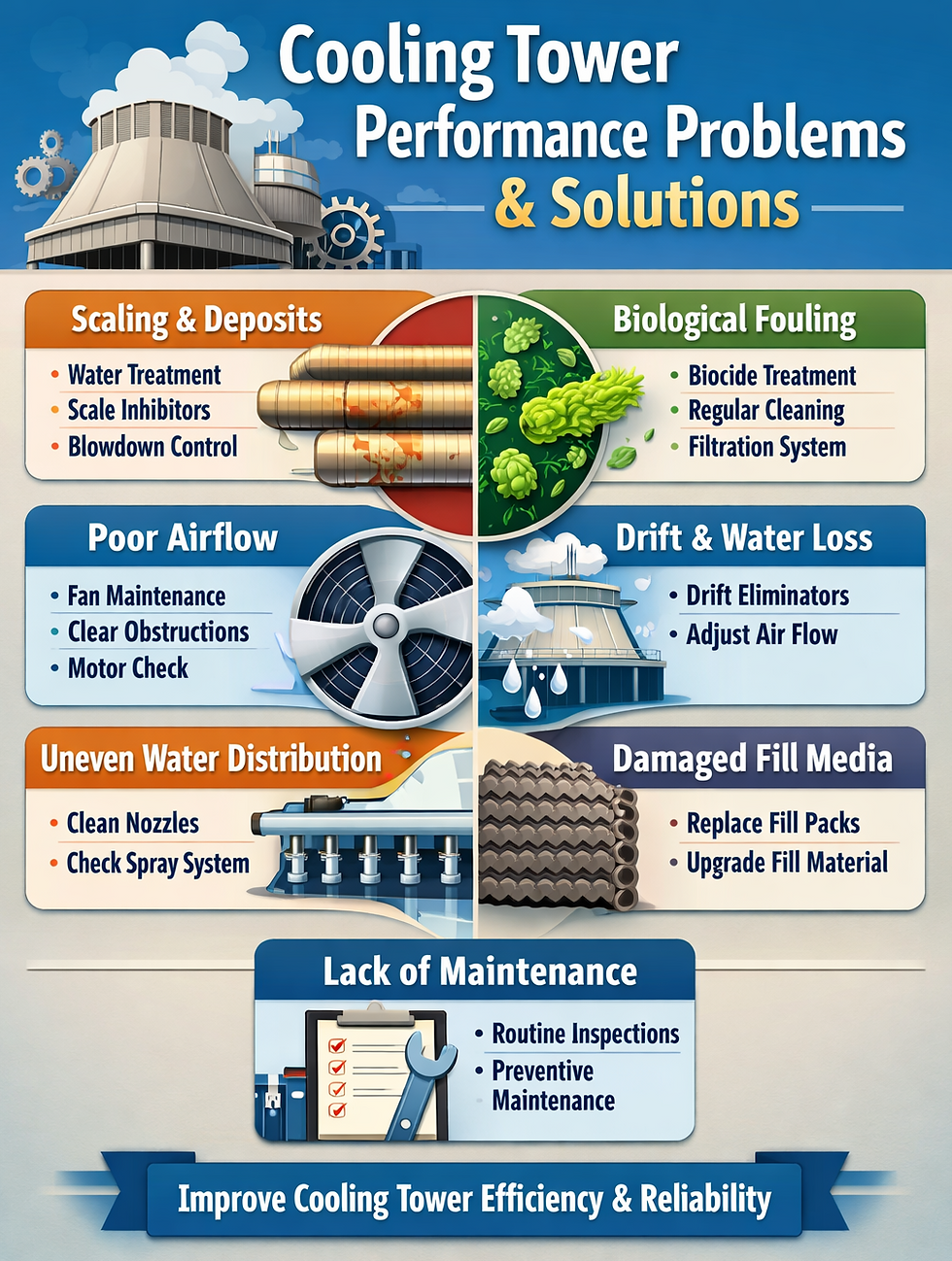
Cooling towers play a critical role in HVAC systems, industrial plants, and district cooling facilities by removing excess heat from water systems and maintaining optimal operating temperatures. When a cooling tower operates inefficiently, it can increase energy consumption, reduce equipment lifespan, and compromise overall system performance. Understanding common cooling tower performance problems and implementing effective solutions is essential for maintaining efficient and reliable operation. (Cooling Tower Performance Problems and Solutions)
1. Scaling and Mineral Deposits (Cooling Tower Performance Problems and Solutions)
One of the most common issues affecting cooling tower performance is scaling caused by dissolved minerals such as calcium and magnesium in the water. As water evaporates during the cooling process, these minerals concentrate and form hard deposits on heat transfer surfaces, piping, and fill media.
Scale buildup reduces heat transfer efficiency and restricts water flow, which ultimately lowers the cooling tower’s effectiveness.
Solutions:
Implement a proper water treatment program to control mineral concentration.
Use scale inhibitors and chemical dosing systems.
Monitor Total Dissolved Solids (TDS) levels regularly.
Schedule periodic mechanical cleaning of fill and piping.
Maintain proper blowdown control to remove concentrated minerals.
Preventive water chemistry management significantly improves cooling tower heat exchange efficiency.
Related topics :
2. Biological Growth and Fouling
Warm water environments in cooling towers are ideal conditions for microbial growth such as algae, bacteria, and biofilm. Biological fouling forms a slimy layer on heat transfer surfaces and fill media, which reduces airflow and heat exchange efficiency.
In severe cases, microbial contamination can also lead to health risks such as Legionella bacteria growth.
Solutions:
Apply biocide treatment programs (oxidizing and non-oxidizing biocides).
Maintain regular tower cleaning and disinfection schedules.
Ensure adequate water circulation and filtration.
Monitor microbial levels through routine water testing.
Install side-stream filtration systems to remove suspended solids.
Proper biological control prevents fouling and maintains consistent cooling tower performance.
3. Poor Airflow and Fan Problems
Cooling towers rely heavily on airflow to transfer heat from circulating water to the atmosphere. If airflow is restricted, cooling efficiency drops significantly. Several factors can reduce airflow, including:
Fan blade damage or misalignment
Motor failure or reduced speed
Blocked air intakes
Structural obstruction around the tower
Poor airflow leads to insufficient heat rejection and higher system temperatures.
Solutions:
Conduct regular fan inspection and balancing.
Verify motor performance and electrical connections.
Remove debris or obstructions around air inlets.
Ensure proper fan pitch and blade alignment.
Maintain adequate clearance around the cooling tower for unrestricted airflow.
Routine mechanical inspection of fan assemblies is essential for maintaining proper airflow rates.
4. Drift Loss and Water Carryover
Drift refers to small water droplets that escape from the cooling tower along with exhaust air. Excessive drift leads to water loss, chemical loss, and potential environmental concerns.
High drift rates are usually caused by damaged or inefficient drift eliminators.
Solutions:
Install high-efficiency drift eliminators.
Inspect and replace damaged eliminator panels.
Maintain correct air velocity through the tower.
Check water distribution uniformity to prevent excessive splashing.
Reducing drift improves water conservation and prevents chemical contamination of surrounding areas.
5. Uneven Water Distribution
Uniform water distribution across the cooling tower fill is necessary for efficient heat transfer. When distribution systems become clogged or damaged, some sections receive less water while others become overloaded.
This results in poor cooling efficiency and dry spots in the fill media.
Solutions:
Inspect and clean spray nozzles regularly.
Remove debris from distribution headers.
Replace worn or damaged spray components.
Maintain adequate pump pressure and flow rates.
A well-balanced distribution system ensures maximum contact between water and airflow.
6. Aging or Damaged Fill Media
Cooling tower fill provides the surface area necessary for heat exchange between air and water. Over time, fill materials may become brittle, clogged, or damaged due to scaling, fouling, or chemical exposure.
When fill performance deteriorates, cooling capacity drops significantly.
Solutions:
Perform routine visual inspections of fill media.
Clean or replace fouled fill packs.
Upgrade to high-efficiency PVC fill materials when possible.
Ensure compatibility between water treatment chemicals and fill material.
Modern high-performance fill designs can improve cooling tower efficiency considerably.
7. Inadequate Maintenance Practices
Many cooling tower performance issues arise simply from insufficient preventive maintenance. Lack of regular inspections allows small problems to grow into major operational failures.
Solutions:
Implement a preventive maintenance program that includes:
Routine inspection of fans, motors, and gearboxes
Monitoring of water chemistry
Cleaning of basins, strainers, and fill
Checking vibration and noise levels
Seasonal startup and shutdown procedures
Predictive maintenance tools such as vibration monitoring and thermal imaging can also help identify early mechanical issues.
Designing the complete plant? The Chilled Water System Design Handbook covers chiller selection, flow and pipe sizing, pump head, control valves, cooling towers, controls and commissioning - with a full worked design example.
Conclusion
Cooling tower performance problems can significantly impact the efficiency, reliability, and operating costs of HVAC and industrial cooling systems. Issues such as scaling, biological fouling, airflow restrictions, drift loss, uneven water distribution, and deteriorated fill media can all reduce cooling capacity.
By implementing proper water treatment programs, performing regular mechanical inspections, and maintaining consistent preventive maintenance schedules, facility managers can ensure optimal cooling tower performance and extend equipment lifespan.
A well-maintained cooling tower not only improves energy efficiency but also supports sustainable and cost-effective operation of large-scale cooling systems.
Frequently Asked Questions (FAQ)
1. What is the most common cooling tower performance problem?
The most common issue is usually scaling and mineral deposit buildup. This happens when dissolved minerals in the circulating water become concentrated during evaporation and form hard deposits on fill, piping, and heat transfer surfaces. Scaling reduces heat transfer efficiency and increases energy consumption.
2. How does scaling affect cooling tower efficiency?
Scaling acts as an insulating layer on heat exchange surfaces, which reduces the tower’s ability to reject heat effectively. It can also restrict water flow and increase system pressure losses, causing the cooling tower and connected equipment to work harder.
3. What causes biological fouling in a cooling tower?
Biological fouling is caused by the growth of algae, bacteria, and biofilm in warm, wet conditions inside the tower. Poor water treatment, stagnant zones, and inadequate filtration can worsen this problem.
4. Why is biological growth dangerous in cooling towers?
Beyond reducing cooling efficiency, biological growth can create serious health and safety risks, especially if harmful bacteria such as Legionella develop in the system. This makes regular cleaning, disinfection, and water treatment essential.
5. How can poor airflow reduce cooling tower performance?
Cooling towers depend on proper airflow to reject heat from the water to the atmosphere. If the fan is damaged, the motor speed is low, air inlets are blocked, or the tower has surrounding obstructions, the tower cannot reject heat properly, leading to higher leaving water temperatures.
6. What are the signs of fan-related cooling tower problems?
Common signs include higher condenser water temperatures, abnormal vibration, unusual noise, poor cooling performance, and visible fan imbalance or blade damage. Regular inspection of the fan, motor, and alignment can help identify these issues early.
7. What is drift loss in a cooling tower?
Drift loss refers to small water droplets that escape with the exhaust air from the cooling tower. Excessive drift causes water loss, chemical loss, and possible contamination of nearby equipment or surrounding areas.
8. How can drift loss be reduced?
Drift can be controlled by using high-efficiency drift eliminators, replacing damaged eliminator panels, maintaining correct air velocity, and ensuring uniform water distribution to avoid splashing and carryover.
9. Why is uniform water distribution important in a cooling tower?
Uniform water distribution ensures that the entire fill surface is effectively used for heat exchange. If spray nozzles are clogged or headers are blocked, some areas become dry while others are overloaded, reducing cooling effectiveness.
10. What happens when cooling tower fill media becomes damaged?
Damaged, brittle, clogged, or fouled fill media reduces the surface area available for heat transfer. This lowers tower capacity and can significantly reduce the cooling tower’s ability to meet design performance.
11. How often should a cooling tower be cleaned and inspected?
The frequency depends on operating conditions, water quality, and system criticality, but cooling towers should always follow a planned preventive maintenance schedule. This should include routine inspection of fans, motors, fill, basins, strainers, water distribution systems, and water chemistry.
12. What role does water treatment play in cooling tower performance?
Water treatment is one of the most important factors in maintaining cooling tower performance. A proper program helps control scaling, corrosion, biological growth, and suspended solids, all of which directly affect heat transfer efficiency and equipment life.
13. Can poor maintenance increase cooling tower operating costs?
Yes. Poor maintenance can lead to reduced heat rejection, higher chiller or condenser energy use, increased water consumption, more chemical use, unplanned shutdowns, and shorter equipment lifespan. Preventive maintenance is usually far more cost-effective than reactive repair.
14. What are the key preventive maintenance tasks for a cooling tower?
Key tasks include checking fan condition, motor performance, vibration, water chemistry, basin cleanliness, spray nozzles, fill condition, drift eliminators, and seasonal startup/shutdown procedures. Predictive tools such as vibration monitoring and thermal imaging can further improve maintenance effectiveness.
15. How can facility managers improve long-term cooling tower reliability?
Long-term reliability depends on three main areas: proper water treatment, regular mechanical inspection, and disciplined preventive maintenance. When these are consistently applied, cooling towers operate more efficiently, last longer, and support lower overall lifecycle cost


Comments