Humidity Ratio and Moist Air Calculations Explained
Updated: Sep 29
Introduction

In HVAC engineering, understanding humidity ratio and moist air calculations is essential for designing efficient air-conditioning and ventilation systems. Engineers constantly deal with air that contains varying amounts of water vapor, especially in climates with high humidity levels.
In real building projects—such as hospitals, commercial towers, and data centers—precise control of moisture content is critical. Excess moisture can cause:
Mold growth
Occupant discomfort
Condensation on building surfaces
Reduced equipment efficiency
To properly design cooling coils, dehumidification systems, and ventilation strategies, HVAC engineers must accurately calculate the humidity ratio, which represents the amount of water vapor present in the air.
Moist air calculations are also used in:
Cooling load calculations
Psychrometric analysis
Energy modeling
Indoor air quality design
Understanding these calculations allows engineers to predict how air behaves as it is cooled, heated, humidified, or dehumidified inside HVAC systems. (Humidity Ratio and Moist Air Calculations)
Definition :
The humidity ratio (also called specific humidity) is the mass of water vapor contained in a unit mass of dry air. It is typically expressed as kilograms of water vapor per kilogram of dry air (kg/kg) or grams per kilogram (g/kg).
Mathematically:
Humidity Ratio = Mass of Water Vapor / Mass of Dry Air
This parameter is one of the most important properties used in psychrometric analysis for HVAC design.
What is Humidity Ratio
The humidity ratio represents the moisture content of air and is a fundamental variable in moist air thermodynamics.
System Purpose
In HVAC systems, humidity ratio helps engineers determine:
Dehumidification requirements
Cooling coil performance
Air handling unit behavior
Indoor humidity control
Where It Is Used
Humidity ratio calculations are applied in:
Air handling units (AHUs)
Cooling coil design
Dedicated outdoor air systems (DOAS)
Clean rooms
Hospitals and laboratories
Industrial drying processes
Why Engineers Use It
Engineers rely on humidity ratio because it:
Remains constant during sensible heating or cooling
Allows accurate moisture balance calculations
Enables precise psychrometric chart analysis
Supports energy optimization strategies
Unlike relative humidity, which varies with temperature, the humidity ratio directly represents the actual moisture content of air.
Engineering Principles
Moist air behavior is governed by principles of thermodynamics and mass transfer.
Air in HVAC systems is actually a mixture of:
Dry air
Water vapor
This mixture behaves according to partial pressure relationships described by Dalton’s Law.
The humidity ratio can be calculated using the following thermodynamic relationship:
W = 0.62198,\frac{P_v}{P - P_v}Where:
W = humidity ratio (kg water/kg dry air)
Pv = partial pressure of water vapor (kPa)
P = atmospheric pressure (kPa)
Key Engineering Concepts (Humidity Ratio and Moist Air Calculations)
1. Partial Pressure
Total air pressure equals:
Total Pressure = Dry Air Pressure + Water Vapor Pressure
2. Moisture Content
As water vapor pressure increases, humidity ratio increases.
3. Temperature Interaction
Air temperature affects:
saturation pressure
condensation potential
cooling coil performance
This interaction is why HVAC engineers rely heavily on psychrometric charts to visualize air properties.
Step-by-Step Engineering Process
Step 1 – Measure Dry Bulb Temperature
The first step is determining the dry bulb temperature (DBT) of the air using:
thermometers
building sensors
BMS systems
Example:
Outdoor air temperature = 35°C
Step 2 – Determine Relative Humidity
Relative humidity is measured using:
hygrometers
humidity sensors
weather data
Example:
Relative humidity = 60%
Step 3 – Determine Vapor Pressure
Using psychrometric tables or software tools, engineers determine:
Saturation vapor pressure at the measured temperature
Then calculate:
Water vapor pressure = RH × Saturation pressure
Step 4 – Calculate Humidity Ratio
Using the humidity ratio equation, engineers calculate the moisture content of the air.
Example:
Atmospheric pressure = 101.3 kPa
Water vapor pressure = 3 kPa
Result:
Humidity ratio ≈ 0.019 kg/kg
This means the air contains 19 grams of water vapor per kg of dry air.
Practical Engineering Example
Consider a commercial office building in a humid climate.
Outdoor conditions:
Dry bulb temperature = 32°C
Relative humidity = 70%
From psychrometric data:
Saturation pressure at 32°C ≈ 5.6 kPa
Water vapor pressure:
Pv = 0.70 × 5.6Pv ≈ 3.92 kPa
Humidity ratio calculation:
W = 0.62198 × (3.92 / (101.3 − 3.92))
Result:
W ≈ 0.025 kg/kg
Engineering Interpretation
This means the air contains:
25 grams of moisture per kg of dry air
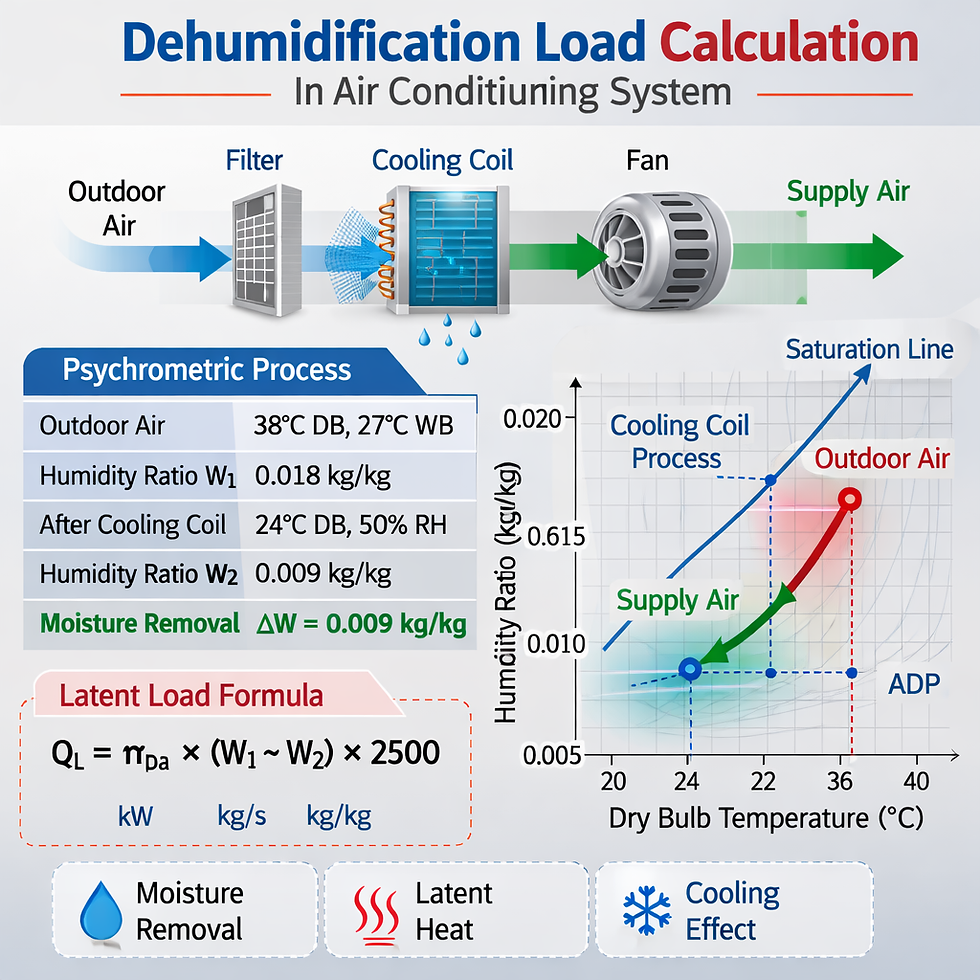
To maintain indoor comfort at 50% RH, the cooling coil must remove a portion of this moisture.
This is why latent cooling load is critical in HVAC design.
Technical Comparison Table
Air Property | Symbol | Unit | Engineering Significance |
Dry Bulb Temperature | DBT | °C | Air temperature used for sensible cooling |
Relative Humidity | RH | % | Percentage of saturation |
Humidity Ratio | W | kg/kg | Actual moisture content |
Dew Point | Tdp | °C | Temperature where condensation begins |
Enthalpy | h | kJ/kg | Total heat content of air |
Key Insight :
Humidity ratio provides the most direct measure of moisture content compared to other psychrometric properties.
Advantages
Understanding humidity ratio calculations offers several engineering advantages:
Accurate HVAC Design
Engineers can size cooling coils and dehumidifiers properly.
Better Indoor Comfort
Maintaining proper moisture levels prevents discomfort.
Energy Efficiency
Proper moisture removal reduces unnecessary cooling energy.
Condensation Prevention
Humidity calculations help prevent:
duct condensation
building envelope moisture damage
mold growth
Improved Air Quality
Controlled humidity improves occupant health and productivity.
Common Engineering Mistakes
Even experienced engineers sometimes misapply moist air calculations.
1. Confusing Relative Humidity with Moisture Content
Relative humidity changes with temperature, while humidity ratio represents actual moisture
content.
2. Ignoring Atmospheric Pressure
Humidity ratio calculations depend on barometric pressure, which varies with elevation.
3. Incorrect Psychrometric Chart Reading
Common errors include:
reading wrong humidity lines
confusing wet bulb and dew point
incorrect interpolation
4. Neglecting Latent Loads
Cooling load calculations must include:
latent heat from occupants
ventilation air moisture
infiltration humidity
Ignoring latent loads leads to oversized or inefficient systems.
Future Trends
Humidity control is becoming increasingly important in smart building design.
AI-Driven HVAC Optimization
Artificial intelligence can predict humidity loads and optimize HVAC operation.
Digital Twin Technology
Digital twins simulate building moisture behavior in real time.
Smart Sensors
Advanced IoT humidity sensors provide continuous monitoring of:
indoor humidity
condensation risk
ventilation effectiveness
Energy-Efficient Dehumidification
New technologies include:
desiccant wheels
hybrid cooling systems
membrane dehumidification
These innovations significantly reduce HVAC energy consumption.
Sizing equipment on a live project? The Cooling Load Design Handbook walks through the full design chain - envelope and internal loads, latent load, airflow, coil duty and equipment selection - with worked examples.
FAQ Section
What is the typical humidity ratio of indoor air?
Comfortable indoor conditions usually correspond to a humidity ratio of 0.007–0.012 kg/kg depending on temperature.
Why is humidity ratio preferred over relative humidity?
Humidity ratio represents actual moisture content, while relative humidity varies with temperature.
How do HVAC engineers measure humidity ratio?
Humidity ratio is usually derived from:
dry bulb temperature
wet bulb temperature
relative humidity measurements
Using psychrometric equations or charts.
What happens if humidity ratio is too high?
High humidity ratio can cause:
condensation
mold growth
reduced occupant comfort
equipment corrosion
Is humidity ratio constant during heating?
Yes. During sensible heating, the humidity ratio remains constant because no moisture is added or removed.
Conclusion
Humidity ratio is one of the most important parameters in HVAC engineering because it directly quantifies the moisture content of air. Accurate moist air calculations allow engineers to design systems that maintain indoor comfort, prevent condensation, and operate efficiently.
By understanding psychrometric relationships, partial pressure principles, and humidity ratio calculations, HVAC professionals can properly design cooling coils, ventilation systems, and humidity control strategies for modern buildings.
As smart buildings and AI-driven HVAC technologies evolve, precise moisture control will become even more important in delivering energy-efficient and healthy indoor environments.
Author Note:
Nexora Design Lab publishes engineering insights on HVAC design, MEP systems, and sustainable building technologies used in modern construction projects.


Comments