HVAC Design Mistakes in Villa Projects (Technical Engineering Guide)
Updated: Sep 29
Why Villa HVAC Design Is Different from Apartments

Residential villas—especially in hot climates like the Middle East and GCC region—require a fundamentally different HVAC engineering approach compared to apartments or commercial buildings.
Villas typically include:
Large glazing areas
High ceiling volumes
High solar heat gain
Significant outdoor air latent load
Irregular occupancy patterns
Architectural complexity
(HVAC Design Mistakes in Villa Projects)
Yet many projects still apply rule-of-thumb sizing and generic system selection methods. The result:
High energy bills
Poor humidity control
Frequent equipment failures
Mold risk
Occupant discomfort
This guide outlines the most critical HVAC design and execution mistakes in villa projects—and the correct engineering practices to prevent long-term performance failures.
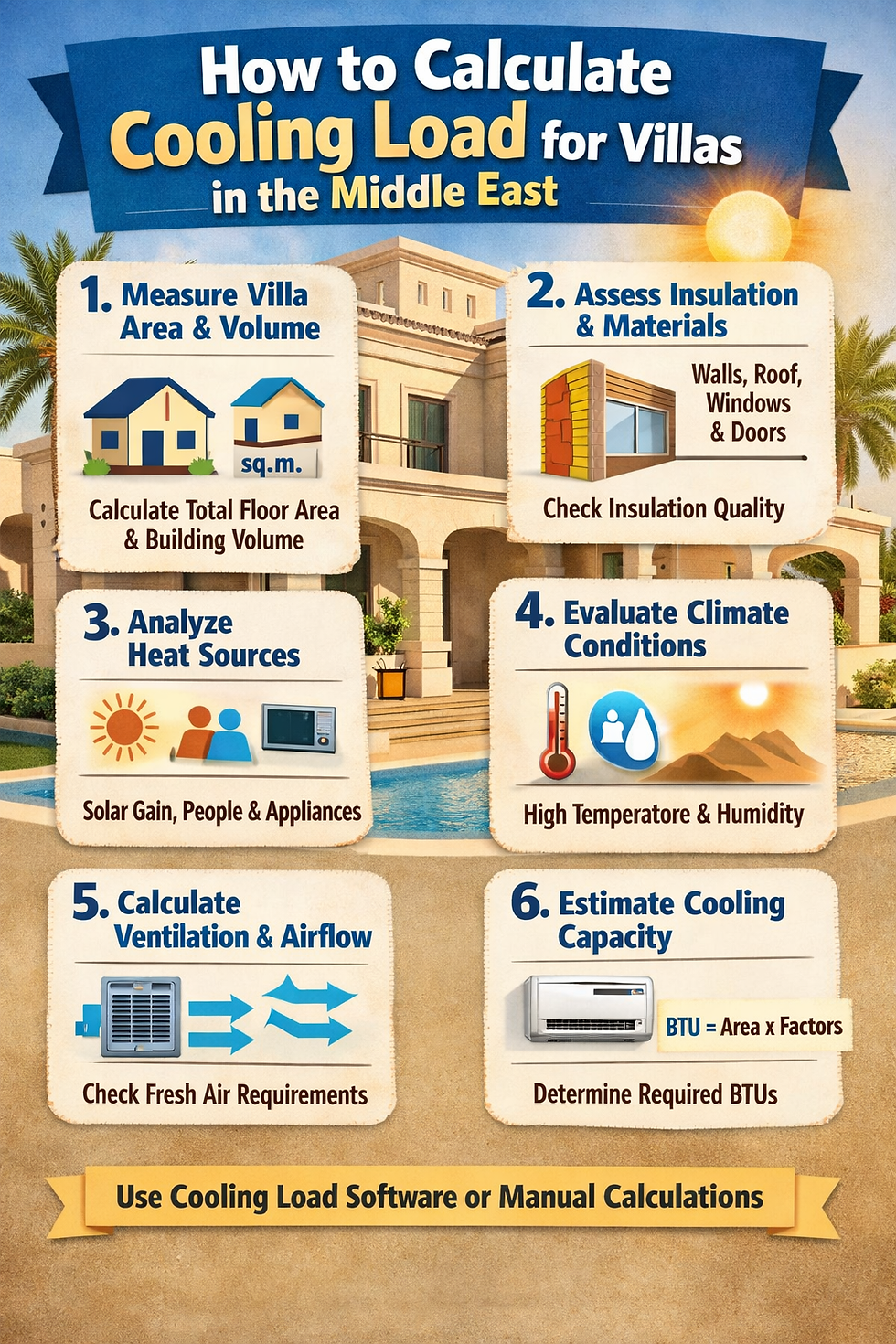
1. Incorrect Cooling Load Calculation
The Mistake (HVAC Design Mistakes in Villa Projects)
Many villa projects still rely on:
Rule-of-thumb sizing (e.g., 600–800 sq.ft per ton)
Ignoring solar orientation
No shading coefficient analysis
No infiltration modeling
Ignoring fresh air load
No separation of sensible and latent loads
In Gulf climates, oversizing is just as damaging as under sizing.
Consequences of Oversizing
Short cycling
Poor humidity removal
Reduced equipment lifespan
Higher capital expenditure
Consequences of Under sizing
Inadequate cooling
Continuous compressor operation
High indoor humidity
Correct Engineering Practice
Perform room-by-room load calculation
Use ASHRAE-based methodology (CLTD/RTS or certified software)
Separate:
Sensible load
Latent load
Ventilation load
Apply diversity factors correctly
Accurate load calculation is the foundation of high-performance villa HVAC design.
2. Poor Duct Design and High Static Pressure
The Mistake
Common duct design failures include:
Excessive flexible duct lengths
Sharp 90° bends
No friction loss calculation
Ignoring external static pressure (ESP) of FCU/AHU
No balancing dampers
Consequences
Airflow imbalance
Noise complaints
Frozen evaporator coils
High energy consumption
Correct Engineering Practice
Perform full duct friction loss calculations
Maintain recommended air velocity:
Main duct: 5–7 m/s
Branch duct: 3–5 m/s
Limit flexible duct length (<1.5 m where possible)
Design based on available ESP from manufacturer data
Install balancing dampers
Proper duct engineering directly impacts energy efficiency and comfort.
3. Ignoring Fresh Air and Ventilation Requirements
The Mistake
Many villas:
Have no mechanical fresh air provision
Rely solely on infiltration
Introduce untreated outdoor air directly into return plenum
In hot-humid climates, untreated outdoor air introduces high latent load.
Consequences
Mold growth
Odor issues
Negative pressure problems
Indoor RH exceeding 65–75%
Correct Engineering Practice
Provide dedicated fresh air system (FAHU or ERV)
Pre-cool and dehumidify outdoor air
Follow ASHRAE 62.1 or local authority standards
Maintain slight positive indoor pressure
Fresh air must be engineered—not improvised.
4. Wrong HVAC System Selection (VRF vs DX vs Chilled Water)
The Mistake
System selection often depends on:
Lowest initial cost
Contractor familiarity
Brand preference
Without evaluating:
Part-load efficiency
Maintenance accessibility
COP/EER performance
Redundancy
Life-cycle cost
Correct Engineering Approach
Small to Medium Villas
High-efficiency DX or VRF systems
Large Luxury Villas
Consider chilled water systems with properly engineered plant design
Always evaluate:
Life-cycle cost (LCC)
Service network availability
Electrical capacity
Long-term maintainability
Initial cost should never dictate system selection.
5. Improper Equipment Location
The Mistake
Outdoor units in poorly ventilated shafts
Condensers exposed to recirculated hot air
AHUs installed without maintenance clearance
No vibration isolation
Consequences
Elevated condensing temperature
Reduced COP
Frequent breakdowns
Noise transmission
Correct Practice
Maintain manufacturer-recommended clearance
Ensure proper airflow paths
Provide maintenance access
Install anti-vibration mounts and flexible connectors
Equipment location directly affects system efficiency.
6. Condensate Drainage Failures
The Mistake
No P-trap
Improper slope
No clean-out access
Long horizontal drain without vent
Consequences
Ceiling leakage
Odor problems
Microbial growth
False ceiling damage
Correct Engineering Practice
Install P-trap sized according to static pressure
Maintain minimum 1% slope
Provide maintenance access points
Insulate drain pipes to prevent condensation
Drainage failures are avoidable with proper detailing.
7. No Zoning Strategy
The Mistake
Entire villa controlled by one thermostat.
No separation for:
Bedrooms
Living areas
Service zones
Consequences
Energy waste
Night overcooling
Uneven comfort
Correct Engineering Practice
Provide multiple thermal zones
Install smart thermostats
Use motorized dampers or VRF zoning capability
Zoning improves both comfort and operational efficiency.
8. Ignoring Humidity Control in Hot-Humid Climates
Latent load in Middle East villas is significant.
The Mistake
Equipment selected only for sensible cooling
No SHR evaluation
No dehumidification or reheat strategy
Effects
Indoor RH 65–75%
Mold formation
Musty odor
Reduced indoor air quality
Correct Engineering Practice
Maintain indoor RH at 50–55%
Select equipment with proper SHR
Consider:
Dedicated dehumidifier
FAHU with reheat
VRF systems with humidity control logic
Humidity control is not optional in Gulf climates.
9. Poor Coordination with Architecture
The Mistake
Duct clashes with beams
No ceiling space verification
No coordinated drawings
Consequences
Reduced duct size
Increased static pressure
Compromised airflow
Correct Engineering Practice
Conduct MEP coordination before construction
Verify false ceiling height early
Issue coordinated shop drawings
HVAC performance depends on coordination accuracy.
10. No Commissioning and Air Balancing
The Mistake
Systems handed over without:
TAB (Testing, Adjusting & Balancing)
Static pressure verification
Airflow measurement
Consequences
Long-term performance degradation
Energy inefficiency
Comfort complaints
Correct Engineering Practice
Conduct full commissioning
Verify airflow at each diffuser
Adjust dampers accurately
Document final test reports
Commissioning ensures the system performs as designed.
Financial Impact of HVAC Design Mistakes in Villas
Mistake | Financial Consequence |
Oversizing | 15–25% higher capital cost |
Poor duct design | 10–20% higher energy bills |
No ventilation control | Mold remediation cost |
Improper installation | Frequent maintenance |
No commissioning | Long-term performance loss |
Over 10 years, poor HVAC design can cost more than the initial system investment.
How to Engineer a High-Performance Villa HVAC System
A properly engineered villa HVAC system must include:
Accurate room-by-room load calculation
Correct system selection
Optimized duct static pressure design
Dedicated fresh air management
Humidity control strategy
Thermal zoning
Full commissioning and air balancing
Villa HVAC design is not about installing AC units—it is about engineered environmental control.
Clients do not pay for drawings. They pay for comfort, reliability, energy efficiency, and lifecycle performance.
Need Expert Villa HVAC Engineering Support?
If you are developing or designing a villa project in hot climates, ensure your HVAC system is engineered—not improvised.
Professional HVAC design consultancy should include:
Detailed load calculations
Life-cycle cost evaluation
Duct optimization
Fresh air and humidity engineering
Commissioning oversight
A technically engineered HVAC system protects long-term investment and operational cost.
Doing this on a live project? The HVAC Load & Duct Sizing Professional Calculator (Excel) takes you from room-by-room cooling load to airflow, duct sizes, pressure loss and equipment selection in one connected workbook.


Comments