Mobile Porta Cabin AC Equipment Sizing Guide
Updated: Sep 29
Executive Overview
Mobile porta cabins are often treated as “simple temporary buildings,” but from an HVAC sizing perspective they can be more difficult than conventional permanent buildings. They are lightweight, highly exposed, frequently installed in open yards, construction sites, temporary offices, worker welfare areas, security checkpoints, clinics, classrooms, and project administration zones. Their envelope is usually thin, the roof is directly exposed to solar radiation, air leakage is often high, and occupancy can change quickly. Because of this, selecting AC equipment based only on floor area, such as “1 TR per cabin,” is not engineering sizing. It is only a rough commercial shortcut.
A correct AC equipment selection for a mobile porta cabin must consider:
Cabin dimensions and orientation
Wall, roof, floor insulation quality
Solar exposure
Outdoor design temperature
Indoor design condition
Occupancy
Fresh air requirement
Lighting and small power loads
Door opening frequency
Infiltration
Equipment derating at high ambient temperature
Voltage availability and starting current
Maintainability in dusty and high-temperature outdoor conditions
ASHRAE Standard 62.1 is widely used as a reference for minimum ventilation and acceptable indoor air quality in non-residential buildings, while ASHRAE handbooks and standards are commonly referenced by HVAC engineers for load calculation and system selection methodology. In Qatar and similar Gulf environments, QCS 2014 and related project requirements may also influence envelope, safety, energy, and workmanship expectations.(Mobile Porta Cabin AC Equipment Sizing Guide)
For small cabins, the cooling load is not only sensible heat through walls and roof. Fresh air and infiltration can become a major latent load, especially in humid coastal climates. A 24 m² office cabin may appear small, but if it has poor insulation, high leakage, 8 occupants, direct sun exposure, and uncontrolled fresh air, the actual requirement can easily move from a nominal 2.5 kW unit to a 5.0–7.0 kW class unit, depending on site conditions.
The objective is not to oversize blindly. Oversizing creates short cycling, poor humidity control, higher starting current, unstable comfort, and reduced compressor life. Undersizing creates continuous operation, poor indoor temperature, occupant complaints, equipment overheating, and frequent maintenance calls. The correct engineering target is a balanced selection with realistic safety margin, proper derating, and practical installation details.
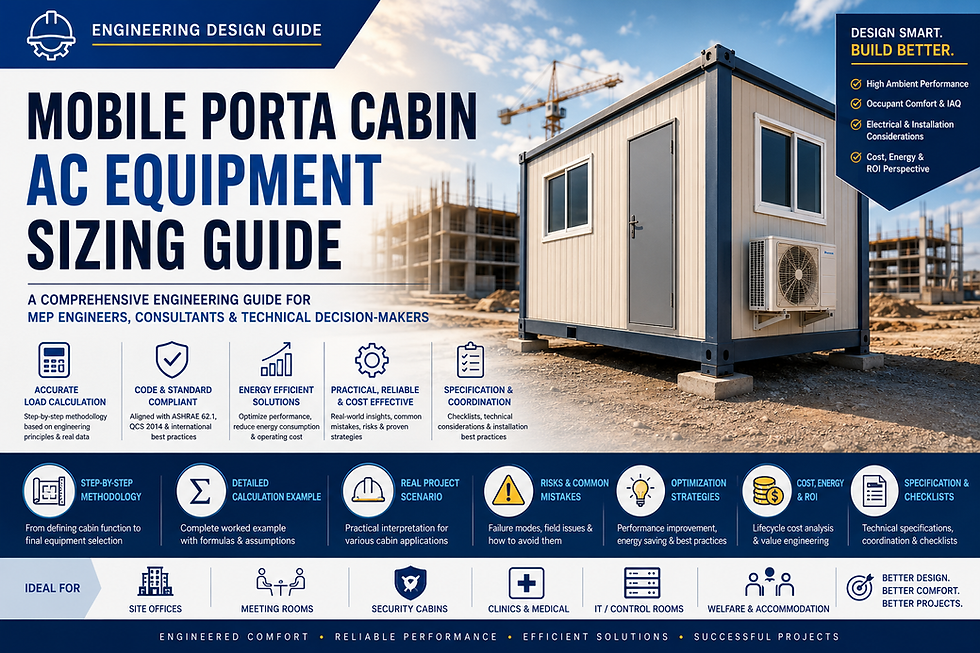
Download the full design guide PDF with detailed calculations, fan sizing, code compliance, and real project insights. Built for HVAC engineers and MEP consultants. (Mobile Porta Cabin AC Equipment Sizing Guide)
For detailed calculations, project-specific design, and authority-compliant solutions, contact our engineering team.
Email : info@nexoradesign.net
Phone : +94 76 720 5408
Web : www.nexoradesign.net
Read related blogs
How to Design an Outdoor Cooling System for a Park
How to Design a Staircase Pressurization System for a High-Rise Building
How to Design a Ventilation System for a Generator Room
How to Design a Ventilation System for an Industrial Warehouse Building
How to Design Ventilation System for Pump Room
Advanced Design of Basement Car Park Ventilation Systems
Doing this on a live project? The HVAC Load & Duct Sizing Professional Calculator (Excel) takes you from room-by-room cooling load to airflow, duct sizes, pressure loss and equipment selection in one connected workbook.


Comments