Chiller COP, EER and kW/TR: Compare Efficiency on the Same Boundary

AI-generated editorial illustration; not a verified installation or construction detail.
Write the units and boundary before comparing numbers
COP, EER and kW/TR are different ways of expressing cooling efficiency. Conversion is straightforward when they refer to the same cooling output, electrical input and operating condition. Most confusing comparisons fail because those conditions differ, not because the arithmetic is difficult.
Put a short label beside every value: chiller or plant; cooling mode; load and water or air temperatures; measured or rated; and the included electrical equipment. A lone “efficiency = 5.0” is incomplete. The worked example below separates chiller electrical input from the listed pumps and tower while retaining the same measured evaporator cooling duty.
The three metrics
Cooling COP equals cooling output in kW divided by electrical input in kW. It is a dimensionless ratio: higher is more efficient at the same duty and boundary. It can exceed one because a refrigeration system moves heat rather than converting all electrical input directly into cooling.
EER in the common I-P convention is cooling capacity in Btu/h divided by electrical input in watts. Higher is better. Some schedules use the label EER with W/W instead; in that case the numerical ratio is on a COP-like basis. Always read the units before applying an I-P conversion.
kW/TR is electrical input in kW divided by cooling capacity in U.S. refrigeration tons. Lower is better. Here 1 TR = 12,000 Btu/h ≈ 3.51685 kW of cooling. A refrigeration ton is a thermal-rate unit, not the physical mass of equipment.
The AHRI 550/590 rating standard identifies cooling efficiency and input-power rating quantities. Read the applicable rating edition and scope on an actual submittal; the example here is a units lesson, not a claim of certification.
Useful conversions on one consistent basis
For EER expressed in Btu/h per watt: EER ≈ 3.41214 × COP. Also, kW/TR ≈ 3.51685 / COP, and kW/TR = 12 / EER. These are reciprocal descriptions of the same input and output, subject to rounding.
As a quick check, COP = 5 corresponds to EER ≈ 17.06 Btu/h per watt and kW/TR ≈ 0.703. It would be incorrect to compare 0.703 kW/TR numerically with COP 5 and conclude that the smaller number indicates worse performance.
Record adequate precision during calculation, then round the reported result to suit the measurements. Converting an imprecise rating to six decimal places does not create a more accurate performance claim. Retain the original supplier value as well as the converted value.
Worked example: chiller electrical input
Assume one chiller has a steady measured evaporator cooling duty of 1,055 kW while drawing 210 kW at its defined electrical boundary. Assume the two readings are synchronized, stable and accurate enough for this illustration. No other plant equipment is included yet.
Cooling capacity is 1,055 / 3.51685 ≈ 300.0 TR. Chiller COP is 1,055 / 210 = 5.02. Using the unrounded COP, EER is 3.41214 × (1,055 ÷ 210) ≈ 17.14 Btu/h per watt. Chiller input per ton is 210 / 300.0 ≈ 0.700 kW/TR.
All three answers describe the same operating point. They do not describe the chiller at a different leaving-water temperature, outdoor temperature, condenser-water condition or load fraction. Keep those operating values beside the result so the next test can be compared fairly.
Now include the associated plant equipment
For the same illustrative hour, add 25 kW for chilled-water pumps, 20 kW for condenser-water pumps and 15 kW for cooling-tower fans. The listed-auxiliary plant input is 210 + 25 + 20 + 15 = 270 kW. Both calculations retain the same measured 1,055 kW evaporator duty as their cooling-output basis. This is not automatically the net cooling delivered to the building: chilled-water pump heat and distribution heat gains can reduce that delivered amount and require separate measurement or an explicit energy balance.
COP at this listed-auxiliary plant-input boundary is now 1,055 / 270 = 3.91, and input per ton of evaporator cooling is 270 / 300.0 = 0.900 kW/TR. The change from 0.700 to 0.900 does not show that the chiller deteriorated. It shows that 60 kW of auxiliaries were added to the accounting boundary.
If two chillers share pumps or towers, define a defensible allocation or compare the complete plant. Do not assign all shared auxiliary input to one chiller and none to the other. Similarly, a remote building cooling meter and a plant meter may differ because they measure different thermal boundaries.
For a constant four-hour example, electrical energy at the listed-auxiliary boundary is 270 × 4 = 1,080 kWh. Real operation varies: sum measured electrical energy and delivered cooling energy over matching intervals. Do not use an unweighted average of many instantaneous COP values as the period’s energy-based COP.
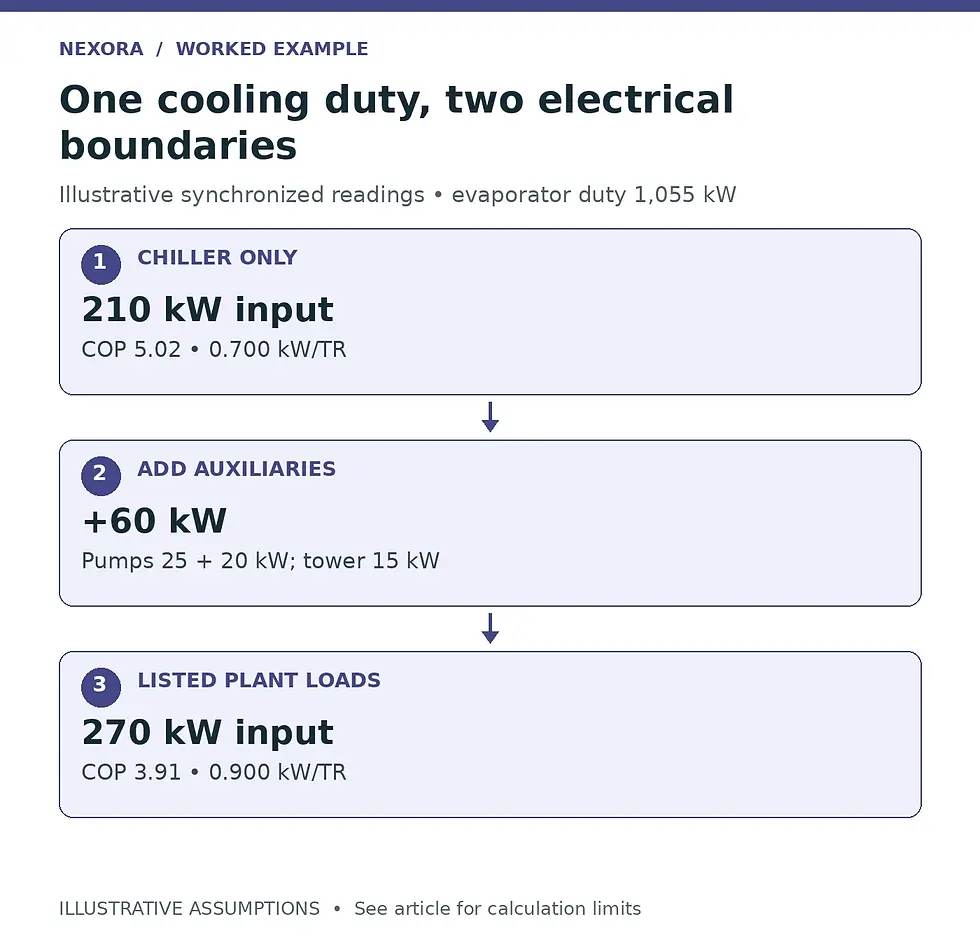
Original example. Both figures use measured evaporator duty; the expanded electrical boundary adds only the listed pumps and tower. Net building-delivered cooling requires separate pump-heat and distribution accounting.
IPLV is a rating, not your annual electricity bill
An integrated part-load value combines prescribed rating points. It helps compare equipment under that rating procedure, but its weighting is not your building’s operating history. Trane’s myPLV explanation discusses why IPLV should not be used as a direct predictor of application-specific annual energy.
Build an annual estimate from a credible load and weather profile, manufacturer performance at the relevant conditions, plant staging, auxiliary power and operating hours. Show which items are modelled and which are measured. Tariff demand charges, time-of-use prices and standby consumption may matter separately from annual kWh.
DOE’s chiller purchasing guidance uses both full-load and part-load requirements. Those federal purchasing limits are not universal acceptance criteria; the useful review habit is to avoid optimizing one headline point while ignoring the operating range.
A field measurement checklist
For water-side cooling, check the flow measurement, matched entering and leaving temperature sensors, fluid properties and sensor locations. Q = mass flow × specific heat × temperature difference only gives a trustworthy thermal duty when those inputs represent the same stream and interval. Glycol needs the appropriate properties.
For electrical input, use suitable real-power measurement covering the intended phases and equipment boundary. Nameplate motor power, a VFD’s displayed percentage and current alone are not interchangeable with measured kW. Electrical testing belongs to qualified personnel using approved procedures; do not open energized equipment to chase a better data point.
Report the load, temperatures, flow, run state and measurement uncertainty with the efficiency result. A low temperature difference makes sensor mismatch more influential. Investigate implausibly high efficiency before claiming savings, and compare trends at similar duty and ambient conditions.
The decision-ready result
A useful conclusion sounds specific: “At the recorded 1,055 kW evaporator duty, the measured chiller electrical boundary was 0.700 kW/TR; adding the listed pumps and tower gave 0.900 kW/TR on that same cooling-duty basis.” That statement can be reproduced and challenged.
Keep conversions, boundary choices and operating conditions on the same sheet. Then compare alternative equipment or operating strategies using the same rules. Clear accounting is the first step toward finding a real plant improvement rather than a more attractive number.
Related learning resource
For a broader plant-design workflow covering the relationship between equipment, pumping and operation, see Nexora’s Chilled Water System Design Handbook. Keep the measurement boundary explicit when applying any efficiency example.
Sources and further reading
Engineering education only. Verify project conditions, applicable requirements and manufacturer data; use qualified professional judgment before design, selection, operation or maintenance decisions.


Comments