Comparing MEP Supplier Quotations: A Like-for-Like Review Before Award

AI-generated editorial illustration; not a verified installation or construction detail.
Compare an agreed package, not just the bottom line
A useful MEP quotation comparison answers three questions: does each offer meet the technical requirement, does it include the same scope, and what remains uncertain before award? Copying three totals into a spreadsheet answers none of them.
Begin with one dated requirement set: equipment schedule, specification revision, drawings, quantities and commercial instructions. Record each supplier’s quotation number, date and revision against that basis. If an offer answers an older schedule, ask for a corrected offer before treating its price as comparable.
The process below is an original practical review framework. It does not replace the project’s procurement rules, technical approval process or contract advice, and the worked figures are fictional. No supplier or live project is represented.
Put technical compliance through a separate gate
Prepare a short matrix of requirements that materially affect performance or acceptance. For a chiller these might include capacity at the stated temperatures, fluid composition, electrical supply, sound criteria, pressure losses, dimensions and maintainability. For an AHU, include airflow, fan pressure basis, coil duty, filtration, casing construction and required controls.
Mark each item compliant, deviation accepted by the responsible reviewer, clarification pending, or noncompliant. Link the supporting selection page or written response. A blank cell is not agreement. An unapproved performance shortfall cannot be repaired by adding an arbitrary price allowance.
The World Bank’s bid-process guidance distinguishes technical and financial evaluation and emphasizes setting evaluation criteria in advance. That principle is useful here, although a private MEP package should follow its own applicable procedure rather than claim to use the Bank’s rules.
Give every inclusion one clear home
Create a common scope list before entering adjustment values. Include the base equipment, required accessories, control panel and interfaces, sensors, isolation or vibration provisions, delivery location, unloading and lifting, installation responsibilities, testing, startup, training, documentation and agreed spares. Tailor this list to the package rather than copying every item into every tender.
For each item, identify whether it is included, excluded, optional or unanswered. Record the exact quotation page and any later clarification. An accessory supplied loose may still need installation labour, wiring or configuration elsewhere in the project estimate. Conversely, avoid adding the same cost in both the supplier comparison and the subcontractor’s installation allowance.
Delivery needs a named place and a clear scope. The ICC’s EXW and DDP explanation shows how different delivery rules assign costs and responsibilities differently. If an Incoterms rule is used, record the named place and version; do not translate a vague “delivered” note into a commitment the supplier never made.
Worked example: the cheaper quotation changes position
Assume two fictional offers for an identical, technically acceptable equipment package. Both are in the same currency, here labelled USD, and use the same quantity, price date and delivery location. Applicable taxes are deliberately excluded from both figures for this example and must be treated consistently in a real comparison.
Supplier A quotes USD 42,000. Required controls are excluded and a written compatible controls quotation is USD 2,400. Unloading/lifting is excluded, with a checked allowance of USD 900. Authorized startup is excluded, with a written cost of USD 1,200. The evaluated package is 42,000 + 2,400 + 900 + 1,200 = USD 46,500.
Supplier B quotes USD 45,000 and explicitly includes those three items. It excludes the agreed spare-parts set, priced at USD 800. Assume Supplier A includes that same set. Supplier B’s evaluated package is 45,000 + 800 = USD 45,800.
A’s raw quotation is USD 3,000 lower, but its comparable package is USD 700 higher. The conclusion is limited: B has the lower evaluated amount on these documented assumptions. It is not an award recommendation until technical approvals, delivery, payment terms, risk and the actual scope documents have been reviewed.
The add-backs must be deliverable, compatible and accepted by the project team. If A’s controls exclusion cannot be resolved with an approved solution, label the package unresolved instead of presenting USD 46,500 as firm. Keep a separate “confirmed” versus “provisional” status beside every adjustment.
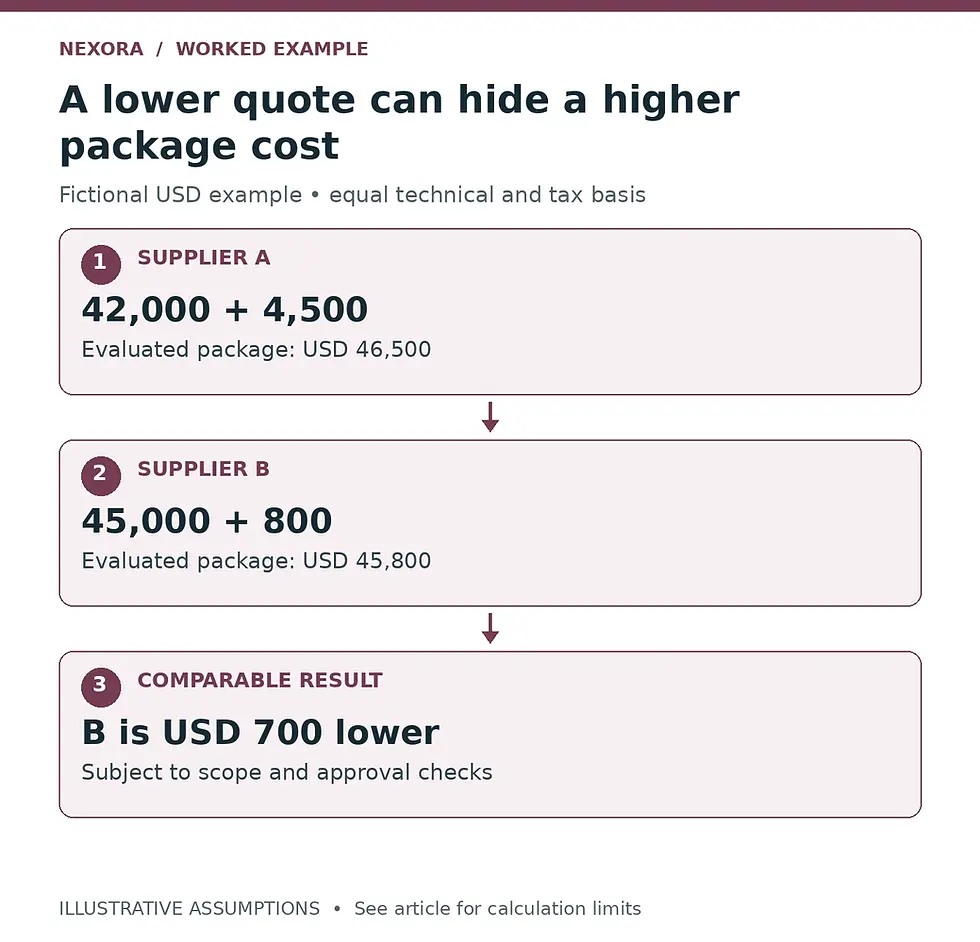
Original fictional example. Add-backs are assumed documented and compatible; unresolved exclusions must remain visibly provisional.
Do not turn uncertainty into a zero
“To be confirmed” is not zero cost. If commissioning support, duties, certification, storage or a specialist interface is unresolved, show it as a pending item with an owner and response date. Keep the total labelled provisional until the commercial consequence is understood.
Currency conversion also needs a stated basis. Retain the original currency amount, the comparison exchange rate and its date, and the party carrying exchange risk. Do not apply a live conversion to one offer and an old budget rate to another. Recoverable and nonrecoverable taxes may need different treatment; ask the project’s finance team rather than assuming they are equivalent.
Keep payment terms, quotation validity, warranty start point and delivery lead time visible next to the evaluated total. A price comparison should not hide a cash-flow or programme issue simply because it is harder to reduce to one number. Apply any scoring or monetization only under the agreed evaluation method.
Compare equipment energy on matching conditions
For energy-sensitive equipment, request performance at the project’s relevant conditions and a consistent input-power boundary. A better-looking efficiency number at a different water temperature or load point is not a direct comparison. Record the test or rating basis with the selected model and options.
DOE’s electric-chiller purchasing guidance evaluates both full-load and part-load performance and discusses life-cycle cost. Its federal purchasing thresholds are not universal project limits. Use the method as a reminder to compare capital and operating assumptions explicitly.
If operating cost matters to the award, produce a separate transparent model with load profile, hours, tariff, auxiliary loads and sensitivity. Do not multiply a headline integrated rating by annual hours and call the result a guaranteed bill. Retain the capital-only comparison so readers can see exactly how the operating model changes the decision.
Issue a reviewable recommendation
The final comparison should fit into a traceable chain: requirement, supplier evidence, deviation decision, adjustment evidence and evaluated result. A reviewer should be able to reproduce the total without searching someone’s inbox. Keep the original quotations unchanged and version the comparison when revised offers arrive.
Close with unresolved items and named review owners. State precisely which package is technically acceptable, which total is provisional, and what approval is requested. Once award is authorized, reconcile the purchase order against the accepted quotation and clarifications so the scope evaluated is the scope actually ordered.
Related learning resource
For a broader estimating workflow, see Nexora’s MEP Estimators Handbook. Use the quotation comparison as one controlled input to the estimate, with project-specific scope and approvals retained.
Sources and further reading
Engineering education only. Verify project conditions, applicable requirements and manufacturer data; use qualified professional judgment before design, selection, operation or maintenance decisions.


Comments