Control Panel Submittal Review: Match SCCR to Fault-Current Evidence

Review an industrial control panel’s short-circuit documentation as a chain of evidence: the exact assembly, its declared rating and conditions, the electrical location it will occupy, and the fault-current study for that location. A high number on the incoming breaker alone does not establish that the complete panel is suitable.
This is a document-review workflow for qualified electrical engineers and project reviewers. It does not calculate a panel rating, select protective devices, prescribe settings or authorize energization. Electrical design, conformity assessment and site safety remain with appropriately qualified personnel and the relevant approval authorities.
1. Record the jurisdiction and applicable edition
The terminology here follows US industrial machinery and control-panel practice. The UL Solutions machinery FAQ explicitly discusses NFPA 79, 2021 edition. That identifies the source’s scope; it does not establish which edition governs your project or imply that US requirements apply in another country.
Start the review record with the installation jurisdiction, the project’s adopted codes and editions, the product standards specified, and the authority responsible for acceptance. Obtain these from the project documents and responsible engineer. Where an IEC-based assembly standard or another national framework applies, request evidence in that framework and have the engineer reconcile terminology and rating conditions.
Also classify the equipment correctly. An industrial control panel, a distribution panelboard and an entire machine are different review objects. A certificate for one component or enclosure should not be filed as evidence for the complete assembled equipment unless its stated scope actually covers it.
2. Keep three different quantities in separate fields
Available fault current: the prospective short-circuit current established for the relevant supply location and operating condition by the electrical study.
Assembly SCCR: the short-circuit current rating declared for the specific control-panel assembly, at its stated voltage and subject to its documented conditions.
Protective-device interrupting rating: the rating of the circuit breaker or fuse for interrupting fault current under its applicable conditions.
Schneider Electric’s control-panel guidance, revision R06/26, explicitly cautions against using the incoming protective device’s interrupting rating as the panel SCCR. Request the assembly evidence rather than copying a breaker catalogue value into the panel schedule.
Voltage belongs beside every rating. UL’s molded-case circuit-breaker marking guide explains that multiple interrupting ratings may correspond to different voltages. A screenshot that crops out the voltage or product identity is incomplete review evidence.
3. Match the study point to the equipment tag
Create a review row for each incoming power supply. Link the equipment tag to the one-line diagram node and the study result at that location. Record the study revision, issue date, relevant operating cases and the engineer’s identification of the controlling result. “Plant fault level” without a connection point is too vague to close the review.
Check the document assumptions against the procurement and installation record. Relevant changes can include a different transformer, revised feeder arrangement, relocated equipment or a changed source configuration. The reviewer should flag these changes for the study author, who decides what must be recalculated. Do not create a substitute fault study from an unverified upstream number.
Make the evidence request precise: identify the missing node, inconsistent revision or undefined operating case. This is more useful than asking the supplier to “confirm compliance” without telling them which project data their submission must address.
4. Use a numerical screen to identify an unresolved mismatch
Consider an original hypothetical submission for control panel CP-07 at 480 V. The current project study reports 35 kA RMS symmetrical available fault current at its incoming terminals for the controlling case. The offered assembly is declared at 22 kA SCCR at 480 V. The incoming breaker has a 65 kA interrupting rating at the same voltage.
On those stated facts, the offered assembly rating is below the study value: 22 kA is less than 35 kA. The breaker’s 65 kA figure does not close that gap. Record the assembly selection as unresolved and refer it to the responsible electrical engineer and panel manufacturer. Do not mark the panel accepted on the strength of the breaker data.
Suppose a revised submission then declares a 50 kA assembly rating at 480 V. The basic comparison now reads 50 kA greater than 35 kA, but acceptance still depends on the exact assembly, the validity of its rating evidence and every stated condition. A higher number in a revised cover sheet is insufficient by itself.
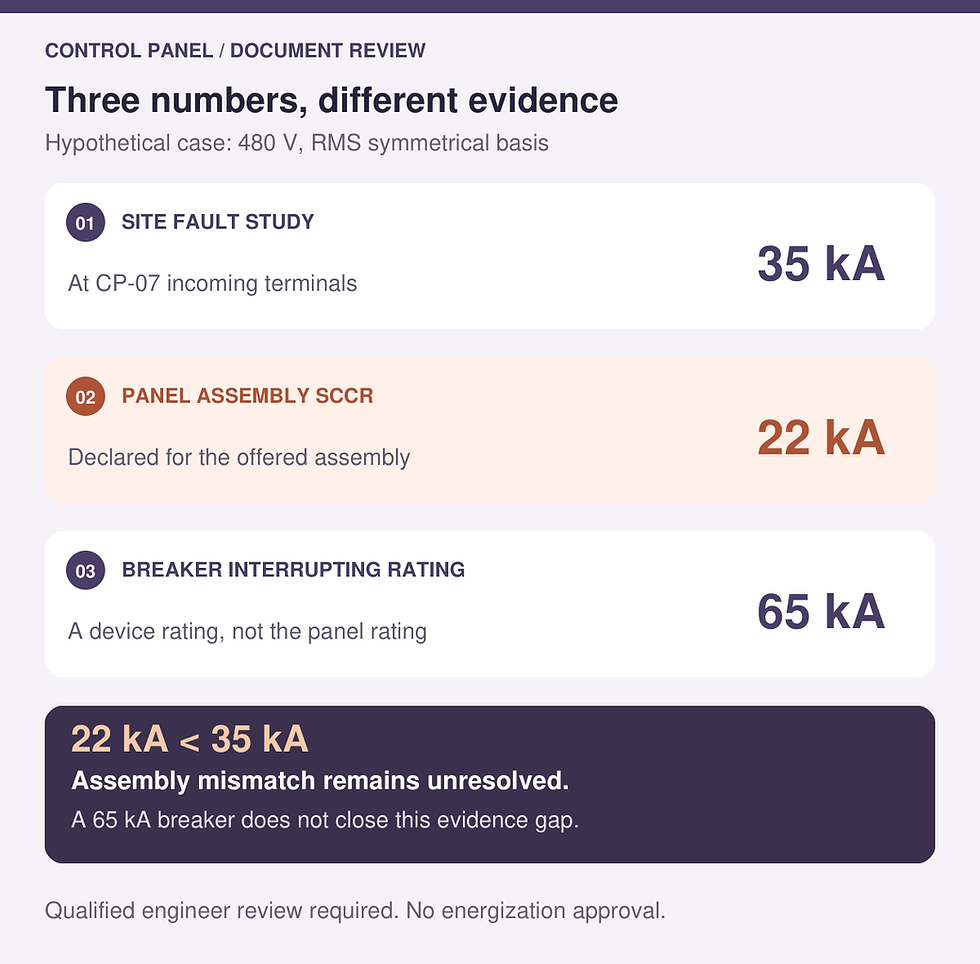
Hypothetical document-review screen only. Values share the stated 480 V and RMS symmetrical basis. A qualified electrical engineer must assess assembly evidence, conditions and project requirements.
5. Read the conditions attached to a higher rating
UL’s combination motor-controller information provides component-combination guidance with specified ratings and application considerations. The review implication is that an elevated rating may depend on an identified combination. Preserve the manufacturer’s exact references and restrictions rather than accepting a generic component-family substitution.
Match the assembly model, drawing revision and bill of materials to the offered equipment.
Identify any specified upstream protective-device type, catalogue reference, rating limit or other condition exactly as stated by the manufacturer.
Ask the responsible engineer to confirm that the actual supply arrangement satisfies those conditions.
Track substitutions through a revised manufacturer assessment and project review; do not assume interchangeability from a similar description.
The UL machinery FAQ also warns that adding current-limiting protection upstream does not automatically make an inadequate panel compliant. Assessing such arrangements requires the relevant technical evidence and specialist review. This checklist deliberately provides no device-selection shortcut.
6. Close the review with traceable documents
Keep a compact evidence register: equipment tag, supply identifier, governing document references, study node and revision, available fault current and basis, assembly SCCR and voltage, conditional-rating references, outstanding comments and the authorized reviewer’s disposition. Attach the underlying documents so the register can be audited.
At delivery, arrange reconciliation of the actual equipment identification and manufacturer documentation with the accepted submission through the project’s authorized inspection process. Any changed component or marking should reopen the relevant review item. This is a documentation check, not an instruction to open or inspect energized equipment.
The final record should make the decision reproducible: which assembly was reviewed, which site conditions were used, what restrictions remain, and who accepted the evidence. That discipline helps procurement, design and commissioning teams avoid passing an unresolved rating mismatch from one stage to the next.


Comments