ERV EATR and OACF: Calculate Net Outdoor Air at the Correct Boundary
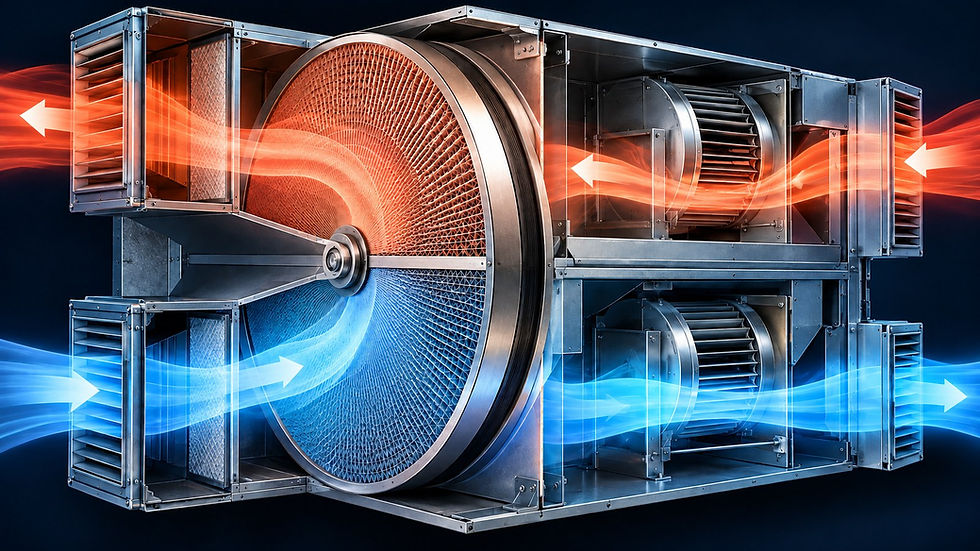
An energy-recovery ventilator can deliver its scheduled gross supply airflow while delivering less air that actually originated outdoors. Use EATR to account for exhaust air transferred into supply, and OACF to relate entering outdoor air to gross leaving supply. Apply both at matching conditions and boundaries; a certified exchanger rating alone does not verify installed ventilation.
1. Name all four exchanger stations
This article uses the station convention in AHRI Standard 1060-2023 (I-P): station 1 is entering supply, normally outdoor air; station 2 is leaving supply toward the building; station 3 is entering exhaust from the building; and station 4 is leaving exhaust to outdoors. The SI companion is AHRI 1061-2023. Retain the edition and units used in the actual submittal.
Place those four labels on the selected exchanger and on the installed drawing. Mark fans, filters, bypasses and flow-measurement stations too. A flow measured downstream of a mixing box does not describe station 2 unless all additional streams are accounted for. Leakage in the distribution duct is outside the exchanger calculation and can further reduce delivery to occupied spaces.
Keep actual volume and standard-air-equivalent volume distinct. A warmer or lower-density airstream occupies more volume at the same mass flow. The examples below use one common standard-air-equivalent basis throughout. Field readings require a documented conversion before comparing station ratios.
2. EATR and OACF answer different questions
EATR, exhaust air transfer ratio, is determined using tracer concentration: (C2 − C1)/(C3 − C1), where the subscripts identify stations. AHRI defines this rating at 100% rated airflows; do not assume it remains unchanged at turndown. Use a decimal fraction in calculations: 4% becomes 0.04. Net supply airflow originating outdoors is Q_net = Q2(1 − EATR). AHRI’s ERV application guidance explains why gross supply alone can overstate outdoor-air delivery.
OACF, outdoor air correction factor, is Q1/Q2: entering supply divided by gross leaving supply. Therefore Q1 = OACF × Q2. OACF is a ratio, not the percentage of outdoor air in supply. A value above one means intake exceeds gross leaving supply on the stated flow basis; it does not by itself establish zero exhaust contamination. Equal gross flows can conceal transfers in both directions.
Exhaust transfer may arise from cross-leakage and, in rotary equipment, carryover. Pressure relationships and equipment arrangement matter. These mechanisms and the separate performance factors are described in ASHRAE’s Air-to-Air Energy Recovery Equipment chapter. Do not substitute thermal effectiveness for either leakage metric.
3. Size a net-delivery requirement with explicit assumptions
Suppose a fictional project requires 2,000 L/s of net outdoor-origin air at station 2. Assume the selected application data at the intended airflow ratio, pressure differential and configuration give EATR = 4% and OACF = 1.08. Assume no additional mixing or casing leakage outside the stated test boundary. These values are invented for arithmetic, not a product claim or allowable contamination limit.
Required gross station-2 supply is Q2 = 2,000/(1 − 0.04) = 2,083.33 L/s.
Required station-1 intake is Q1 = 1.08 × 2,083.33 = 2,250 L/s.
Exhaust-origin air in station 2 is 0.04 × 2,083.33 = 83.33 L/s. The remaining 2,000 L/s originated at station 1.
Under the simplified closed exchanger boundary, outdoor-origin air diverted away from supply is 2,250 − 2,000 = 250 L/s. Its destination and mechanism must be consistent with the selected unit’s leakage or purge arrangement.
Notice that Q1 − Q2 is only 166.67 L/s. It is the net difference between gross entering and leaving supply, not the outdoor-origin quantity lost to the exhaust stream in this example. The simultaneous 83.33 L/s exhaust-origin transfer accounts for the distinction.
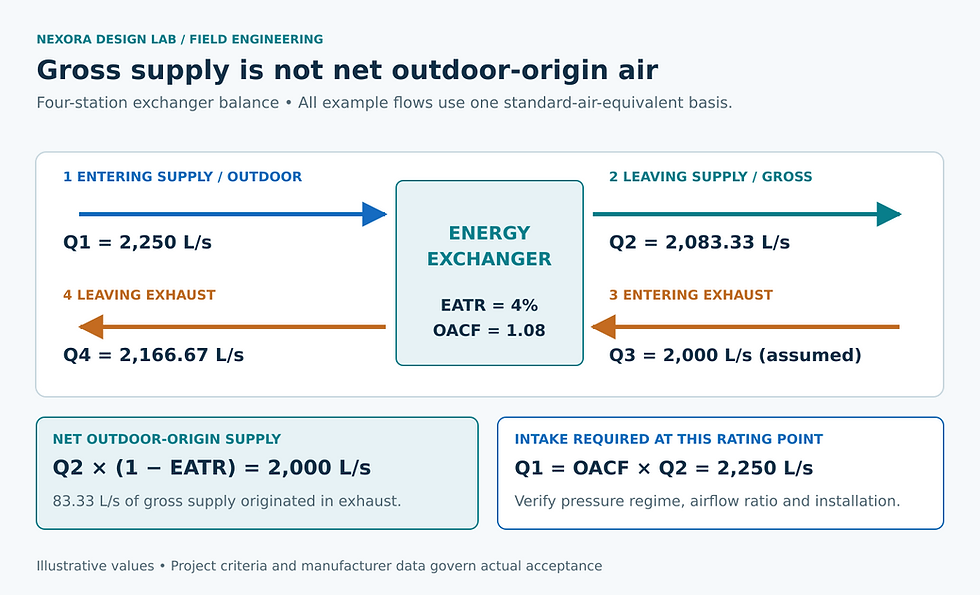
Original bookkeeping example on a common standard-air-equivalent basis. EATR corrects gross station-2 supply to net outdoor-origin delivery; OACF relates station-1 intake to gross station-2 flow.
For an additional balance check, assume station-3 flow is 2,000 L/s on the same basis. Then station 4 is 2,250 + 2,000 − 2,083.33 = 2,166.67 L/s, with negligible storage and no other mass paths. This invented flow set is a bookkeeping example; the manufacturer must confirm that a real selection achieves the assumed EATR and OACF at this supply-to-exhaust ratio.
4. Test the tempting shortcut
If a contractor sets gross station-2 flow to exactly 2,000 L/s while the applicable EATR remains 4%, net outdoor-origin supply becomes 1,920 L/s. The shortfall is 80 L/s. Increasing station-1 intake alone is not a verified fix: a changed fan balance can alter the pressure regime and the leakage factors.
Likewise, reusing the original gross target after a pressure-regime change is unsafe as a calculation assumption. If EATR were 7% instead, the previous 2,083.33 L/s gross supply would contain only 1,937.50 L/s of outdoor-origin air. Holding OACF fixed during that change would be another unverified assumption. Request revised application data rather than extending the old rating by guesswork.
5. Match the submittal to the operating condition
AHRI defines the rating pressure differential as static pressure at station 2 minus static pressure at station 3. This is different from the supply-side pressure drop through the exchanger. Use the specified sign convention; “250 Pa across the wheel” is too ambiguous for a leakage review. Published ratings describe stated conditions, not every condition encountered in service.
Obtain the exact model, exchanger construction, test boundary, rating edition and selection-software version. Identify whether certification covers a component or the complete packaged unit.
Request EATR and OACF together at the scheduled supply and exhaust flows, pressure differential and relevant configuration. Record purge settings and wheel operation where applicable.
Check fan locations, filter loading, bypass operation and expected turndown. Ask for application evidence where operation leaves the provided rating envelope.
Carry corrected flows through intake, exhaust and fan selections. Verify pressure losses at those flows rather than at the uncorrected net ventilation target.
Evaluate the permitted exhaust-air application and cross-contamination requirements separately under the applicable project rules. A satisfactory net-flow calculation is not a health-risk or code-compliance determination. EATR is not a universal contaminant-transfer rating.
6. Accept the installed result with a test plan
Document all four station labels and the actual versus standard flow basis.
Verify installed airflow and pressure relationships at representative operating points.
Inspect seals, bypass paths and any purge configuration against manufacturer instructions.
Distinguish measured installed EATR from an EATR inferred from applicable rating data. A routine airflow traverse does not measure tracer transfer.
Where required, arrange a suitable tracer-gas test with qualified personnel, a defined method and uncertainty assessment.
Confirm downstream distribution, ventilation controls and maintenance arrangements separately.
Record whether net delivery is measured, calculated from verified application factors, or still provisional. Filters, seals and control changes can shift the pressure conditions later, so retain the baseline. For context, see Energy Recovery Ventilator Design Guide and Heat Recovery Systems in HVAC Explained.
Continue your engineering workflow
For a broader AHU review workflow, explore the Nexora AHU Selection & Fault Diagnosis Handbook. Get the complete handbook.


Comments