HVAC Beginner’s Guide: Learn Heating, Ventilation & Air Conditioning Step by Step
A practical, highly visual handbook for students, junior engineers, technicians and anyone ready to build a strong foundation in HVAC.
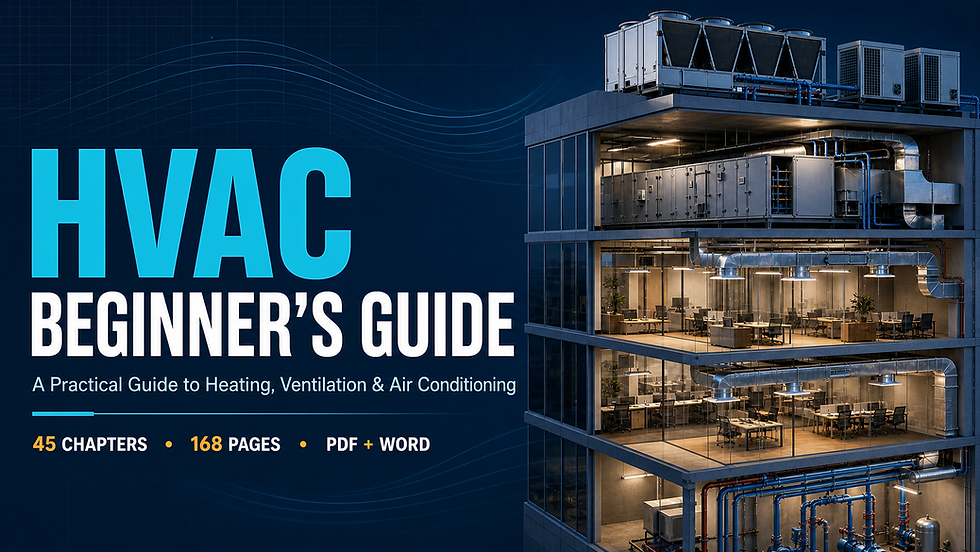
HVAC Doesn’t Have to Feel Complicated
Learning HVAC can feel overwhelming at first.
You may encounter unfamiliar equipment, technical drawings, psychrometric charts, airflow calculations, refrigeration cycles and dozens of abbreviations—all before seeing how the pieces connect.
The HVAC Beginner’s Guide was created to make that learning process clearer.
This 168-page handbook takes you from essential HVAC principles to a complete, coordinated small-office design. Instead of presenting disconnected formulas, it explains what each concept means, where it is used and how it fits into a real HVAC system. (HVAC Beginner’s Guide: Learn Heating Ventilation & Air Conditioning Step by Ste)
Whether you are studying mechanical engineering, beginning an HVAC career or moving from fieldwork into design, this guide gives you a structured path to follow.
🎯 What Makes This Guide Different?
The handbook combines technical knowledge with visual explanations and practical engineering context.
You will not simply memorize definitions. You will learn how to:
Understand the movement of heat, air, water and refrigerant
Recognize common HVAC systems and equipment
Follow calculations step by step
Read drawings, symbols and schedules
Connect design decisions with installation and operation
Identify common mistakes before they become site problems
Approach an HVAC project in a logical sequence
Every topic is written in clear language for beginners while preserving the engineering discipline needed for professional work.
📚 What You Will Learn (HVAC Beginner’s Guide: Learn Heating Ventilation & Air Conditioning Step by Ste)
🌡️ HVAC Fundamentals
Build your understanding of:
Heat and temperature
Sensible and latent heat
Pressure, density and airflow
Humidity, dew point and condensation
Conduction, convection and radiation
Thermal comfort and indoor air quality
Beginner-friendly psychrometrics
❄️ Refrigeration and Air-Conditioning Systems
Discover how common systems work, including:
The vapour-compression refrigeration cycle
Refrigerants and environmental responsibility
Split air-conditioning systems
Packaged and rooftop units
VRF and VRV systems
Chilled-water systems
Chillers and cooling towers
🌀 Air-Side Equipment and Ductwork
Learn how air is moved, treated and distributed through:
Air-handling units
Fan coil units
Centrifugal and axial fans
Supply and return ductwork
Duct sizing
Pressure-loss calculations
Diffusers and grilles
Fresh-air and exhaust systems
💧 Water-Side Systems
Develop a practical understanding of:
HVAC piping arrangements
Pipe sizing
Water velocity and pressure loss
Closed-circuit pump-head calculations
Valves, strainers and accessories
Chilled-water flow calculations
Pipe insulation and installation
🧮 HVAC Design Calculations
Follow structured examples covering:
Cooling-load fundamentals
Sensible and latent loads
Supply-airflow calculations
Outdoor-air calculations
Coil-duty calculations
Duct sizing and pressure loss
Pipe sizing and pump head
Equipment selection principles
Each numerical example separates:
Given
Required
Formula
Calculation
Answer
Engineering Interpretation
This structure helps you understand both the mathematics and the engineering meaning behind the result.
🏢 Follow a Complete HVAC Project
One of the handbook’s most valuable sections takes you through the design of a small-office HVAC system from start to finish.
The project brings together:
Room-by-room cooling loads
Outdoor-air requirements
Supply and return airflow
Air-handling-unit zoning
Diffuser selection and distribution
Duct sizing
Pressure-loss calculations
Equipment schedules
Chilled-water flow
Pump-head coordination
Condensate drainage
Controls and operating sequences
Testing and commissioning requirements
Bill-of-quantities information
This complete example shows how individual calculations become one coordinated design.
✨ Designed for Visual Learning
The guide includes more than 50 technical diagrams and visual teaching plates.
These visuals help explain:
Airflow paths
Refrigeration cycles
AHU and FCU arrangements
Fan and system curves
Duct and piping concepts
Pump-head calculations
Control sequences
HVAC drawing development
Installation practices
Commissioning workflows
The complete design process
The clean layouts, colour-coded systems and practical illustrations make complex subjects easier to understand and remember.
✅ Every Chapter Helps You Practise
All 45 chapters include:
Clear learning outcomes
Beginner-friendly explanations
Technical diagrams or visual briefs
Engineering tips
Site tips
Common mistakes
Worked examples
Chapter summaries
Five review questions
A practical exercise
You can use the handbook for independent learning, classroom study, staff training or structured revision.
🛠️ Learn More Than Calculations
A successful HVAC professional needs more than formulas.
The guide also introduces:
HVAC drawings and symbols
Design, shop and as-built drawings
Duct, pipe and equipment installation
Condensate drainage
Testing and commissioning
Testing, adjusting and balancing
Systematic troubleshooting
Energy-efficiency principles
HVAC career paths
A practical 12-month learning roadmap
These topics help connect design work with construction, operation and real site conditions.
👥 Who Is This Guide For?
The HVAC Beginner’s Guide is ideal for:
Mechanical-engineering students
HVAC and MEP students
Junior HVAC design engineers
Site engineers
BIM engineers and modellers
Estimators
HVAC technicians moving into design
Facility-management professionals
Career changers
Self-directed learners
No advanced HVAC background is required. The material begins with first principles and gradually progresses toward complete-system thinking.
📦 What Is Included?
Your digital download includes:
168-page professional A4 handbook
45 complete HVAC chapters
PDF edition
Editable Microsoft Word edition
50+ technical diagrams and visual plates
Complete small-office design project
Glossary of HVAC terminology
Common abbreviations
SI and Imperial conversions
Frequently used HVAC formulas
Troubleshooting tables
Beginner design checklist
Equipment-identification guide
References to authoritative industry resources
No physical product will be shipped.
📌 Keep the Quick Reference Nearby
The handbook’s quick-reference section is designed for everyday study and project work.
Use it to check:
HVAC terminology
Abbreviations
Engineering units
Temperature conversions
Airflow and water-flow conversions
Pressure and head conversions
Cooling-capacity conversions
Common HVAC formulas
Design considerations
Equipment information
Troubleshooting steps
Project checklists
It is a useful companion when studying, reviewing calculations or preparing project documentation.
❓ Frequently Asked Questions
Is this guide suitable for complete beginners?
Yes. It begins with heat, temperature, pressure, humidity and airflow before introducing systems, calculations and design workflows.
Does it include worked calculations?
Yes. The handbook contains structured, step-by-step worked examples with units, answers and engineering interpretations.
Does it cover practical HVAC design?
Yes. A complete small-office project demonstrates how cooling loads, airflow, ductwork, equipment, water flow, controls and commissioning requirements are coordinated.
What file formats are included?
You will receive a professionally designed PDF and an editable Microsoft Word edition.
Can experienced technicians use it?
Yes. It is especially useful for technicians who want to strengthen their design knowledge or understand the engineering behind installed systems.
Start Building Your HVAC Knowledge Today
HVAC becomes easier when you learn it in the correct sequence:
Understand the system. Design the path. Verify the result.
The HVAC Beginner’s Guide gives you a structured learning path, practical calculations, professional visuals and a complete design example in one convenient resource.
Professional note: This handbook teaches foundational engineering reasoning using illustrative examples. Project designs must always be verified against applicable local codes, authority requirements, project specifications and manufacturer data.


Comments