HVAC Noise Measurements: Subtract Background Energy, Not Decibel Numbers

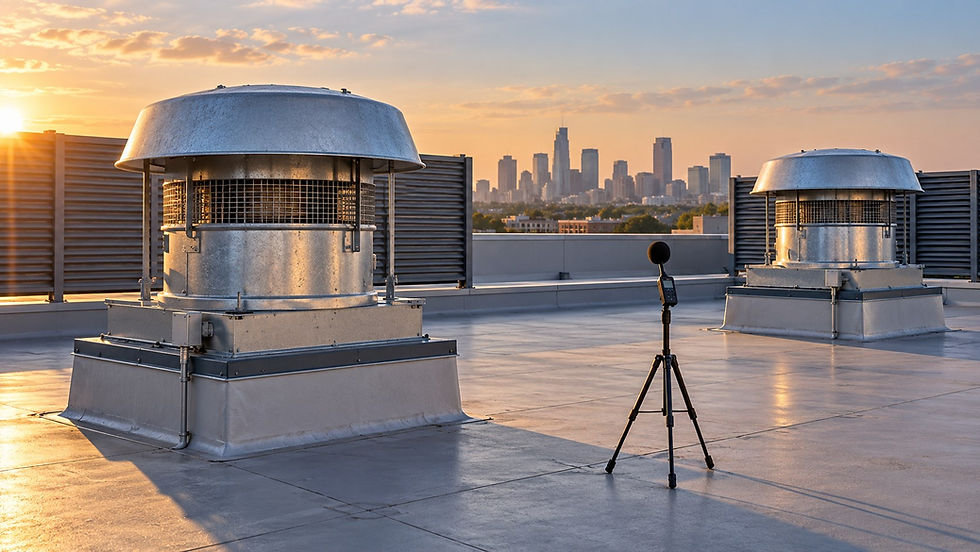
AI-generated illustrative scene, not a product screenshot or a completed-project photograph. The worked calculation below uses explicit example inputs.
A room measures 48 dB with an HVAC source operating and 43 dB with that source stopped. Subtracting the displays gives 5 dB, but 5 dB is the separation between the measurements, not the sound level attributable to the source. The calculation must subtract the underlying mean-square sound contributions before converting back to decibels.
This article is an educational sound-pressure data check. It is not a workplace exposure assessment, a room acoustic acceptance test or a replacement for the applicable project measurement standard. Any shutdown must be authorized and must not interrupt a required ventilation, safety or critical service. Where a valid source-off condition cannot be obtained, record that limitation rather than forcing a result.
First make the two records comparable
Use the same instrument, location, microphone orientation, frequency weighting, time metric and measurement duration. A maximum reading and an equivalent continuous level are not interchangeable inputs. If comparing frequency bands, use the same band for both records and repeat the correction band by band rather than using a broadband correction on every band.
The background must remain representative when the source changes state. Occupancy, traffic, adjacent equipment and weather can change between measurements. Turning off an AHU may also alter another system’s behaviour, so a lower reading is not automatically the original background with just one source removed. Describe these interactions in the test record.
Original example: correct the energy difference
Assume two valid, comparable sound-pressure level records: a combined source-plus-background value of 48 dB and background alone at 43 dB. Assume statistically uncorrelated contributions, stable background and the same measurement basis. The manufacturer’s acoustics guidance provides the logarithmic subtraction relationship; the numerical example here is original and hypothetical.
Source estimate Ls = 10 log₁₀[10^(48/10) − 10^(43/10)]
Combined relative mean-square value = 63095.73
Background relative mean-square value = 19952.62
Difference = 43143.11
Ls = 46.35 dB; correction to combined reading = 48 − 46.35 = 1.65 dB
The relative values have a common reference and are used only to perform the subtraction. They are not watts and do not turn a room sound-pressure measurement into a sound-power rating. Report the result with precision consistent with the measurement method; the extra decimal places above are shown to make the arithmetic reproducible.

Same metric and unchanged background assumed. Not an acceptance or exposure assessment.
Small separation makes the result fragile
Keep the combined reading at 48 dB but change the background input to 46 dB. The mathematical source estimate becomes 43.67 dB. If that background were 45.5 dB instead, the result would be 44.41 dB; at 46.5 dB it would be 42.65 dB. A small background change now causes a much larger shift in the inferred source contribution.
Brüel & Kjær’s introductory guidance warns that background separation below 3 dB is too small for an accurate correction by this simple method. Treat that as a warning about measurement quality, not as a universal acceptance rule overriding the applicable standard. Formal methods may prescribe specific limits, corrections and reporting qualifiers. Do not label the 2 dB case a reliable source measurement merely because a calculator produces a number.
If the combined reading equals or falls below the background reading, the subtraction is zero or negative before the logarithm. There is no finite source estimate from this expression. Do not replace the result with zero dB or hide it as a spreadsheet error. Flag the pair as unsuitable and investigate the measurement conditions.
Turn a noisy result into a focused next action
Preserve timestamps, source states, measurement settings, duration, room conditions and calibration checks alongside the raw readings. Mark unusual events instead of silently deleting them. If the background is too high or unstable, agree a more suitable observation window or an appropriate specialist method; do not improvise a different measurement location and compare it with the old baseline as though nothing changed.
A commissioning record should distinguish the measured combined level, measured background, calculated correction and confidence limitation. The air-balancing toolkit and field handbook is a related resource for organizing HVAC field evidence, not a claim that it provides an acoustic analysis module or establishes noise compliance.
Continue the calculation review
Sources and calculation basis
Primary references checked on 27 October 2026. The worked examples and diagrams are original illustrative calculations, not manufacturer selections or project approvals. Apply the stated limitations and the requirements governing the actual project.
Comments