Industrial Dehumidification System Design Calculations
Updated: 3 days ago
Introduction

Industrial dehumidification system design calculations are essential in facilities where moisture directly affects product quality, process stability, equipment reliability, and worker safety. In pharmaceutical plants, food processing areas, lithium battery manufacturing lines, cold storage loading zones, printing facilities, and archival storage buildings, uncontrolled humidity can cause condensation, corrosion, microbial growth, coating failure, dimensional instability, and process downtime.
In real building projects, engineers rarely design dehumidification as a standalone function. It is usually integrated with ventilation, makeup air treatment, process exhaust, pressure control, cooling systems, and building envelope performance. That is why the design process must move beyond simply selecting a dehumidifier by airflow. Engineers need a load-based method that evaluates outdoor air moisture, infiltration, internal latent gains, product evaporation, and required indoor dew point.
When done correctly, industrial dehumidification system design calculations provide the basis for:
selecting the right dehumidification technology
sizing airflow and moisture removal capacity
estimating regeneration energy or cooling demand
validating indoor humidity setpoints
avoiding oversized or inefficient systems
(Industrial Dehumidification System Design Calculations)
Definition :
Industrial dehumidification system design calculations are the engineering steps used to determine how much moisture must be removed from air in an industrial space to maintain a specified indoor relative humidity, humidity ratio, or dew point under defined operating conditions.
What is Industrial Dehumidification System Design
Industrial dehumidification system design is the process of analyzing moisture sources and selecting equipment that can maintain a controlled indoor humidity condition. The system purpose is to reduce the moisture content of air to a target level that supports industrial operations.
Engineers apply these systems in spaces such as:
pharmaceutical cleanrooms
food and confectionery plants
electronics and battery manufacturing
water treatment buildings
warehouses with condensation risk
indoor pools and wet process areas
cold rooms and loading docks
The reason engineers use industrial humidity control systems is not always comfort. In many projects, the main goal is process protection. For example, a battery dry room may require a very low dew point to protect materials from moisture contamination. A food packaging room may need humidity control to prevent product spoilage or wrapper distortion. A storage warehouse may need dehumidification to prevent condensation on steel or equipment.
Therefore, industrial dehumidification design must focus on moisture balance, psychrometric behavior, and process reliability rather than standard comfort cooling assumptions.
Engineering Principles
Industrial dehumidification is governed by psychrometrics, heat transfer, mass transfer, and air distribution.
1. Moisture Content and Humidity Ratio (Industrial Dehumidification System Design Calculations)
The core variable in design is usually humidity ratio rather than relative humidity. Humidity ratio, commonly expressed as kg of water vapor per kg of dry air, allows direct moisture balance calculations.
Relative humidity changes with temperature, but humidity ratio directly indicates how much water vapor is present in air. For dehumidification load calculations, this is the more useful engineering parameter.
2. Dew Point Control
Many industrial applications are actually designed around dew point. If the room dew point is below the surface temperature of equipment, ducts, or walls, condensation can be avoided. This is critical in cold-process industries and low-temperature spaces.
3. Latent Load
Latent load is the moisture added to the space from:
outdoor ventilation air
infiltration through doors and leakage paths
occupants
wet products or open tanks
cleaning operations
process evaporation
The total latent load determines the required moisture removal rate of the dehumidifier.
4. Sensible-Latent Interaction
Some systems remove moisture by cooling air below its dew point and condensing water, then reheating if necessary. Others use desiccant media to absorb vapor directly. The chosen technology affects both sensible and latent performance, as well as reheat or regeneration energy.
5. Airflow Distribution
The system must not only remove moisture in total but also distribute dry air effectively. Poor airflow can create local humid zones, especially near process equipment, loading doors, and exterior walls.
Step-by-Step Engineering Process
Step 1 – Define Design Criteria
Start by establishing:
indoor dry-bulb temperature
indoor relative humidity or dew point
outdoor design condition
operating schedule
occupancy and process profile
pressure relationship with adjacent spaces
Example design criteria:
Indoor condition: 22°C, 35% RH
Outdoor condition: 38°C DB, 24°C WB
Space volume: 6,000 m³
Ventilation requirement: 5,000 m³/h
Positive room pressure required
At this stage, engineers should also identify whether the process is sensitive to RH, dew point, or both.
Step 2 – Identify Moisture Sources
Calculate all moisture gains into the space. Typical components include:
Ventilation moisture load
Outdoor air introduced for IAQ or pressurization carries water vapor.
Infiltration load
Moisture enters through door openings, cracks, dock areas, and envelope leakage.
Internal generation
Occupants, washdown activities, wet materials, and open liquid surfaces contribute vapor.
Process load
Manufacturing operations may release substantial moisture.
The total moisture load is:
Total Moisture Load = Ventilation Load + Infiltration Load + Internal Load + Process Load
Step 3 – Perform Psychrometric Analysis
Using psychrometric data, determine:
outdoor humidity ratio
target indoor humidity ratio
difference in humidity ratio between entering and leaving air
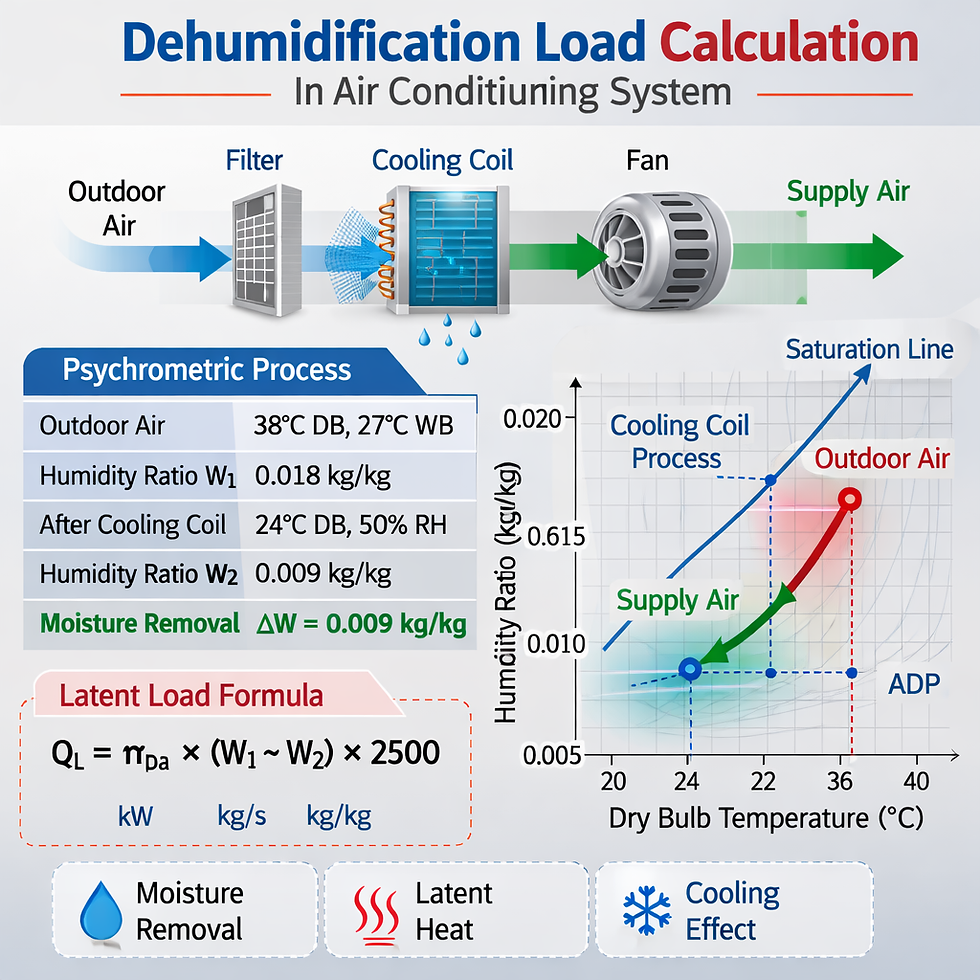
The fundamental moisture removal equation is:
Moisture removal rate = Dry air mass flow × (W_in - W_out)
Where:
W_in = entering air humidity ratio
W_out = supply or room target humidity ratio
For ventilation air alone, the moisture load can be estimated as:
Latent load from outdoor air = ṁ_da × (W_outdoor - W_indoor)
Where ṁ_da is the dry air mass flow rate.
Step 4 – Select System Type and Capacity
After calculating the required moisture removal rate, select the most suitable technology:
Refrigerant dehumidifier for moderate humidity control and higher dew points
Desiccant dehumidifier for low RH or low dew point applications
Hybrid system where cooling handles sensible load and desiccant handles deep drying
Then verify:
airflow rate
coil leaving condition
regeneration energy
reheat demand
fan static pressure
part-load performance
Practical Engineering Example
Consider an industrial packaging room with the following design data:
Room ventilation air = 4,000 m³/h
Infiltration air = 1,000 m³/h
Total incoming air = 5,000 m³/h
Outdoor air condition = humidity ratio 0.018 kg/kg dry air
Required indoor air condition = humidity ratio 0.0075 kg/kg dry air
Air density ≈ 1.2 kg/m³
Step 1: Convert volumetric flow to air mass flow
Total moist air mass flow:
5,000 m³/h × 1.2 kg/m³ = 6,000 kg/h
For simplified preliminary sizing, this can be used as approximate dry air mass flow.
Step 2: Calculate humidity ratio difference
ΔW = 0.018 - 0.0075 = 0.0105 kg/kg
Step 3: Calculate moisture removal rate
Moisture removal = 6,000 × 0.0105 = 63 kg/h
So the dehumidification system must remove approximately 63 kg/h of water just to offset the incoming air moisture load. If the room has internal moisture generation from product washing or open containers, that must be added.
Assume internal process moisture adds 12 kg/h.
Total required moisture removal = 63 + 12 = 75 kg/h
Step 4: Equipment implication
A system selected at 75 kg/h should not be the final choice immediately. Engineers must include:
safety factor only where justified
part-load control logic
door opening frequency
coil fouling allowance
future process changes
If the required room dew point is very low, a desiccant dehumidifier will likely be more suitable than a refrigerant system.
Step 5: Check energy implications
If desiccant equipment is used, regeneration heat must be calculated. If the regeneration energy requirement is, for example, 3,000 to 4,000 kJ per kg of removed moisture, then at 75 kg/h the regeneration heat input could become a major utility load. This is why industrial dehumidification design calculations must consider both moisture capacity and lifecycle energy use.
Technical Comparison Table
Parameter | Refrigerant Dehumidification | Desiccant Dehumidification | Hybrid System |
Best operating range | Moderate RH control | Low RH / low dew point | Wide range |
Moisture removal method | Cooling and condensation | Vapor adsorption | Combined |
Typical industrial use | Warehouses, general process rooms | Pharma, battery, dry rooms | Complex process spaces |
Low dew point performance | Limited | Excellent | Very good |
Reheat requirement | Often needed | Often integrated with regeneration logic | Case-dependent |
Energy profile | Strongly linked to compressor power | Strongly linked to regeneration heat | Balanced but complex |
First cost | Moderate | Higher | Highest |
Control flexibility | Good | Excellent for dry applications | Excellent |
Maintenance focus | Coils, drains, refrigerant circuit | Rotor, seals, heaters | Combined systems |
Advantages
Proper industrial dehumidification design offers several engineering and operational benefits:
prevents condensation on cold surfaces and equipment
protects moisture-sensitive products and raw materials
reduces microbial risk in controlled spaces
improves process consistency and product yield
limits corrosion on machinery and building components
stabilizes indoor conditions during seasonal weather changes
supports compliance in regulated industries such as pharma and food
From an HVAC engineering perspective, accurate dehumidification load calculation also prevents oversizing. Oversized systems often short-cycle, waste energy, and fail to maintain stable humidity.
Common Engineering Mistakes
A common problem in industrial humidity control design is focusing only on room volume rather than actual moisture load. A large room with low infiltration may need less dehumidification than a smaller room with frequent wet process activity.
Other frequent mistakes include:
using relative humidity alone without psychrometric analysis
ignoring infiltration through doors and dock openings
underestimating ventilation air latent load
selecting refrigerant systems for very low dew point applications
neglecting regeneration energy in desiccant designs
failing to coordinate humidity control with building pressure strategy
ignoring envelope vapor leakage and thermal bridges
not verifying part-load performance
Engineers should also avoid applying comfort HVAC assumptions to industrial processes. A process room may require humidity stability within tight limits even when sensible load is low.
Future Trends
Industrial dehumidification is evolving quickly as buildings and processes become more data-driven.
One major trend is the use of smart humidity control with continuous dew point monitoring, variable airflow control, and dynamic reset strategies. Instead of operating at fixed conservative setpoints, systems can adjust to actual process conditions.
Another important trend is digital twin integration. Facility teams can compare live humidity performance against design models to detect leakage, process anomalies, or control drift.
Heat recovery in desiccant systems is also improving. Engineers are increasingly recovering waste heat from industrial processes to support regeneration, reducing operating cost.
In high-performance facilities, AI-assisted optimization is being applied to coordinate dehumidifiers, chilled water plants, DOAS units, and pressure control sequences. This helps maintain process humidity targets with lower energy use.
Finally, as electrification and battery manufacturing expand, demand for low-dew-point industrial humidity control is increasing. That makes accurate psychrometric design and desiccant system knowledge even more valuable.
Sizing equipment on a live project? The Cooling Load Design Handbook walks through the full design chain - envelope and internal loads, latent load, airflow, coil duty and equipment selection - with worked examples.
FAQ Section
1. What is the main formula used in industrial dehumidification load calculation?
The core formula is moisture removal rate equals dry air mass flow multiplied by the change in humidity ratio. This determines how much water vapor must be removed from the air stream.
2. When should engineers choose a desiccant dehumidifier instead of a refrigerant unit?
Desiccant systems are preferred when the application requires low relative humidity, low dew point, or stable drying performance at low temperatures.
3. Why is humidity ratio more useful than relative humidity in design calculations?
Humidity ratio directly represents water vapor mass in the air and allows accurate moisture balance calculations. Relative humidity changes with temperature and is less reliable for load estimation alone.
4. How does infiltration affect industrial humidity control systems?
Infiltration can add a major hidden latent load, especially in warehouses, loading docks, and frequently opened process rooms. Ignoring it often leads to undersized systems.
5. Can an AHU cooling coil alone handle industrial dehumidification?
In some moderate applications yes, but not always. If the room requires low dew point or precise humidity control, a standard cooling coil may be insufficient without reheat or desiccant support.
Conclusion
Industrial dehumidification system design calculations are fundamentally about moisture balance, not just airflow. Engineers must quantify outdoor air load, infiltration, internal generation, and process evaporation, then match the total latent demand to the right technology. Psychrometric analysis, humidity ratio calculations, and dew point control are the foundation of reliable system sizing.
In practice, successful industrial humidity control design depends on three things: defining the correct indoor target, calculating all moisture sources realistically, and selecting a system that can meet performance requirements across real operating conditions. Whether the solution is refrigerant-based, desiccant-based, or hybrid, the engineering quality of the initial calculations determines long-term process stability and energy performance.
Author Note :
Nexora Design Lab publishes engineering insights on HVAC design, MEP systems, and sustainable building technologies used in modern construction projects.


Comments