MEP Preliminaries: Separate One-Time Costs from Weekly Site Costs
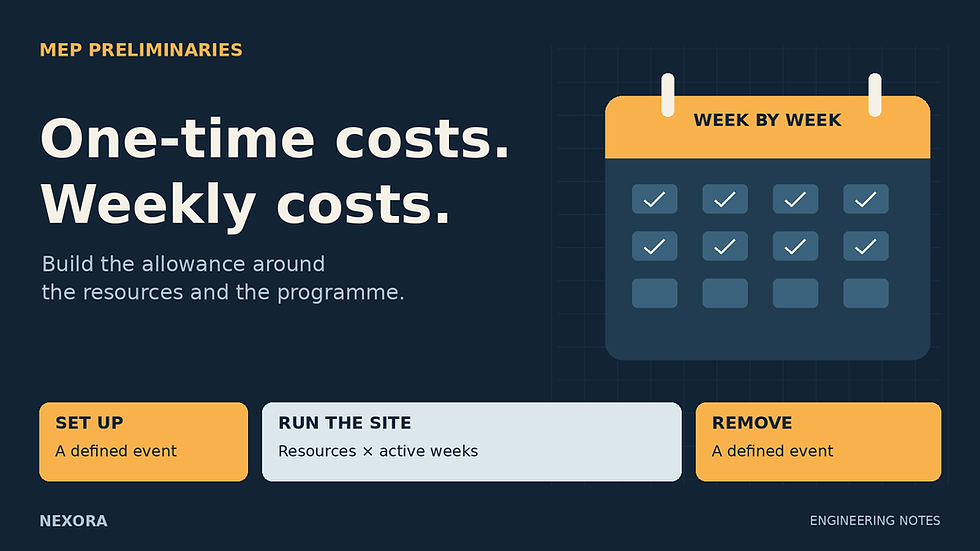
An MEP package can keep the same pipework, ductwork and equipment quantities while its site-running cost changes. Four extra weeks might retain the full coordination team, or only a small closeout presence. A preliminaries allowance expressed as one percentage cannot show that difference. A useful estimate records what happens once, what continues with time and what changes when the work enters another phase.
1. Classify the cost by its actual driver
Preliminaries cover project support that the chosen estimate structure does not allocate directly to an installed item. The boundary must match the particular package. Shared accommodation supplied by the main contractor, for example, should not also appear as a fully duplicated MEP allowance. Conversely, an MEP contractor’s separately required project office cannot disappear merely because the main contractor has an office somewhere on site.
RICS NRM 2 distinguishes fixed charges from time-related charges and provides separate columns for them in its preliminaries pricing schedules. It also separates preliminaries from head-office overheads and profit. This offers a useful classification reference; the project’s own pricing instructions and scope still establish how the estimate is presented.
One-time or event-based costs: initial establishment, a planned relocation, and final removal. A fixed charge can occur near the end of the project.
Time-related costs: retained coordination staff, accommodation hire or a shared service that continues for an identified period.
Usage-related costs: deliveries, equipment operating hours or consumption that follows activity rather than calendar duration alone.
Mixed costs: a hired facility with delivery and collection charges plus a weekly rental. Split the components instead of forcing the whole item into one category.
Classify the underlying resource rather than the payment date. An annual invoice can purchase a time-related service; several instalments can pay for one establishment event. A percentage allowance may remain useful as a high-level reasonableness check, but it does not explain the resource requirement.
2. Put each resource on the programme
Create a simple resource register with a description, responsible package, cost driver, quantity, active period and evidence source. For a weekly item, record the start and finish assumptions. For a one-time item, record the event that triggers it. Include the revision of the programme used so another estimator can reproduce the calculation.
Do not assign every resource to the full headline contract duration. A commissioning coordinator may start late; logistics support may finish before final documentation; rented storage might remain through a gap between installation stages. If two work areas overlap, count the actual shared resource once and add a second resource only where the plan calls for it.
The GAO Cost Estimating and Assessment Guide treats scope, schedule, technical baseline and documented assumptions as connected parts of a reliable estimate. Applied here, that means the weekly cost should be traceable to the planned site presence rather than copied from a previous project with a different sequence.
3. Build an original, phase-based example
Assume a simplified 24-week MEP site period: 20 weeks of full activity followed by four weeks of reduced closeout support. Use fictional normalized cost units, abbreviated CU, solely to demonstrate the arithmetic. These are not currency amounts, market rates or a tender recommendation. Assume constant unit costs, no inflation, no separate remobilization and no changes in installed quantities.
Initial establishment: 8.0 CU once.
Full-activity support: project coordination 0.60, accommodation and services 0.35, and shared logistics/access 0.45 CU per week. Total: 1.40 CU per week for 20 weeks.
Reduced closeout support: an assumed combined 0.60 CU per week for four weeks.
Final removal: 5.0 CU once.
The baseline is 8.0 + (20 × 1.40) + (4 × 0.60) + 5.0 = 43.4 CU. Its fixed component is 13.0 CU and its time-related component is 30.4 CU. The two phase rates are explicit assumptions for this example, not standard staffing ratios or recommended allowances.
This structure lets a reviewer challenge the correct input. If coordination is needed for all 24 weeks, its closeout contribution must be visible. If accommodation cannot be reduced when activity falls, the reduced-phase rate must reflect that constraint. The attractive total does not justify a resource assumption that the programme cannot support.
4. Test where the extra weeks occur
Scenario A extends the full-activity phase by four weeks while leaving closeout and one-time events unchanged. The additional cost is 4 × 1.40 = 5.6 CU, giving 49.0 CU overall. Scenario B instead adds four weeks of reduced closeout support. Its additional cost is 4 × 0.60 = 2.4 CU, giving 45.8 CU. Both programmes are 28 weeks long; the retained resources explain the different totals.
Multiplying the entire baseline by 28/24 would produce approximately 50.63 CU. That operation extends establishment and removal costs as though they recur weekly, and assumes the original phase mix continues. It overstates both simplified scenarios. On another project it could understate the result if the extension requires more expensive support or another mobilization.

Original normalized example. Fixed establishment and removal total 13.0 CU; only the resource period specified in each scenario is extended. CU are fictional cost units.
Use the difference between the revised and baseline resource plans. Add a repeated event only when the revised plan actually includes it. A suspension followed by remobilization, for example, may involve retained facilities during the gap and a separate restart event. Neither is established merely by changing the finish date.
5. Keep allocation separate from additional cost
An estimate may distribute preliminaries across measured work for reporting. That allocation does not change the underlying cost driver. If equipment prices rise while duration and site resources remain identical, a blanket percentage produces a larger allowance even though the modeled site-running cost is unchanged. If duration grows while equipment prices stay flat, the same percentage may miss the additional support.
Also reconcile shared resources with direct labor, subcontract quotations and company overheads. A dedicated installation supervisor already included in a subcontract’s scope should not silently reappear as the same full-time person in a separate support allowance. Clearly state when two entries represent genuinely different responsibilities. Keep contingency visible rather than hiding it inside every weekly rate.
6. Review the estimate before using it
Confirm the package boundary and identify support supplied by others.
Match each active period to the current programme and document reduced-phase assumptions.
Split delivery, hire, usage and removal where one supplier line contains several cost drivers.
Test a longer active phase, a longer closeout phase and any plausible repeat event separately.
Check actual commitments and retained resources before updating the forecast.
This is an estimating and forecasting method, not a conclusion about entitlement to payment, delay responsibility or contract recovery. Those questions depend on the applicable agreement and project records. For broader estimating reference, review the paid MEP Estimators Handbook. The useful output is a cost model that explains what changes when the programme changes.


Comments