The 2025/2026 HVAC Refrigerant Transition: What Homeowners Need to Know About R-454B and R-32
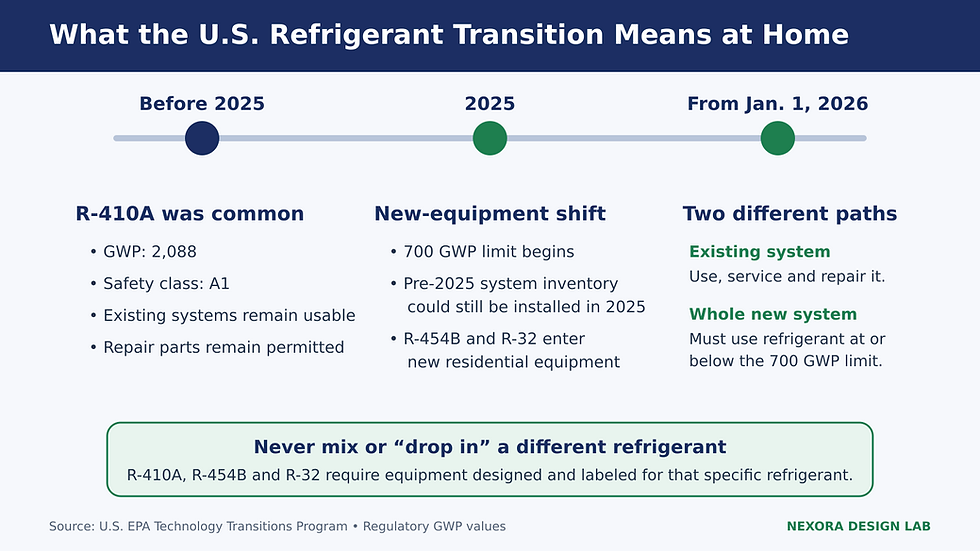
Short answer: If your R-410A air conditioner or heat pump still works, you do not have to replace it. It can continue to be used, serviced and repaired. The major change is that whole new U.S. residential split systems installed from January 1, 2026 must use refrigerant with a global warming potential (GWP) of 700 or less. R-454B and R-32 are two common options in new equipment.
The transition can sound like another refrigerant ban, but that description is misleading. It affects how new equipment is designed and installed while preserving a repair path for existing systems. For homeowners, the practical questions are compatibility, contractor training, correct capacity, verified efficiency, service support and total ownership cost.
What changed in 2025 and 2026?
The U.S. EPA’s current Technology Transitions table applies a 700-GWP limit to stationary residential and light-commercial air-conditioning and heat-pump equipment. Self-contained products such as window and portable units reached their manufacture/import compliance date on January 1, 2025. Field-assembled systems such as central splits followed a staged transition.
The 2025 equipment shift
Beginning January 1, 2025, manufacturers and importers had to meet the 700-GWP limit for covered new residential and light-commercial equipment. A one-year transition allowed complete systems whose specified components were made or imported before that date to be installed during 2025. This avoided stranding lawful inventory already in the distribution chain.
The 2026 installation rule
After January 1, 2026, a whole new residential split system must use a refrigerant at or below the 700-GWP threshold. EPA treats replacement of both the outdoor condensing unit and indoor evaporator coil together as installation of a new system. A system in a newly constructed home is also a new system.
Existing R-410A systems can still be repaired
EPA’s homeowner guidance says existing systems may be maintained and repaired throughout their useful lives. A failed outdoor unit, indoor coil, compressor or smaller part may be replaced with a compatible R-410A component when the work qualifies as service of an existing system. Availability and price may change as HFC supply declines, but repair is not prohibited.
What are R-454B and R-32?
R-454B and R-32 are lower-GWP refrigerants selected by different equipment manufacturers for new air conditioners and heat pumps. R-32 is a single-component HFC. R-454B is a blend containing R-32 and an HFO component. Both meet the current U.S. 700-GWP threshold for this residential subsector, but they are not interchangeable.
The values below use EPA’s regulatory 100-year GWP reference table. GWP compares the heat-trapping impact of one mass unit of a gas with the same mass of carbon dioxide over the stated time horizon.
Refrigerant | 100-year GWP | Safety class |
R-410A | 2,088 | A1 |
R-454B | 465 | A2L |
R-32 | 675 | A2L |
The lower GWP numbers reduce the direct climate impact of an equal refrigerant mass released to the atmosphere. They do not, by themselves, prove that one complete system is more efficient, quieter, cheaper or better suited to a particular home.
Refrigerant | Type | Homeowner takeaway |
R-410A | Blend | Legacy systems may continue to operate and be repaired. |
R-454B | Blend | Use only in equipment designed and listed for R-454B. |
R-32 | Single component | Use only in equipment designed and listed for R-32. |
Worked GWP comparison
Direct GWP reduction (%) = [(GWPold − GWPnew) ÷ GWPold] × 100
Using EPA’s regulatory values, replacing an equal mass of R-410A with R-454B reduces direct GWP by approximately 77.7%. Using R-32 gives approximately 67.7%. This is a simplified environmental comparison only: actual life-cycle impact also depends on charge, leakage, refrigerant recovery and the electricity used by the system.
What does A2L mean?
ASHRAE Standard 34 assigns refrigerant safety classifications using a letter for toxicity and a number for flammability. The letter A denotes lower toxicity. The 2L subclass denotes lower flammability with low burning velocity; it does not mean nonflammable.
The ASHRAE and UNEP safety fact sheet explains that A2L refrigerants burn very slowly compared with higher-flammability refrigerants. Safe use still depends on purpose-designed equipment, permitted charge, correct installation, ventilation or mitigation where required, leak control and proper service procedures.
What changes inside the equipment?
Components, controls and wiring are selected and evaluated for the named refrigerant.
Equipment labels identify the refrigerant and communicate A2L service precautions.
Some equipment includes leak detection or airflow mitigation when required by its design, charge and installation conditions.
Service tools, recovery machines, vacuum pumps and leak detectors must be suitable for the refrigerant and applicable rules.
Technicians must control ignition sources, recover refrigerant properly and follow the installation manual and local code.
Homeowners should not disable a leak sensor or mitigation function, obstruct required airflow, or allow unqualified work on the sealed refrigerant circuit. The correct response is not alarm; it is using listed equipment and a trained contractor who follows the manufacturer’s instructions and adopted code.
Can R-454B or R-32 go into an R-410A system?
No. R-454B and R-32 are not drop-in replacements for R-410A. EPA notes that industry standards prohibit mildly flammable refrigerants in systems not designed for them. Components, controls, charge limits, service procedures, refrigerant properties and equipment certification differ.
Never charge an R-454B system with R-32 or an R-32 system with R-454B. The equipment nameplate and installation manual—not cylinder availability or a technician’s preference—identify the permitted refrigerant. Mixing refrigerants can create unsafe operation, poor performance, service contamination and warranty problems.
R-454B vs R-32: which should you choose?
Do not choose a system on refrigerant name alone. Both refrigerants fit the current U.S. residential GWP limit and both require A2L-compatible equipment and service practices. The better purchase is the properly sized, matched and supported system that performs well in your climate and home.
Verified efficiency: compare the complete matched system’s SEER2, EER2 and HSPF2 ratings where applicable.
Correct capacity: ask for a cooling and heating load calculation, not a replacement based only on the old nameplate.
Humidity control: check part-load performance, blower setup and sensible-versus-latent capability in humid climates.
Matched components: confirm the outdoor unit, indoor coil or air handler, metering device and controls are approved together.
Local service support: ask whether trained technicians, refrigerant and replacement parts are available in your area.
Installation details: confirm line-set limits, evacuation, charge adjustment, condensate, airflow and electrical requirements.
Documentation: obtain model numbers, commissioning readings, warranty terms and the final refrigerant charge record.
Related Nexora guide: Is Your AC Bad, or Are Your Ducts Just Dumb? The Rise of Smart HVAC Systems Beyond the Thermostat. It explains why capacity must be selected from the building load and operating conditions rather than refrigerant type alone.
Will the transition increase costs?
Transition-period pricing varies because manufacturers redesigned products, distributors changed inventory and contractors invested in compatible tools and training. That does not justify a blanket premium or prove one refrigerant will always cost less. Compare installed cost, rated efficiency, warranty, service coverage and expected operating cost.
If a major component fails in an existing R-410A system, request both repair and replacement quotations. The economical choice depends on system condition, repeated leakage, compressor or coil condition, efficiency, comfort, parts availability and the quality of the proposed replacement—not the calendar alone.
The homeowner’s quotation checklist
What refrigerant is shown on the exact outdoor and indoor unit nameplates?
Are both units a listed, manufacturer-approved match?
Can you provide the load calculation and selected design conditions?
What are the complete-system efficiency ratings?
Does the installation require a new line set, and what diameter, length and elevation limits apply?
What A2L leak-detection or mitigation provisions apply to this model and room configuration?
Are your technicians trained and equipped for this refrigerant?
What commissioning records will I receive: airflow, static pressure, vacuum, charge, temperatures and electrical readings?
What parts, labor and refrigerant coverage are included in the warranty?
Who will recover the old refrigerant and document responsible handling?
Common mistakes to avoid
Replacing a working R-410A system only because someone says it is illegal.
Treating R-454B and R-32 as interchangeable versions of the same refrigerant.
Accepting a new system sized only from floor area, old tonnage or a sales rule of thumb.
Comparing GWP while ignoring system efficiency, leakage and installation quality.
Installing unmatched indoor and outdoor units without verified performance.
Allowing an A2L sensor or required airflow function to be bypassed.
Assuming every country, state or city follows the same deadline and code edition.
Limitations and professional checks
These dates describe the U.S. federal transition for stationary residential and light-commercial air-conditioning and heat-pump equipment as reflected in EPA guidance current in September 2026. VRF systems, chillers, self-contained products and commercial refrigeration have different dates or conditions. State rules and locally adopted mechanical, fire and building codes may add requirements.
Final selection must follow current manufacturer data, an approved matched-system rating, the installation manual, local code and the authority having jurisdiction. Refrigerant work should be performed only by properly qualified technicians using compatible equipment and recovery procedures.
Frequently asked questions
Is R-410A banned in 2026?
No. The transition restricts its use in whole new residential systems above the 700-GWP limit, but existing R-410A equipment may continue to operate and be repaired. Replacement components remain permitted for service.
Must I replace my working R-410A air conditioner?
No. EPA does not require homeowners to replace functioning equipment. Maintain it, repair leaks promptly and evaluate replacement when condition, comfort, efficiency and repair economics justify it.
Is R-454B safer than R-32?
Both are A2L: lower toxicity and lower flammability with low burning velocity. Safety depends on the complete listed system, charge, installation, controls and service practices; refrigerant name alone is not a safety verdict.
Which refrigerant is more efficient?
Compare the rated performance of the complete matched system. Capacity control, heat exchangers, compressor design, airflow, ductwork and installation quality also determine real efficiency.
Can old refrigerant lines be reused?
Sometimes, but never assume. The manufacturer must permit reuse, and the contractor must verify diameter, length, elevation, cleanliness, pressure rating, joints and leakage requirements for the exact equipment.
What if I suspect a refrigerant leak?
Follow the equipment manual, avoid ignition sources, do not attempt refrigerant work and contact a qualified HVAC technician. If there is an immediate safety concern, leave the area and follow local emergency guidance.
The practical bottom line
The 2025/2026 transition changes new equipment, not the legal life of your existing R-410A system. R-454B and R-32 both bring substantially lower regulatory GWP, and both require equipment designed for that exact A2L refrigerant. Your best protection is a correctly sized matched system, a trained installer, documented commissioning and reliable local service support.
Calculate before selecting equipment
For HVAC engineers, contractors and technically involved owners, the Nexora HVAC Load & Duct Sizing Professional turns cooling-load and duct-sizing checks into a repeatable workflow. It reduces guesswork in capacity and airflow selection; final equipment and refrigerant selection must still follow manufacturer data and local requirements.
Authoritative references: U.S. EPA Technology Transitions; EPA homeowner and technician FAQs; EPA GWP reference table; and ASHRAE refrigerant designations.


Comments