AHU Moist-Air Mixing: Flag a Saturation Crossing Before Accepting the Result

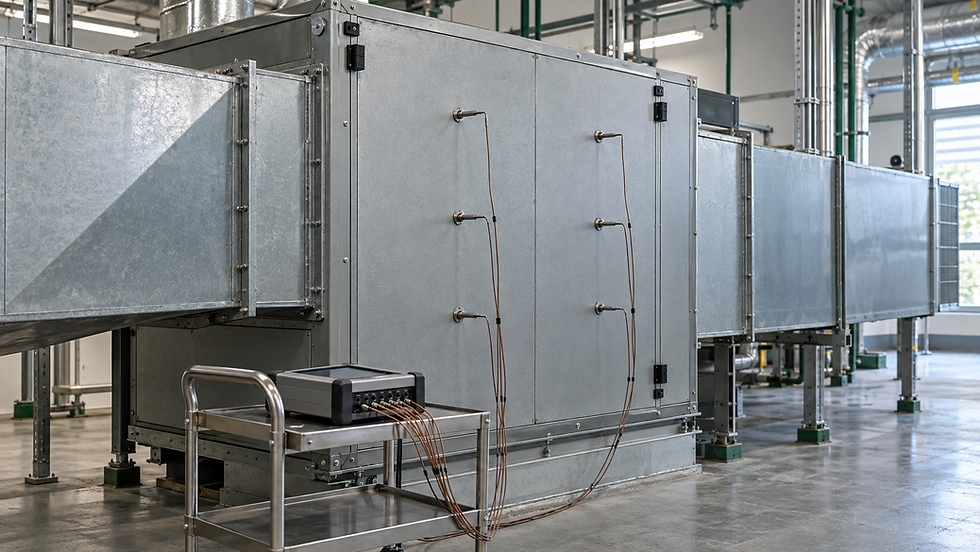
Original illustrative engineering schematic. The worked calculation below uses explicit example inputs.
Two physically possible entering air conditions do not guarantee that a vapor-only mixing calculation will produce another unsaturated condition. With sufficiently different temperatures and high moisture contents, the mixed water content can exceed what remains vapor at the calculated temperature. A spreadsheet that simply displays a relative humidity above 100% has found a boundary problem, not a normal AHU design state.
This article demonstrates a screening calculation for well-mixed air at one pressure. It is not a prediction of droplet size, deposition, microbial risk or safe equipment operation. Real mixing, drainage and moisture carryover require competent engineering review. The example is deliberately selected to make the phase boundary obvious rather than represent a typical Qatar outdoor-air condition.
Conserve dry air, total water and energy
ASHRAE’s psychrometrics chapter describes adiabatic mixing on a dry-air mass basis and distinguishes the fog region as saturated moist air together with liquid water. Those concepts are enough to identify the calculation’s branch point. First calculate the total water and enthalpy carried into the mixing boundary. Then test whether a single vapor phase can contain that water at the resulting temperature and pressure.
For two equal dry-air mass flows: W_total = (W_1 + W_2)/2 and h_mix = (h_1 + h_2)/2.
Illustrative perfect-gas enthalpy relation: h = 1.006T + W(2501 + 1.86T), in kJ/kg dry air.
A provisional vapor-only temperature is T_v = (h_mix − 2501W_total)/(1.006 + 1.86W_total).
Compare W_total with saturation humidity ratio W_sat(T_v,p).
Here T is in°C and W is kilograms of water per kilogram of dry air. Equal volume flows are not generally equal dry-air mass flows: different entering temperatures and moisture contents change specific volume. If the measured inputs are m³/s, convert each stream using its own state before forming the weights. Do not average relative humidity, because RH is not a conserved quantity.

101.325 kPa,adiabatic equilibrium example; liquid rate is not a drain-sizing or carryover prediction.
Original two-stream example
Assume each stream carries 1.00 kg/s of dry air at 101.325 kPa. Stream A is saturated at 5.0°C; stream B is saturated at 30.0°C. There is no entering liquid water, external heat exchange, fan heat or work in the mixing boundary. Approximate saturated humidity ratios from the ASHRAE saturation-pressure relationship are 0.005402 and 0.027203 kg/kg dry air respectively. Use the same property model throughout.
W_total = (0.005402 + 0.027203)/2 = approximately 0.016302 kg/kg dry air.
h_mix = approximately 59.161 kJ/kg dry air.
Provisional vapor-only T_v = approximately 17.745°C.
W_sat at that temperature and pressure = approximately 0.012724 kg/kg dry air.
Because 0.016302 exceeds 0.012724, the vapor-only result is outside the equilibrium single-phase region.
If the provisional water content is nevertheless treated entirely as vapor, its calculated RH is approximately 127.4%. That number is a useful error flag in this example, not the final equilibrium relative humidity. Simply clipping the display to 100% while retaining the same temperature and total vapor content fails to reconcile the water and energy balances.
The liquid phase changes the final temperature
For an illustrative equilibrium calculation with suspended liquid water at the final air temperature, split the incoming total water into saturated vapor and liquid. Let W_liquid = W_total − W_sat(T). Solve the energy balance including the sensible enthalpy carried by that liquid. A constant liquid-water specific heat of 4.186 kJ/(kg·K), referenced to 0°C, is adequate for showing the mechanism here.
h_mix = 1.006T + W_sat(T)(2501 + 1.86T) + [W_total − W_sat(T)] ×4.186T.
Numerical solution for the stated model: T ≈20.479°C.
Liquid water ≈0.001155 kg per kg dry air.
At 2.00 kg/s total dry-air flow: liquid-water rate ≈0.002310 kg/s, or 8.32 kg/h.
The equilibrium temperature is warmer than the provisional 17.745°C because condensation releases latent energy into the mixture. The calculation does not claim all predicted liquid collects in a drain pan: droplets can remain airborne, deposit, re-evaporate or interact with surfaces. It also assumes enough time to approach equilibrium. Those transport details lie outside this simple state calculation.
Build a branch check into the review
Preserve the pressure and separate dry-air mass-flow weights for each entering stream.
Calculate total water and enthalpy before deriving a mixed temperature.
Compare the provisional state with saturation using one consistent property method.
If it crosses saturation, flag a two-phase review rather than forcing a conventional RH value.
Keep the hypothetical equilibrium liquid rate separate from a drain-sizing or carryover claim.
For routine calculations that remain comfortably below saturation, the vapor-only balance is still useful. Near the boundary, input uncertainty matters: sensor bias, incomplete spatial mixing and fluctuating entering states can change which side of the curve the result falls on. Report those limitations and examine a credible range of conditions rather than presenting a three-decimal temperature as field accuracy.
Use the result to ask a better design question
The practical conclusion is not “mixing always causes fog.” It is that the selected operating combination needs a phase-aware check before its leaving condition is used for a downstream coil or component. Confirm the operating modes, assess the actual mixing arrangement and obtain appropriate component guidance. Do not infer that a computational fog flag alone proves a current defect in an installed AHU.
The AHU Selection and Fault Diagnosis Handbook is a related reference for psychrometrics, component review and diagnostic reasoning. This worked example is an independent teaching calculation, not a claim that the handbook provides a manufacturer-rated fog model. A reviewed calculation should retain the provisional state, the saturation comparison and any two-phase solution so another engineer can reproduce the decision.
Continue the calculation review
Sources and calculation basis
Primary references checked on 25 October 2026. The worked examples and diagrams are original illustrative calculations, not manufacturer selections or project approvals. Apply the stated limitations and the requirements governing the actual project.
Comments