Commercial Laundry Ventilation: Dryers, Ironers and Makeup Air

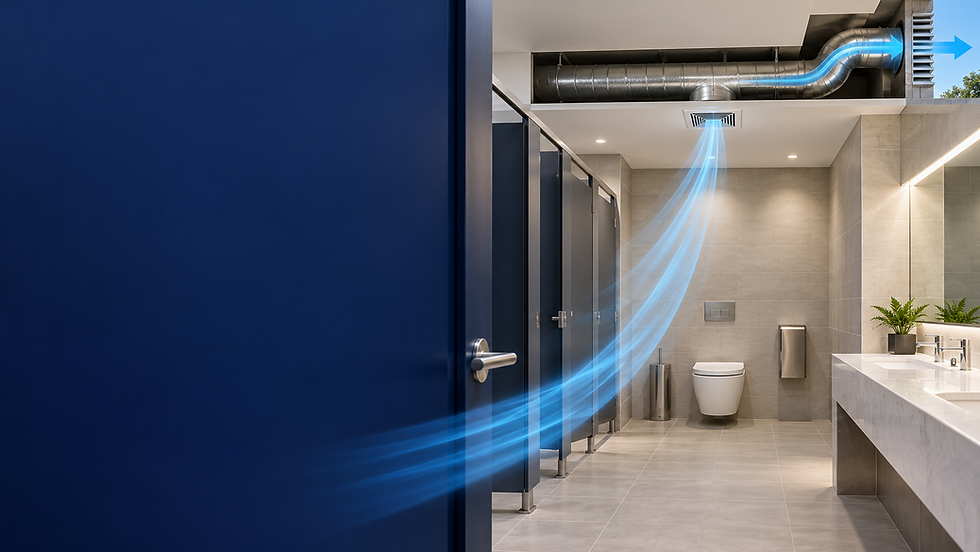
Illustrative image. Not a photograph of a Nexora project or a design detail.
Start with machine exhaust, then balance replacement air and its cooling load.
A laundry can have a large air conditioner and still feel hot and damp. Recirculated cooling does not replace air exhausted by the dryers, and a ceiling grille does not capture steam as reliably as a correctly designed connection at the machine. Start with the equipment, then balance the room and size the coil.
1. Give each machine a defined exhaust path
List each dryer's, flatwork ironer's and ironing station's operating airflow, external pressure limit, outlet size, heat rejection to the room and operating schedule. For vented tumble dryers, route lint-laden exhaust outdoors using the selected manufacturer's duct construction, termination and cleaning requirements. Check fitting losses and the installed pressure at the specified test point; an outlet diameter alone does not establish that a long route will work. Use common ducts or booster fans only where the manufacturer and applicable codes permit them.
A flatwork ironer with a factory vapour outlet should use that connection. For an ironing table, verify whether the connection is for exhaust, vacuum or steam. If local capture is needed, locate it close to the release point and keep supply jets from pushing the plume past the operator. Coordinate any expected condensate with the supplier rather than adding an unapproved drain or restriction.
See the Alliance Laundry tumble dryer manual, Exhaust Requirements and Electrolux Professional ironer installation manual, Section 15 for examples of model-specific requirements. Use Nexora's Ventilation and Exhaust Design Handbook to structure the exhaust schedule and airflow checks.
2. Balance makeup air for each operating mode
At similar air densities, an illustrative schedule might show 0.65 m³/s dryer exhaust, 0.15 m³/s ironer exhaust and 0.10 m³/s general exhaust. With no separate return, 0.75 m³/s of mechanical makeup plus 0.15 m³/s of engineered transfer balances the 0.90 m³/s exhaust. For hotter streams, convert to a common air basis or use mass flow.
Verify the transfer path and room pressure with doors in their normal positions. Check all-on, part-load and standby modes; avoid unintentionally drawing air from a combustion-appliance room. Confirm combustion air separately without double-counting air already included in the machine schedule. See Nexora's makeup-air troubleshooting guide for field checks on general ventilation.
3. Separate room gains from outdoor-air coil load
Room: Count heat and moisture that actually escape into the space, not the full heater input or the vapour already captured in a duct. For a steady, well-mixed room, 3.6 kg/h of uncaptured moisture adds 1 g/kg to an effective net dry-air flow of 1.0 kg/s. If incoming replacement air averages 10 g/kg, the room would settle near 11 g/kg in this simplified example, absent other moisture sources or sinks. For sensible heat, use the air that actually serves the room: 1.0 kg/s delivered 6 K below room temperature provides roughly 6 kW. Don't credit bypass air with cooling the occupied zone.
Makeup-air coil: For a separate 0.80 kg/s dry-air stream cooled from 35°C and 18 g/kg to 16°C and 10 g/kg, the enthalpy drop is approximately 40 kJ/kg. Coil duty is about 32 kW, and moisture removal is about 23 kg/h. These are illustrative air-side loads before fan heat or any reheat. The ASHRAE psychrometrics chapter gives the property relationships. Document the room and coil loads separately with the Cooling Load Design Handbook.
4. Commission the system under load
Verify airflow, machine-outlet static pressure, room pressure and humidity with equipment running. Check the duct route, cleaning access and the approved response to loss of makeup or exhaust. A run signal is not airflow proof. The HVAC Duct Pressure Loss Design Suite can help document design inputs and pressure-loss paths; machine limits and adopted requirements still govern acceptance.


Comments