The Hidden Transition: Navigating the Great HVAC Eco-Refrigerant Pivot

Illustrative AI-generated image. Equipment details are conceptual, not installation instructions.
REFRIGERANT TRANSITION • Lower GWP, energy performance, installation safety and local compliance must be reviewed together.
The refrigerant transition is easy to miss until it reaches a real project: an equipment schedule changes, a familiar refrigerant becomes a procurement question, or a replacement proposal introduces a different safety classification. Behind those details is a wider shift toward refrigerants with lower climate impact and equipment designed to use them responsibly.
Calling a refrigerant “eco” does not establish its efficiency, safety or suitability. Engineers and owners need to evaluate global warming potential, system performance, refrigerant charge, leakage, serviceability and local requirements together. This guide provides a practical framework, with regulatory examples checked in November 2026. Requirements differ by jurisdiction, equipment category and action, so verify the current rules before procurement or installation.
Separate refrigerant impact from energy efficiency
Global warming potential, or GWP, compares the warming influence of a greenhouse gas with that of carbon dioxide over a stated time horizon. A lower-GWP refrigerant can reduce the climate impact of a given mass released. It does not automatically mean that the equipment consumes less electricity.
A useful first-pass distinction is between direct refrigerant emissions and indirect emissions associated with energy use. Direct impact depends on the refrigerant's GWP and the mass released during installation, operation, servicing and retirement. Indirect impact depends on energy consumption and the emissions associated with that energy supply. Broader life-cycle assessments may include manufacturing and other stages as well.
For illustration, releasing 1 kg of a refrigerant with a GWP of 500 represents 500 kg of carbon-dioxide-equivalent emissions using that GWP basis. Releasing 1 kg of another refrigerant with a GWP of 2,000 represents 2,000 kg. These invented example values explain the arithmetic; they are not a comparison of named products or a complete equipment assessment. Background: EPA's explanation of global warming potentials.
There is no single worldwide changeover date
Regulation often distinguishes manufacture, import, sale, installation and servicing. It may also separate factory-built products from field-assembled systems, or apply different limits to chillers, room air conditioners and variable-refrigerant-flow systems. A headline saying “the old refrigerant is banned” can conceal these distinctions.
In the United States, EPA's current Technology Transitions table lists a GWP limit of 700 for residential and light-commercial air-conditioning and heat-pump systems, with a January 1, 2025 compliance date and an important inventory qualification. EPA's May 2026 final rule removed the installation deadline for qualifying systems whose specified components were manufactured or imported before January 1, 2025. This is not permission to treat all old equipment or all HVAC categories identically. Sources: EPA sector restrictions and May 2026 final-rule fact sheet.
In the European Union, Regulation (EU) 2024/573 introduced a separate framework with equipment-specific restrictions and dates. Annex IV differentiates categories, capacities and refrigerant thresholds; some entries include safety-related exceptions. A US equipment decision cannot simply be transferred to an EU project. The European Commission's F-gas legislation overview and the regulation itself are the appropriate starting points.
For every project, identify the country, relevant authority, equipment type and intended action before interpreting a deadline. Distinguish existing-system maintenance from a new installation, and confirm the status of replacement components. Record the applicable rule and review date in the project file.
Understand what A2L does and does not mean
Refrigerant safety classifications describe toxicity and flammability characteristics under defined test conditions. In the ASHRAE classification system, A denotes the lower-toxicity class and 2L denotes a lower-flammability subclass with limited burning velocity. Lower toxicity does not mean harmless, and lower flammability does not mean non-flammable. Source: UNEP/ASHRAE Refrigerant Factsheet, May 2025.
The practical response is to use equipment designed and approved for its refrigerant, installed and maintained by qualified personnel under the applicable rules. Depending on the system and charge, the design assessment may involve room size, refrigerant concentration, piping routes, detection, ventilation and mitigation controls. The required measures come from the relevant standards, adopted codes and equipment instructions, not from a generic internet checklist.
ASHRAE's refrigeration safety resources describe the role of safety standards, including residential provisions addressing allowable refrigerant charge and system arrangements. A training resource can help explain terminology, but it cannot certify a proposed installation or replace the authority having jurisdiction.
A refrigerant change is not a DIY retrofit
Do not add a different refrigerant to an existing system because its label appears environmentally preferable. Equipment compatibility includes the compressor, lubricant, pressure rating, heat exchangers, expansion devices, seals, controls and safety provisions. A proposed conversion needs explicit manufacturer and regulatory support, assessed by a qualified professional. New refrigerant does not make incompatible equipment suitable.
ASHRAE's refrigeration-system handbook chapter notes that retrofitting is not allowed or approved with some refrigerants, including most A2L and A3 applications. Owners should request a documented equipment-specific recommendation rather than a generic “drop-in replacement” assurance.
For readers building their technical foundation, Nexora's HVAC Beginner's Guide is a practical introduction to how heating, ventilation and air-conditioning components connect. It is an educational resource, not refrigerant-handling certification or instructions for modifying a refrigeration circuit.
Procurement needs a better equipment schedule
A useful schedule should identify the exact manufacturer and model, refrigerant designation, safety classification, design charge and applicable performance conditions. Ask for confirmed capacity, electrical input, operating limits and the approved indoor/outdoor component combination where relevant. Keep the manufacturer's installation and service documentation attached to the submittal.
Also ask what changed from the originally specified model. An apparently equivalent replacement may have different dimensions, electrical requirements, controls or installation constraints. Check maintenance clearances, lifting arrangements and service access before the delivery date. These coordination checks are valuable even when the refrigerant itself is fully compliant.
Nexora's HVAC RFI Pack offers a request-for-information register, form and tracker for documenting unresolved questions. A focused RFI might ask the supplier to confirm the approved component combination and identify any changed installation requirements. The form organises the question; the manufacturer and responsible design team must supply and review the technical answer.
Keep the whole-system performance review
Refrigerant selection belongs beside load calculations, distribution design and controls. If the equipment is oversized, poorly balanced or operated outside its intended conditions, a lower-GWP label will not resolve the resulting comfort and energy problems. Compare proposed equipment at the same design conditions and with the same scope of auxiliary loads.
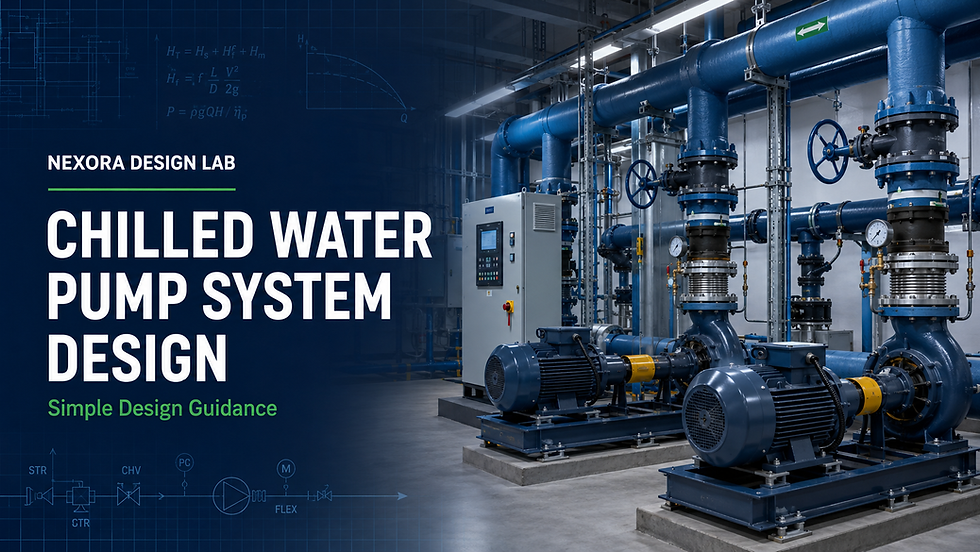
Nexora's HVAC Design Fundamentals connects cooling loads with airflow and equipment coordination. For water-based plant projects, Chilled Water Pump System Design Guidance explains why the load, water flow and hydraulic duty must remain connected. These checks continue to matter when the plant's refrigerant changes.
Build a service and handover record
Maintain an equipment register with model and serial identification, refrigerant type, commissioning information and links to current instructions. Record maintenance, reported leakage, corrective work and qualified service-provider details as required for the project. Plan refrigerant recovery and end-of-life handling through authorised professionals under local requirements.
The HVAC Maintenance Checklist Pack provides general planned-maintenance resources that can help organise routine records. Adapt them to the manufacturer's instructions and applicable rules. They do not establish refrigerant-specific compliance, prescribe a leak-test interval or replace technician training.
The refrigerant pivot rewards careful coordination. Identify the applicable rules, choose an approved system, verify installation constraints and preserve the evidence through handover. A lower-GWP refrigerant becomes part of a credible environmental strategy when it is paired with efficient operation, controlled leakage and a maintainable installation.
Explore the connected HVAC series
Continue with the heat-pump electrification guide to compare equipment performance, or review indoor air quality and ventilation for the occupied-space side of the design.

Comments