MEP BOQ Unit Mapping: Reconcile Metres, Each and Supplier Packs
A quantity export can look tidy while combining millimetres, metres, feet, individual items and supplier packs in one numeric column. Summing that column produces a number with no useful meaning. Another common error happens later: an estimator replaces the reviewed quantity with the rounded ordering quantity, losing the original measurement.
A dependable BOQ workflow keeps three records connected: the source quantity, a normalized quantity in the chosen reporting unit, and any proposed purchase quantity. This article develops that connection using original arithmetic examples. It addresses quantity data and ordering units; material selection and installation details remain outside its scope.
1. Give every quantity a measurement basis
Start with a small unit dictionary. For each item code, record the description, source unit, reporting unit, conversion factor, measurement basis and source reference. Define aliases explicitly: “No.” and “ea” may both mean individual items in one project, while “set” requires a list of what belongs to that set. Never infer set contents from a short description.
A metre of centreline pipe and a metre of cut stock share a dimension but describe different records. Likewise, gross area and net area cannot be merged simply because both use m². The buildingSMART IFC 4.3.2.0 definition of length quantities recognizes that a reported length depends on its measurement rules. Record those rules before combining sources.
For model-derived quantities, inspect exported unit information. buildingSMART’s unit-assignment documentation describes project-level units and possible local assignments. A model’s displayed dimensions are therefore insufficient evidence for an unexplained number in a downstream file. Keep the original value and unit beside the conversion rather than overwriting them.
2. Normalize first, aggregate second
Assume four reviewed source rows describe non-overlapping lengths of the same pipe item, measured on the same agreed basis. Their quantities are 18,450 mm, 7,650 mm, 11.2 m and 40 ft. For this example, ft means the international foot. NIST’s exact conversion table gives 1 ft = 0.3048 m.
18,450 mm × 0.001 m/mm = 18.450 m.
7,650 mm × 0.001 m/mm = 7.650 m.
11.2 m × 1 = 11.200 m.
40 ft × 0.3048 m/ft = 12.192 m.
The normalized total is 18.450 + 7.650 + 11.200 + 12.192 = 49.492 m. It can display as 49.49 m while the underlying calculation retains 49.492 m. The displayed decimal places describe reporting precision; they do not improve the accuracy of the original measurement. Conversion and rounding rules should be visible to the reviewer.
Keep dimensions in the calculation. Millimetres convert to metres by 0.001, but square millimetres convert to square metres by 0.000001. A length factor cannot be applied unchanged to an area. Reject any attempted sum of unlike dimensions, and investigate a blank unit instead of automatically treating it as the project default.
3. Translate to purchase units without changing the BOQ
Assume 46 identical, interchangeable grilles are required and the selected supplier sells them in cartons of four. Assume no spare allowance, no loose-item supply and no existing inventory. The order calculation is ceiling(46/4) = 12 cartons, which contain 48 grilles. The carton count is 12; the each quantity is 48; the reviewed requirement remains 46.
Now suppose the same supplier also lists an outer case containing five cartons. The nested conversion is 1 case × 5 cartons/case × 4 each/carton = 20 each. If only full cases can be ordered, ceiling(46/20) = 3 cases, containing 60 grilles. Do not multiply the twelve-carton quantity by twenty each per case: that would apply a factor belonging to a different purchase unit.
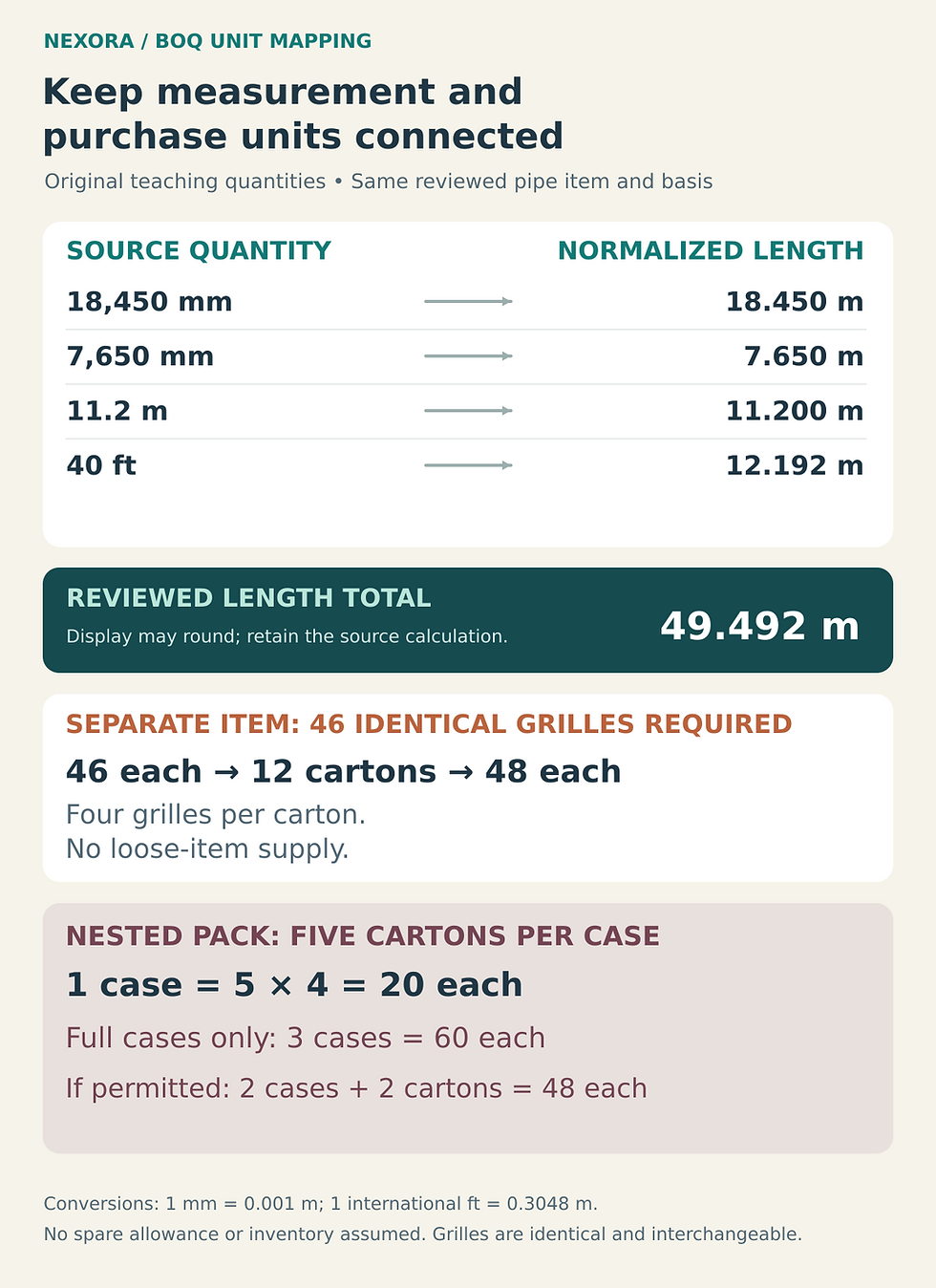
Original teaching examples. The grille pack sizes, permitted order combinations and pooling conditions are assumed, not supplier product data. Lengths and grille counts are separate items.
If the supplier permits a mixture of full cases and separate cartons, two cases plus two cartons contain 2 × 20 + 2 × 4 = 48 grilles. This is the same each quantity as twelve cartons, represented by a different ordering breakdown. Record the permitted order combinations and current packaging data. Pack conversion alone does not establish which combinations the supplier will accept.
Pooling matters. If two zones need 23 grilles each and can share one delivery pool, 12 cartons cover both. If each zone must receive its own unopened cartons, each requires six cartons, again 12 here. Change the requirements to 21 and 25: pooling still needs 12 cartons, while separate rounding needs six plus seven, or 13. State the grouping boundary before applying a ceiling function.
4. Build a mapping that survives another export
Retain source document, revision, sheet or model reference, and the original row identifier.
Separate source quantity, normalized quantity and proposed purchase quantity into named fields.
Store supplier item code, pack content, purchase unit and effective date with the pack conversion.
Record whether rounding occurs by item, delivery lot, location or another agreed group.
Use an exception status for missing units, ambiguous sets and unmatched supplier descriptions.
Apply pack rounding only after grouping quantities that can genuinely share the same purchased item. Similar descriptions do not prove interchangeability. Size, finish, handedness, included accessories or packaging may create separate item codes. A conversion map should reference the reviewed specification and supplier description without silently substituting one product for another.
5. Test the handoff in both directions
Check the reverse arithmetic: 12 cartons × four each per carton must return 48 each. Three cases × five cartons per case × four each per carton must return 60 each. Then compare these purchase totals against the normalized requirement with a separately labelled difference. The test catches reversed factors, confused pack sizes and the accidental use of carton counts as individual-item counts.
Before issuing the quantity register, sample one row from every source format and purchase unit. Confirm that the source can be found, the conversion is reproducible, the grouping boundary is documented and the rounding explanation is appropriate. Preserve unresolved lines in an exception report rather than making them disappear from the total.
The useful output is a connected record: what was measured, how its unit was normalized, and how a supplier quantity was derived. Keeping those stages visible makes the BOQ easier to review and the purchasing handoff easier to explain when a pack size, delivery split or source export changes.



Comments