Pipe Insulation Takeoff: Separate Outer Jacket Area from Insulation Volume

AI-generated illustrative scene, not a product screenshot or a completed-project photograph. The worked calculation below uses explicit example inputs.
Insulation and its outer covering share the same pipe route, but they do not share the same quantity basis. Insulation volume occupies an annular space around the pipe. A thin outer jacket covers the outside circumference. Purchased preformed sections may instead be counted by length and nominal product size. Using one number for all three can make a takeoff look consistent while hiding a dimensional error.
This article is a geometric quantity example for a uniform, straight cylindrical run. It does not select insulation thickness, establish condensation control, calculate heat loss or verify fire performance. The insulation system, vapour-control details and covering specification require their own design review. The stated dimensions are assumed inputs for arithmetic, not a recommendation for a particular service or jurisdiction.
1. Start with actual outside dimensions
Assume a pipe outside diameter of 114.3 mm, uniform radial insulation thickness of 40 mm and net straight insulated length of 80 m. Treat the insulation as a concentric cylinder with no gaps or compression. Ignore the thickness of the outer jacket in the surface calculation. These assumptions make the geometric boundary clear; actual products may require manufacturer-specific dimensions and fabrication allowances.
Pipe outside diameter Dp = 114.3 mm = 0.1143 m.
Radial insulation thickness t = 40 mm = 0.0400 m.
Insulation outside diameter Do = Dp + 2t = 0.1943 m.
Straight insulated length L = 80 m.
The thickness is added twice because diameter spans insulation on both sides of the pipe. Adding only 40 mm would confuse radial thickness with a diameter increase. Equally, a nominal pipe designation is not automatically the physical outside diameter. Use the approved pipe dimensions and selected insulation configuration, then convert all lengths into a consistent unit before calculating square or cubic quantities.

Original illustrative quantity/statistics diagram. Assumptions and scope are stated in the worked example.
2. Calculate the net outer covering area
The curved surface of a cylinder is its circumference multiplied by length. For a thin covering around the insulation, use the outside insulation diameter, not the bare pipe diameter. This gives the net cylindrical covering area before overlaps, seams, cutting loss, fittings or removable components. It also excludes the two annular end faces; this example is not a total exposed-surface calculation.
Net outer curved area = π × Do × L.
A = π × 0.1943 × 80 = 48.8329 m², reported as 48.83 m².
Using the bare pipe diameter would give π × 0.1143 × 80 = 28.73 m².
Difference in geometric bases = 20.11 m².
The difference is not a measured material saving or a recommended purchase allowance. It simply shows why the selected diameter matters. If the covering has a specified longitudinal lap, model that lap separately using the fabrication arrangement. Circumferential joints between sections introduce another allowance. A generic percentage can conceal both the assumed sheet layout and whether those details have already been included in a supplier's coverage figure.
3. Calculate the insulation volume as an annulus
The material occupies the outer cylinder minus the inner cylinder. With diameters in metres, subtract the squares before multiplying by π/4 and length. This is a net geometric volume. It does not include density, compression, joint adhesive, packaging voids or manufacturing tolerances, and it does not indicate the order quantity for a particular preformed product.
V = (π/4) × (Do² − Dp²) × L.
V = (π/4) × (0.1943² − 0.1143²) × 80.
V = 1.55119 m³, reported as 1.551 m³.
A useful independent check uses the mean circumference through the insulation thickness. The mean diameter is Dp + t, or 0.1543 m. Multiplying π × 0.1543 × 0.0400 × 80 also gives 1.55119 m³. For this concentric annulus the equivalence is exact, not a thin-wall approximation. Using the outer circumference times thickness would overstate the annular volume because it treats every radial layer as if it had the largest circumference.
4. Keep fittings and procurement outside the straight-run total
An elbow, tee, valve box or removable cover is not represented by adding its centreline length to this uniform-cylinder formula without checking the measurement rule. List fittings and accessories separately according to the contract and product system. Confirm how insulation terminates at supports, equipment connections, flanges and inspection points. Do not turn an estimating shortcut into an instruction to omit a required component.
For preformed sections, record the approved size, thickness and usable section length. If an illustrative product section covers 1 m, an uninterrupted 80 m route has a theoretical baseline of 80 sections. That is not a final order: cuts, branches, lengths between fittings, supplier packs and approved joint details still matter. Retain the net baseline alongside the procurement build-up so reviewers can see what each adjustment represents.
5. Review the quantity before attaching a rate
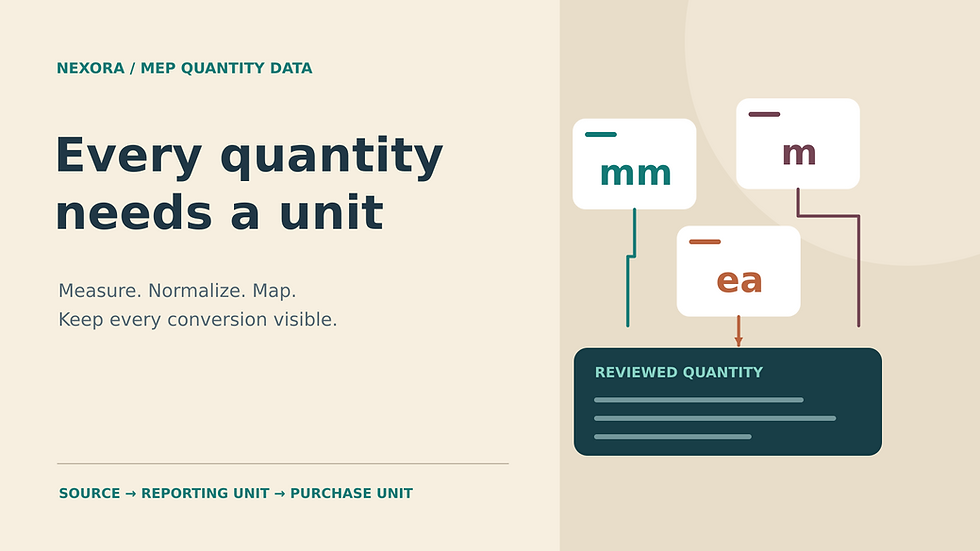
A rate per metre of preformed insulation, a rate per square metre of jacket and a rate per cubic metre of material cannot be applied interchangeably. Put the unit and included work beside each quantity. Record whether accessories, seams, waste, support details and fitting labour are included in that rate or measured elsewhere. This prevents duplicate allowances as well as omissions.
Round final quantities for reporting, but preserve unrounded calculations in the takeoff. Check one representative line manually, verify the dimensional source and reconcile the straight length to the approved drawing revision. The defensible result is three distinct records: the net geometry, the specification-dependent additions and the supplier order basis. None substitutes for the thermal, moisture or safety design of the insulation system.
Continue the calculation review
Sources and calculation basis
Primary references checked on 26 October 2026. The worked examples and diagrams are original illustrative calculations, not manufacturer selections or project approvals. Apply the stated limitations and the requirements governing the actual project.

Comments