Provisional MEP Quantities and Firm Rates: Check Tender Exposure
A firm unit rate does not make the final commercial result predictable when the measured quantity remains provisional. Reduced quantities can leave fixed costs unrecovered; increased quantities can trigger extra supervision, access or staging costs. Test the quantity range against the way the work will actually be delivered before approving the tender.
The worksheet described here is an internal estimating tool. It does not establish contract entitlement, a right to reprice, or a legal interpretation of “provisional.” Use the tender’s exact definitions and have the contract administrator or appropriate adviser resolve ambiguous valuation and adjustment provisions.
1. Establish the quantity and rate rules first
Identify whether the item is remeasured, paid as a lump sum, or governed by another stated mechanism. Record the measurement unit, inclusions, applicable drawings, quantity basis and the point at which quantities become agreed. A provisional quantity and a provisional sum may have different contractual meanings; a familiar label is insufficient evidence of the payment rule.
Which quantity will be used for payment, and who measures or certifies it?
Does the rate remain applicable across the expected quantity range?
Are there stated thresholds, notice requirements or valuation procedures for changes?
Which mobilization, attendance, testing and temporary-work costs are included in the rate?
What happens if the item is omitted, divided into phases or moved to a different working condition?
Give each answer a clause or document reference. Where the answer is missing, create a tender query rather than embedding an optimistic interpretation in the spreadsheet. Keep unresolved commercial assumptions visible to the person approving the bid.
2. Separate quantity-driven costs from fixed and stepped costs
Build the internal model around three behaviours. Variable costs increase with measured units under the assumed working conditions. Fixed costs remain even if fewer units are completed. Stepped costs arise when a defined capacity or delivery threshold is crossed. Real project costs can have mixed behaviour, so state the simplification being used.
For an MEP package, variable costs might include material and installation effort per metre. An item-specific setup cost might remain at lower volume. A second work zone might require another access arrangement or supervisor. Avoid allocating the same fixed cost both to the item and to project preliminaries.
The GAO Cost Estimating and Assessment Guide includes ground rules, assumptions, sensitivity analysis and updating estimates among its core estimating practices. Those principles support keeping this model traceable: every fixed amount, variable allowance and threshold needs a documented basis.
3. Run a transparent numerical example
Assume a hypothetical MEP item is paid by actual measured quantity at a firm rate of 100 cost units per metre. Direct variable cost is 72 cost units per metre. Item-specific fixed cost is 18,000 cost units. The tender quantity is 1,000 m. These invented cost units are for arithmetic only, not market prices or a recommended rate; tax, finance costs and wider company overhead are excluded.
For this example, measured revenue equals quantity multiplied by 100. Modelled item cost equals quantity multiplied by 72, plus 18,000. The residual is the amount remaining after only the modelled costs. It should not be presented as net company profit.
At 600 m: revenue is 60,000; variable cost is 43,200; total modelled cost is 61,200; residual is negative 1,200 cost units.
At 1,000 m: revenue is 100,000; variable cost is 72,000; total modelled cost is 90,000; residual is positive 10,000 cost units.
At 1,400 m: revenue is 140,000; variable cost is 100,800; total modelled cost is 118,800; residual is positive 21,200 cost units before any stepped cost.
The variable contribution is 28 cost units per metre. Dividing fixed cost of 18,000 by 28 gives a break-even quantity of approximately 643 m, provided all other assumptions remain valid. Below that quantity, this item does not recover its modelled costs. Break-even is an internal warning point, not a contractual threshold or a guarantee of project profitability.
4. Add the delivery condition that changes the result
Now assume quantities above 1,200 m require an additional work zone with a documented one-time cost of 8,000 cost units. At 1,400 m, total modelled cost becomes 126,800 and the residual falls to 13,200. The larger quantity still helps relative to the base case, but the benefit is smaller than a straight-line calculation suggests.
Test working conditions separately from quantity. For example, if restricted access raises variable cost from 72 to 80 cost units per metre at the base quantity, the residual becomes 2,000 instead of 10,000. Do not hide this productivity change inside a quantity percentage. It needs a separate assumption, evidence and possible mitigation.
The UK government’s Cost Estimating Guidance stresses traceable assumptions and ranges linked to scope, design, schedule and risk. For this worksheet, choose lower and upper quantities from identifiable design alternatives or measured uncertainty. A convenient percentage without a project basis can produce precise-looking but unhelpful results.
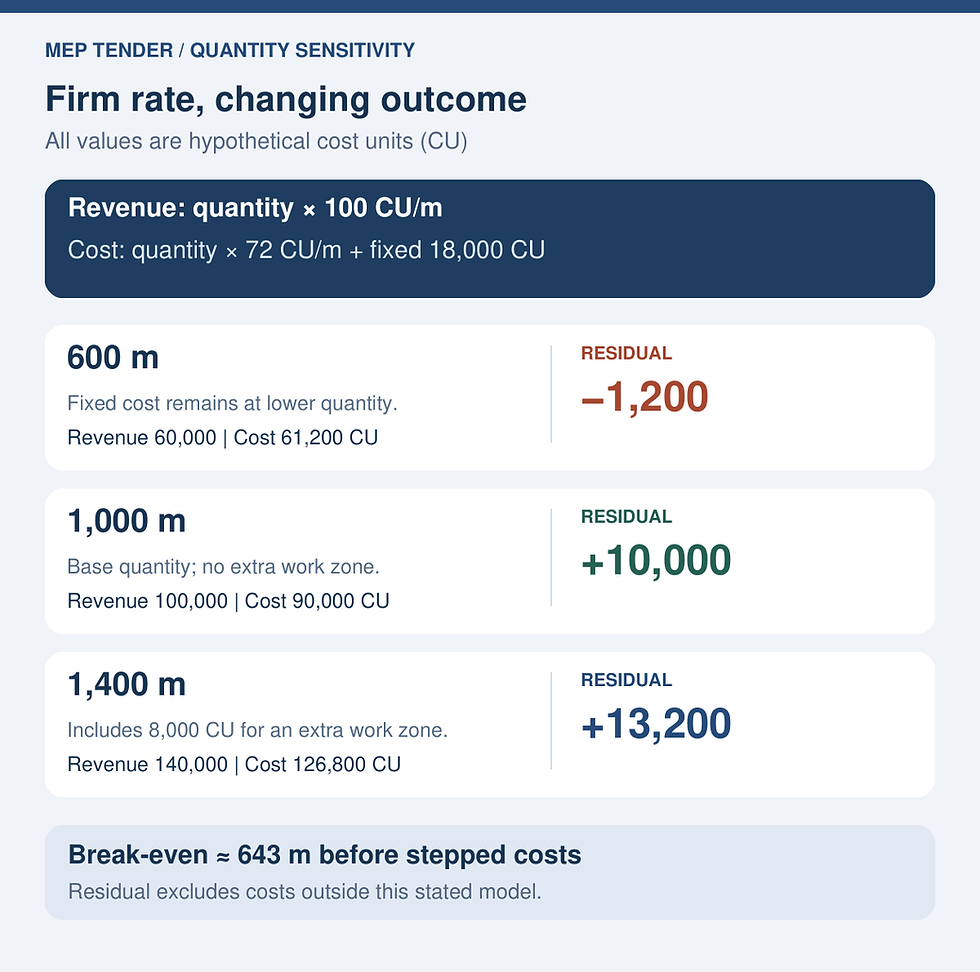
Illustrative cost units only. Residual excludes costs outside the stated model; scenario quantities and the extra-work-zone threshold are assumptions, not contractual entitlements.
5. Turn the scenarios into tender decisions
List the items with the largest residual deterioration under credible lower quantities or changed delivery conditions. Prioritize those for review.
Ask whether any permitted tender structure can identify fixed work separately. Do not alter the mandatory pricing format without authorization.
Check that supplier commitments, minimum order quantities and cancellation exposure match the quantity scenarios.
Assign each uncertainty to a query, design decision, qualification where permitted, or consciously approved risk allowance.
Retain the scenario sheet with the tender approval so the awarded scope can be compared with the assumptions later.
Contract provisions can be highly specific. For example, the US federal FAR 52.211-18 clause provides a defined mechanism for certain estimated unit-priced construction quantities. It is an example of why the actual incorporated clause matters; its thresholds and procedures must not be imported into another jurisdiction or contract.
Keep the warning points visible after award
Update the model when coordinated quantities, delivery zones or work access become clearer. Track the forecast quantity against the internal break-even point and any separately identified contract notice points. Escalate a material change early enough for the responsible commercial team to evaluate it. The useful output is a decision with evidence, not simply a wider contingency percentage.
For a structured approach to reviewing MEP estimates, explore the paid MEP Estimators Handbook and use it alongside your project-specific quantity and cost records.



Comments