Condensate Drain Pipe Insulation: Types, Applications, Advantages, and Disadvantages
Updated: 3 days ago
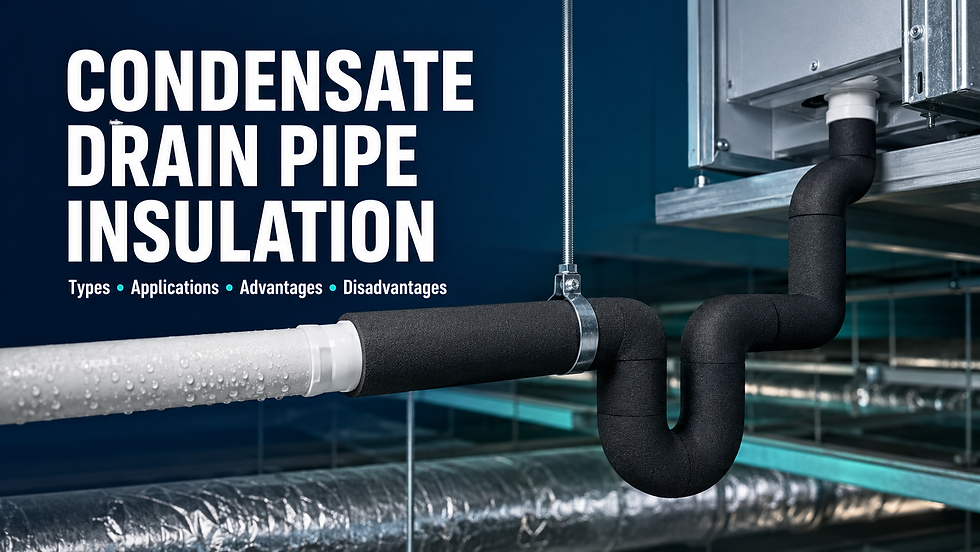
Condensate drain piping is an essential part of air-conditioning and refrigeration systems. Its purpose is to safely carry water collected from cooling coils, drain pans, and other moisture-producing equipment to an approved discharge point.
Although the water inside a condensate pipe is usually not extremely cold, its temperature can be lower than the dew-point temperature of the surrounding air. If the pipe surface falls below the dew point, moisture from the air condenses on the outside of the pipe. This phenomenon is commonly called “pipe sweating.”
Proper insulation prevents surface condensation, protects ceilings and finishes, reduces corrosion risk, and supports hygienic operation. However, the insulation must be selected and installed correctly. Insulation without a continuous vapor barrier can sometimes make the problem worse by trapping moisture around the pipe. (Condensate Drain Pipe Insulation: Types, Applications, Advantages, and Disadvantages)
1. Why Condensate Drain Pipes Require Insulation
Water leaving an air-conditioning coil is normally close to the coil’s operating temperature. Depending on the system, the condensate water temperature may commonly fall within approximately 10°C to 18°C.
In hot and humid locations, the surrounding air may have a dew-point temperature higher than the external surface temperature of an uninsulated drain pipe. When this occurs, water droplets form on the pipe surface.
Condensate pipe insulation helps to:
Download the full design guide PDF with detailed calculations, fan sizing, code compliance, and real project insights. Built for HVAC engineers and MEP consultants. (Condensate Drain Pipe Insulation: Types, Applications, Advantages, and Disadvantages)
For detailed calculations, project-specific design, and authority-compliant solutions, contact our engineering team.
Email : info@nexoradesign.net
Phone : +94 76 720 5408
Web : www.nexoradesign.net
Read related blogs
Water Supply Pipe Insulation: Types, Applications, Advantages and Disadvantages
Chilled-Water Pipe Insulation: Types, Applications, Advantages and Disadvantages
How to Design an Outdoor Cooling System for a Park
HVAC Duct Insulation: Types, Applications, Advantages and Disadvantages
How to Design a Staircase Pressurization System for a High-Rise Building
How to Design a Ventilation System for a Generator Room
How to Design a Ventilation System for an Industrial Warehouse Building
Sizing pipework on a live project? The MEP Pipe Design & Sizing Handbook covers chilled water, refrigerant, fire protection and plumbing/drainage piping with governing formulas, code references and worked examples.


Comments