Water Supply Pipe Insulation: Types, Applications, Advantages and Disadvantages
Updated: 3 days ago
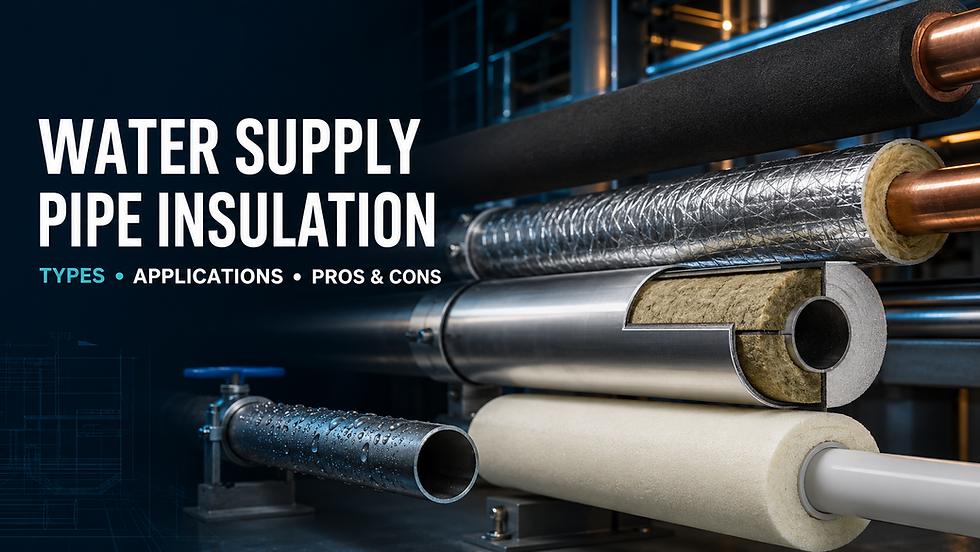
Water supply pipe insulation is an essential part of a well-designed plumbing system. Although pipes can operate without insulation in some conditions, an uninsulated system may experience condensation, heat loss, unwanted heat gain, freezing, corrosion, excessive energy consumption and uncomfortable water temperatures.
Selecting the correct insulation requires more than choosing a material based on price. The designer must consider the pipe service, operating temperature, surrounding environment, moisture exposure, fire performance, required insulation thickness and long-term maintenance.
This guide explains the main types of water supply pipe insulation, where each material is used, and their advantages and limitations. (Water Supply Pipe Insulation: Types Applications Advantages and Disadvantages)
1. Why Water Supply Pipes Need Insulation
Pipe insulation performs several important functions.
Condensation control
Cold-water pipes can operate below the surrounding air’s dew-point temperature. When this happens, moisture from the air condenses on the pipe surface.
Download the full design guide PDF with detailed calculations, fan sizing, code compliance, and real project insights. Built for HVAC engineers and MEP consultants. (Water Supply Pipe Insulation: Types, Applications, Advantages and Disadvantages)
For detailed calculations, project-specific design, and authority-compliant solutions, contact our engineering team.
Email : info@nexoradesign.net
Phone : +94 76 720 5408
Web : www.nexoradesign.net
Read related blogs
Chilled-Water Pipe Insulation: Types, Applications, Advantages and Disadvantages
How to Design an Outdoor Cooling System for a Park
HVAC Duct Insulation: Types, Applications, Advantages and Disadvantages
How to Design a Staircase Pressurization System for a High-Rise Building
How to Design a Ventilation System for a Generator Room
How to Design a Ventilation System for an Industrial Warehouse Building
How to Design Ventilation System for Pump Room
Sizing pipework on a live project? The MEP Pipe Design & Sizing Handbook covers chilled water, refrigerant, fire protection and plumbing/drainage piping with governing formulas, code references and worked examples.


Comments