Dehumidification Calculation for Indoor Swimming Pools: Types of Systems, Design Methodology, and Cost Analysis
Updated: Sep 29
Introduction

Indoor swimming pools are among the most technically demanding spaces in HVAC and building services engineering. Many designers initially focus on water heating, air temperature, or ventilation rates, but in practice the dominant challenge is often moisture management. If dehumidification is under-designed, the consequences are severe: persistent condensation on glazing and steel, corrosion of structural members, mold growth, deterioration of finishes, occupant discomfort, poor visibility, slippery surfaces, and major lifecycle cost escalation.
Unlike a conventional occupied space, an indoor pool is a continuous latent load generator. The water surface behaves as a large evaporative source. The evaporation rate changes with water temperature, air temperature, room relative humidity, water activity, swimmer density, and airflow across the water surface. A pool hall can therefore look acceptable during commissioning, then fail badly once occupancy rises, covers are not used, outside weather changes, or control sequences are not tuned properly.
From a consulting and developer perspective, indoor pool design is not just a comfort issue. It is a risk-control and capital-protection issue. Poor dehumidification design can destroy façade systems, shorten equipment life, trigger recurring complaints, and create a maintenance burden that is disproportionately high relative to the project size. On the other hand, a properly engineered system can reduce corrosion risk, stabilize indoor conditions, lower energy use, and significantly improve operational predictability.
For premium projects such as hotels, health clubs, sports complexes, residential towers, therapy pools, schools, and competition facilities, the engineer must go beyond rule-of-thumb design.
The correct approach requires:
calculating evaporation load properly,
sizing moisture removal capacity,
evaluating outdoor air contribution,
selecting the right type of dehumidification system,
coordinating envelope and air distribution design,
checking energy recovery opportunities,
and assessing capital versus operating cost.
This article explains indoor pool dehumidification from a practical engineering standpoint. It is written for MEP engineers, consultants, and developers who need consulting-grade clarity rather than generic textbook summaries. The focus is on real design workflow, calculation logic, system selection, engineering judgement, and financial implications. (Dehumidification Calculation for Indoor Swimming Pools)
Swimming Pool Dehumidification: Quick Sizing Method
Indoor pool dehumidification is sized from the water evaporation rate, not from the room cooling load. The ASHRAE natatorium method (HVAC Applications) in SI units is:
Wp = (A / Y) × (pw − pa) × (0.089 + 0.0782 V) × Fa
Wp = evaporation rate, kg/s
A = pool water surface area, m²
Y = latent heat at the water surface temperature, about 2,400–2,450 kJ/kg
pw = saturation vapour pressure at the water temperature, kPa
pa = partial vapour pressure of the room air at design conditions, kPa
V = air velocity over the water surface, m/s (typically 0.05–0.15)
Fa = activity factor
Typical Activity Factors (ASHRAE)
Residential pool: 0.5
Condominium or therapy pool: 0.65
Hotel pool: 0.8
Public or school pool: 1.0
Whirlpool or spa: 1.0
Wave pool or water slides: 1.5 or higher
Typical Design Conditions
Room air 1–2 °C above the water temperature to limit evaporation
Relative humidity 50–60%
Water at 26–28 °C for recreational pools; higher for therapy pools and spas
Slightly negative room pressure so moist air does not migrate into adjacent spaces
Worked check: a 25 m × 12.5 m hotel pool (A = 312.5 m²) with 28 °C water (pw ≈ 3.78 kPa), room air at 29 °C and 55% RH (pa ≈ 2.21 kPa), V = 0.1 m/s, Y = 2,435 kJ/kg and Fa = 0.8 gives Wp ≈ (312.5 / 2,435) × 1.57 × 0.0968 × 0.8 ≈ 0.0156 kg/s, or about 56 kg/h of moisture to remove before outdoor-air and occupant loads are added.
Fundamentals of Indoor Pool Dehumidification
Why Swimming Pools Need Dedicated Moisture Control
The central issue in an indoor pool hall is the evaporation of water from the pool surface into the surrounding air. When water molecules leave the surface, they absorb latent heat and increase the moisture content of the room air. If that moisture is not removed or diluted, relative humidity rises. Once room air reaches dew point against cold surfaces, condensation starts.
This means the HVAC system for a pool is not primarily a “cooling-only” or “ventilation-only” system.
It is a psychrometric control system with the following objectives:
Maintain acceptable indoor relative humidity.
Maintain pool hall dry-bulb temperature.
Prevent condensation on walls, roof, and glazing.
Provide outdoor air for IAQ and code compliance.
Recover energy wherever practical.
Protect building fabric against corrosion and moisture damage.
In ordinary comfort air conditioning, sensible cooling often dominates. In a pool hall, the latent load can be the defining parameter. Therefore, a designer who sizes the system only from sensible heat gains will almost certainly under-design the plant.
Recommended Indoor Design Conditions
Typical indoor pool hall design targets are often in the range of:
Air temperature: 1°C to 2°C above pool water temperature
Water temperature: commonly 26°C to 30°C depending on pool type
Relative humidity: typically 50% to 60%, sometimes up to 65% depending on project and envelope strategy
Practical ranges by application:
Competition pool: water 26°C to 28°C
Hotel/leisure pool: water 28°C to 30°C
Therapy pool: water 32°C to 34°C
Pool hall RH target: 50% to 60%, sometimes 55% as design basis
Why keep air temperature slightly above water temperature? Because cooler air over warmer water accelerates evaporation and increases bather discomfort upon exiting the pool. Slightly warmer air reduces the perceived chill effect.
Why not simply keep humidity very low? Because aggressively lowering RH increases evaporation and can significantly increase energy consumption. Pool design is therefore a balance between comfort, condensation prevention, and operating cost.
The Physics of Evaporation
Evaporation occurs when the vapor pressure at the water surface exceeds the partial vapor pressure of water in the surrounding air. In simple terms:
warmer water increases vapor pressure,
lower room RH increases the vapor pressure difference,
higher air velocity over the water surface increases mass transfer,
more swimmer activity disrupts the water surface and increases evaporation.
This is why the same pool can have very different moisture loads during:
unoccupied standby condition,
moderate hotel use,
heavy public occupancy,
training sessions,
wave or splash activity.
From field experience, one of the most common design mistakes is using a single simplistic evaporation figure without considering usage profile. That usually results either in oversized plant with poor part-load performance or undersized plant that cannot maintain RH during peak activity.
Read related articles :
Why Condensation Is Dangerous in Pool Buildings
Condensation is not merely an aesthetic issue. In indoor pools it often leads to:
corrosion of steel roof trusses and connectors,
failure of suspended ceilings,
degradation of aluminum framing,
mold within concealed cavities,
staining of finishes,
damage to glazing seals,
premature failure of electrical fixtures,
slippery perimeter surfaces and safety risks.
Pool buildings are especially vulnerable because the air contains not only moisture but often chloramine-laden contaminants. These compounds accelerate corrosion. Once high humidity and chemical-laden air are present near cold surfaces or poorly ventilated voids, building damage can progress rapidly.
For that reason, HVAC design must be coordinated with:
envelope U-values,
glazing performance,
air throw patterns,
pressurization,
exhaust locations,
plant room material selection,
and maintenance access.
Fundamentals / Theory
Key Psychrometric Concepts (Dehumidification Calculation for Indoor Swimming Pools)
A pool dehumidification design requires a clear understanding of the following:
Dry-Bulb Temperature
The standard air temperature measured by a thermometer.
Relative Humidity (RH)
The percentage ratio of actual moisture in the air relative to the maximum moisture the air can hold at that temperature.
Humidity Ratio
The mass of water vapor per mass of dry air, usually expressed as kg/kg dry air.
Dew Point
The temperature at which moist air becomes saturated and starts condensing. This is critical for checking window and envelope condensation risk.
Latent Heat
The energy associated with phase change of water. For evaporation at pool conditions, latent heat is approximately 2,430 to 2,500 kJ/kg, depending on temperature.
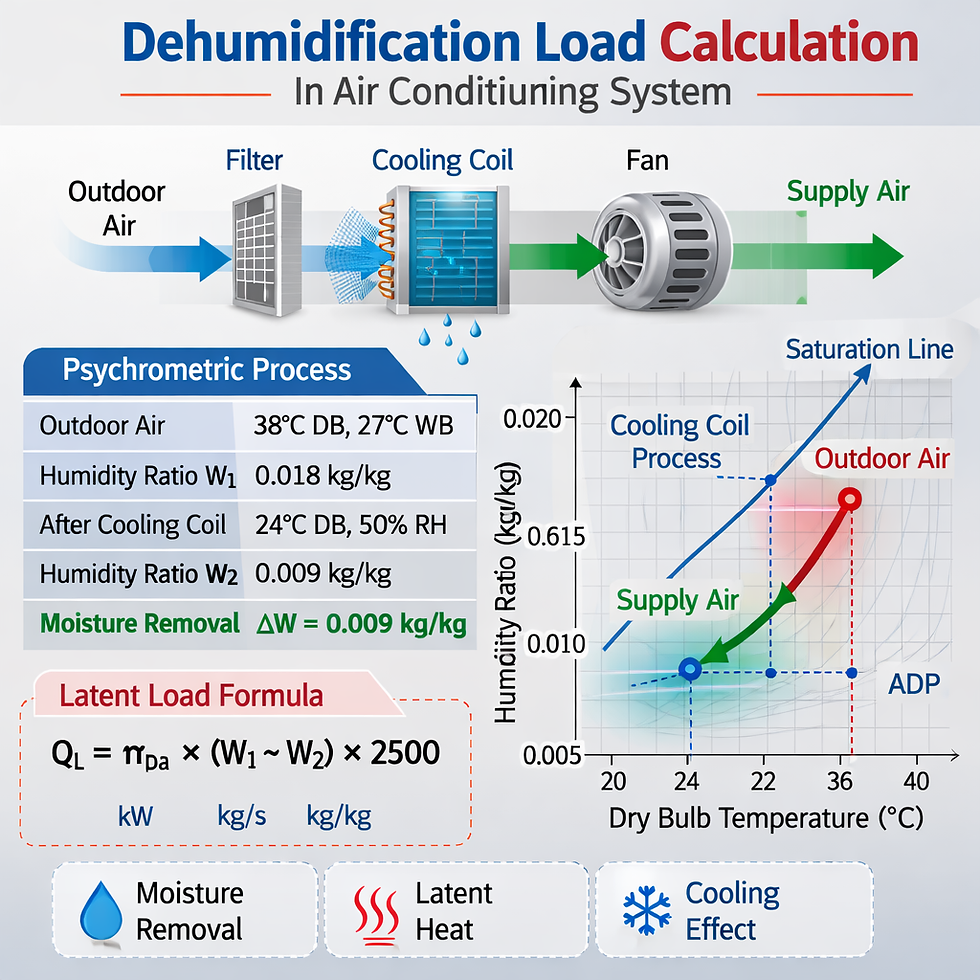
In practical HVAC design, if you know the evaporation rate in kg/h, the latent load can be approximated as:
QL=m˙evap×hfg
Where:
QL = latent heat load (kW)
m˙evap = evaporation rate (kg/s)
hfg = latent heat of vaporization (kJ/kg)
Sensible and Latent Behavior in Pool Halls
A pool hall has both sensible and latent loads:
Sensible Loads
transmission through envelope,
solar gain through glazing,
lighting,
pumps and equipment within the hall,
occupants,
outdoor air sensible load,
heating requirement in winter.
Latent Loads
evaporation from water surface,
shower and wet deck moisture,
occupants to some extent,
outdoor air latent load.
In many climates and use cases, the pool water evaporation dominates the latent side. Therefore, dehumidification capacity is normally based first on moisture generation, then cross-checked against room temperature control and ventilation needs.
Relationship Between RH Control and Energy Use
This is a major commercial issue for developers.
Suppose the operator asks for 45% RH because “drier must be better.” In reality:
lower RH increases the vapor pressure difference,
higher vapor pressure difference increases evaporation,
higher evaporation increases both latent load and pool water heat loss,
the system works harder and energy consumption rises.
That means an over-aggressive RH target can create:
larger dehumidifiers,
higher electric demand,
higher reheat requirement,
increased pool water heating energy.
From an ROI viewpoint, controlling at 55% to 60% RH instead of 45% to 50% RH can reduce annual energy significantly, provided condensation risk remains controlled through good envelope design and supply air distribution.
Detailed Technical Explanation
Main Sources of Moisture Load in an Indoor Pool
1. Pool Surface Evaporation
This is the dominant component. It depends on:
water surface area,
water temperature,
room air temperature,
room RH,
activity factor,
air velocity above water.
2. Wet Deck Evaporation
Surrounding wet surfaces can add noticeable latent load, especially in high-traffic leisure pools with splash zones.
3. Spa / Jacuzzi Features
Spas, hot tubs, water jets, and waterfalls sharply increase evaporation because of higher water temperature and disturbed surface.
4. Outdoor Air
In humid climates, ventilation air can add a large latent burden. In dry climates, outdoor air can help dehumidification.
5. Occupancy-Related Moisture
People exiting showers, water droplets on bodies, and carried moisture can add to the total, though typically less than the water surface itself.
Types of Indoor Pool Dehumidification Systems
Selecting the right system is as important as getting the numbers right.
Type 1: Refrigerant-Based Pool Dehumidifier (DX Dehumidifier)
This is a packaged unit using a refrigeration cycle:
moist return air passes over a cooling coil,
moisture condenses,
the air is then reheated using recovered condenser heat,
sometimes additional heat is rejected to pool water or outdoor air.
Advantages
compact packaged solution,
good latent control,
condenser heat recovery available,
widely used for small to medium pools,
relatively straightforward controls.
Limitations
performance depends on operating conditions,
may require supplementary heating,
outdoor air handling capability may be limited unless specifically configured,
larger units can become expensive.
Typical Applications
hotel pools,
apartment/residential pools,
school pools,
moderate-sized leisure facilities.
Type 2: Desiccant Dehumidification System
These systems use a desiccant wheel or medium to absorb moisture from air, followed by regeneration using heat.
Advantages
strong latent control,
effective in low dew-point applications,
useful where very dry air is required,
can outperform cooling-coil-only methods in some special cases.
Limitations
higher capital cost,
regeneration heat required,
more complex system,
often not first choice for standard pool halls unless special conditions apply.
Typical Applications
specialty natatoriums,
aggressive humidity control requirements,
low-temperature environments,
facilities with available waste heat.
Type 3: Outdoor Air / Ventilation-Driven Dehumidification
In dry climates, a large amount of outdoor air can help remove moisture simply by dilution and exhaust.
Advantages
conceptually simple,
may work well in hot-dry or cool-dry climates,
lower reliance on mechanical moisture removal.
Limitations
ineffective or very expensive in humid climates,
large heating/cooling energy penalty,
difficult to control accurately,
often unsuitable as sole strategy for premium indoor pools.
Typical Applications
very dry climates,
standby mode support,
hybrid systems rather than standalone approach.
Type 4: Heat Pump Pool Dehumidification System
This is often the preferred premium solution. It combines:
refrigeration-based dehumidification,
air reheat,
heat recovery to pool water,
optional outdoor condenser,
integrated ventilation section.
Advantages
high energy recovery potential,
one of the most efficient solutions,
stable humidity control,
useful recovery of latent heat that would otherwise be wasted.
Limitations
higher initial cost than basic packaged AHU,
requires proper controls and commissioning,
performance varies with operating mode.
Typical Applications
hotels,
sports complexes,
wellness centers,
commercial natatoriums.
Type 5: Custom AHU with Chilled Water / Hot Water Coils and Heat Recovery
A central air-handling solution with:
chilled water coil,
hot water reheat,
energy recovery,
potentially a separate dehumidification section.
Advantages
high flexibility,
suitable for large projects,
good integration with central utility plants,
easier to align with district or campus systems.
Limitations
more complex design,
requires central plant support,
can be less efficient than purpose-built pool dehumidifiers if not designed well.
Typical Applications
large sports centers,
university pools,
public aquatic centers,
integrated mixed-use developments.
Step-by-Step Calculation / Methodology
Step 1: Define Design Criteria
Let us establish a sample design basis for a hotel indoor leisure pool.
Example Inputs
Pool length = 20 m
Pool width = 8 m
Water surface area = 160 m²
Water temperature = 29°C
Indoor air temperature = 30°C
Indoor RH = 55%
Peak occupancy = moderate activity
Outdoor design summer condition = 40°C DB / 24°C WB
Outdoor design winter condition = 10°C DB / 70% RH
The first task is not to jump into equipment selection. First define:
occupancy mode,
operational hours,
whether a pool cover is used,
whether there is a spa,
whether glazing condensation is critical,
whether humidity control is required 24/7.
Step 2: Calculate Evaporation Rate
A commonly used engineering approach is based on empirical formulas such as those published in natatorium design guidance and ASHRAE-related practice. One practical form is:
m˙evap=A×Fa×(Pw−Pa)
Where:
m˙evap = evaporation rate
A = water surface area
Fa = activity/mass transfer factor
Pw = saturation vapor pressure at water surface temperature
Pa = partial vapor pressure of room air
For consulting practice, manufacturers often provide more precise proprietary formulas and correction factors. But the engineering logic remains the same.
Approximate Vapor Pressures
At 29°C water temperature, saturation vapor pressure Pw is about 4.01 kPa.
At 30°C and 55% RH, saturation pressure is about 4.24 kPa, so room partial vapor pressure is:
Pa = 0.55 × 4.24 = 2.33 kPa
Therefore:
Pw−Pa = 4.01 − 2.33 = 1.68 kPa
Now we select an activity factor. For a moderate activity leisure pool, assume a practical overall coefficient leading to an evaporation rate around 0.20 to 0.28 kg/h·m² under occupied use.
Let us take:
0.24 kg/h⋅m^2
Then:
m˙evap = 160 × 0.24 = 38.4 kg/h
This is a reasonable first-pass design result for occupied moderate-use conditions.
Standby Condition
If the pool is unoccupied and calm, the evaporation rate may drop significantly, perhaps to 0.08–0.12 kg/h·m².
Take 0.10 kg/h·m²:
m˙evap,standby = 160 × 0.10 = 16 kg/h
This matters greatly because the system will operate most of the year at part load, not peak load.
Step 3: Convert Evaporation Rate to Latent Load
Using latent heat of vaporization approximately 2,450 kJ/kg:
For occupied mode:
QL = (38.4×2450) / 3600
QL=26.1 kW
For standby mode:
QL,standby = (16 × 2450) / 3600
QL,standby = 10.9 kW
So the pool evaporation alone creates:
about 26 kW latent load at occupied design,
about 11 kW latent load at standby.
Read related articles :
Psychrometric Calculations in HVAC Design
Step 4: Calculate Outdoor Air Load
Suppose code and IAQ design require 1,800 m³/h of outdoor air.
Convert to mass flow approximately:
air density ≈ 1.2 kg/m³
m˙air = (1800 × 1.2) / 3600=0.60 kg/s
Assume outdoor humidity ratio Wo = 0.018 kg/kg
Indoor humidity ratio WiW_iWi = 0.0145 kg/kg
Latent moisture added by outdoor air:
m˙water = m˙air × (Wo−Wi)
m˙water = 0.60 × (0.018−0.0145) = 0.0021 kg/s
=7.56kg/h
Latent load from outside air:
QL,OA = (7.56 × 2450) / 3600 = 5.15 kW
Therefore total latent load may be:
QL,total = 26.1+5.15 = 31.25 kW
This already shows why pool calculations cannot ignore outdoor air.
Step 5: Sensible Load Check
Assume approximate sensible loads:
envelope + solar + lighting + occupants + fan heat = 18 kW
outdoor air sensible load = 9 kW
Then total sensible load:
QS=27 kW
Combined room load:
Qtotal = 31.25+27 = 58.25 kW
However, this does not directly mean you select a 58 kW cooling unit and finish the design. For a pool hall, equipment must be checked for:
moisture removal rate in kg/h,
sensible capacity,
reheat capability,
ventilation air handling,
heat recovery to air and/or water,
winter heating duty,
off-cycle operation.
Step 6: Moisture Removal Capacity Selection
From the load above, required moisture removal is approximately:
38.4 + 7.56 = 45.96 kg/h
Round upward with prudent margin for uncertainty, activity spikes, and wet deck effects:
Select system moisture removal capacity ≈ 50 to 55 kg/h
This is usually a much more useful figure for dehumidifier selection than cooling kW alone.
Step 7: Check Winter Operation
Winter may be even more critical than summer for condensation risk. Outdoor air is cold, glazing surface temperatures drop, and the room needs heating while RH must still be controlled.
In winter:
evaporation still occurs,
outdoor air may help dehumidification if dry,
but heating demand rises significantly,
perimeter glazing requires warm dry air wash.
This is why many pool units include:
hot gas reheat,
auxiliary heating coil,
perimeter supply strategy.
Step 8: Check Pool Cover Impact
If a pool cover reduces evaporation by, say, 70% to 90% during unoccupied periods, the energy implications are massive.
If standby evaporation falls from 16 kg/h to 3 kg/h, annual latent energy and water heating demand drop sharply. For many private or hotel pools, recommending a cover is one of the strongest ROI measures available.
Real Project Example (with Numbers)
Project Description
Consider a medium-end hotel indoor pool facility with the following:
Pool: 25 m × 10 m = 250 m²
Water temperature: 28°C
Air temperature: 29°C
Indoor RH setpoint: 55%
Ceiling height: 5.5 m
Hall volume: 2,200 m³
Moderate occupancy with periods of high activity
Outdoor design condition: hot climate
Full-height glazing on one façade
Design Objective
Maintain:
29°C room temperature
55% RH
no visible condensation on glazing
stable operation with minimum lifecycle cost
Evaporation Estimate
Assume:
occupied evaporation rate = 0.27 kg/h·m²
standby evaporation rate = 0.11 kg/h·m²
Occupied
m˙evap = 250 × 0.27 = 67.5 kg/h
Standby
m˙evap,standby = 250×0.11 = 27.5 kg/h
Latent Load
Occupied
QL = (67.5×2450) / 3600 = 45.9 kW
Standby
QL,standby = (27.5×2450) / 3600 = 18.7 kW
Outdoor Air
Assume required outdoor air = 3,000 m³/h.
Mass flow:
m˙air = (3000×1.2) / 3600 = 1.0 kg/s
Assume humidity ratio difference in peak summer:
ΔW=0.0035 kg/kg
Then moisture addition:
m˙water,OA = 1.0×0.0035 = 0.0035 kg/s = 12.6 kg/h
Additional latent load:
QL,OA = (12.6×2450) / 3600 = 8.6 kW
Total latent design load:
QL,total = 45.9+8.6 = 54.5 kW
Equivalent moisture removal target:
67.5+12.6=80.1 kg/h
A practical selection would therefore target:
80–90 kg/h moisture removal
with sufficient sensible cooling/heating and reheat
System Selection Comparison
Option A: Basic Outdoor Air + Conventional AHU
This would require large cooling and reheat capacity. In a humid climate, it becomes energy intensive and operationally weak.
Option B: Dedicated Heat Pump Pool Dehumidifier
Provides:
moisture removal,
air reheat,
heat recovery to pool water,
controlled outdoor air,
better part-load control.
For this project, Option B is clearly superior.
Cost Assumptions
Illustrative budgetary values only:
Option A: Conventional AHU + Chiller + Boiler + Large OA Control
Equipment and installation: USD 110,000
Annual energy cost: USD 32,000
Higher commissioning and control complexity
Option B: Purpose-Built Heat Pump Pool Dehumidifier with Heat Recovery
Equipment and installation: USD 145,000
Annual energy cost: USD 21,000
Incremental capital cost:
145,000−110,000=35,000 USD
Annual energy savings:
32,000−21,000=11,000 USD/year
Simple payback:
35,00011,000=3.18 years
For a hotel or premium residential project, a roughly 3.2-year simple payback is commercially attractive, especially considering reduced corrosion risk and better environmental stability.
Design Considerations and Engineering Judgement
1. Air Distribution Is as Important as Capacity
A perfectly sized dehumidifier can still fail if air distribution is poor.
Pool halls need supply air directed to:
glazing,
external walls,
perimeter zones,
spectator areas if applicable.
The aim is to wash cold surfaces with conditioned air and avoid stagnant pockets. From field experience, condensation complaints are often caused less by insufficient tonnage and more by poor air delivery to glazing mullions, corners, and roof soffits.
2. Avoid Excessive Air Velocity Over Water
High air velocity across the water surface increases evaporation. Designers sometimes oversize diffusers or direct air too aggressively across the pool, unintentionally increasing the latent load. Good design delivers perimeter protection without sweeping the water surface excessively.
A practical target is to keep air motion above the water controlled and gentle.
3. Envelope Coordination Is Critical
HVAC cannot compensate for a poor façade forever.
The engineer should check:
glazing U-value,
frame thermal break performance,
roof insulation,
condensation resistance factor,
thermal bridging at steel penetrations.
A weak envelope forces the HVAC system into a more difficult and energy-intensive operating window.
4. Corrosion-Resistant Construction
Pool air is chemically aggressive. System design should consider:
coated coils,
stainless or corrosion-resistant fixings,
suitable fan and casing materials,
protected electrical components,
drainage design resistant to chemical attack.
A low-cost materials decision at procurement stage can become a major OPEX problem within a few years.
5. Pressurization Strategy
Slight positive or neutral pressure relative to adjacent spaces is often desirable, depending on building arrangement. But uncontrolled exfiltration into cold cavities can create condensation problems. Conversely, excessive negative pressure can pull contaminants into adjacent zones. Pressure must be coordinated with exhaust, outdoor air, and adjacent room use.
6. Pool Water Heating Integration
Evaporation is also a pool water heat loss. Heat recovery from the dehumidification cycle back to pool water can materially reduce water heating cost. In many projects this is a major design advantage and should not be treated as an optional afterthought.
Cost / Energy / ROI Impact
Where the Money Goes
Indoor pool HVAC lifecycle cost usually includes:
capital cost of dehumidification equipment,
controls and sensors,
ductwork and distribution,
pool water heating interaction,
reheat and winter heating,
electricity for compressors and fans,
maintenance of coils and drains,
corrosion-driven replacement risk.
In cheap designs, CAPEX may appear lower, but OPEX and defect liability rise.
Major Cost Drivers
Capital Cost Drivers
pool size and activity class,
whether glazing requires perimeter ducting,
whether heat recovery to water is included,
packaged vs custom system,
climate severity,
corrosion-resistant materials,
controls sophistication.
Operating Cost Drivers
evaporation rate,
indoor RH setpoint,
outdoor air latent burden,
pool cover use,
heat recovery effectiveness,
control sequence quality,
occupancy profile.
Illustrative Energy Logic
Consider two designs for the same pool:
Case 1: RH target 50%
Evaporation higher, larger latent load, more compressor hours.
Case 2: RH target 58%
Slightly lower evaporation, less latent removal, lower energy use.
If envelope and condensation checks remain acceptable, Case 2 often delivers lower annual energy cost. This is where engineering judgement beats simplistic “drier is always better” thinking.
Pool Cover ROI Example
Assume a covered hotel pool reduces off-hour evaporation by 20 kg/h over 12 hours daily.
Annual water evaporation reduction:
20×12×365=87,600 kg/year
Equivalent latent energy avoided:
87,600×2450=214,620,000 kJ/year
Convert to kWh:
214,620,000 / 3600=59,617 kWh/year
If effective energy cost is USD 0.12/kWh:
59,617×0.12=7,154 USD/year
If the cover system costs USD 18,000:
18,000 / 7,154=2.5 years
That is before considering reduced pool water heating demand and reduced equipment runtime. In practice, the business case can be even better.
Common Mistakes to Avoid
1. Using Generic Fresh Air AHU Design Without Dedicated Dehumidification Logic
This is one of the most common failures. A standard comfort AHU is rarely enough for a premium indoor pool unless climate and use pattern strongly favor ventilation-based control.
2. Ignoring Occupancy and Activity Factors
A calm training pool, a therapy pool, and a leisure splash pool do not behave the same way. Water agitation matters.
3. Selecting Based Only on Cooling kW
Pool systems must be selected on moisture removal rate, not only sensible capacity.
4. Over-Drying the Space
Lower RH increases evaporation and energy use. Design the RH setpoint rationally.
5. Poor Glazing Air Wash
Even a strong dehumidifier will not prevent perimeter condensation if the supply air strategy is wrong.
6. Neglecting Night/Standby Mode
Most of the year is part-load operation. If controls are not optimized for unoccupied mode, energy waste becomes severe.
7. Failing to Integrate Pool Cover Strategy
For many projects this is a top-tier energy measure.
8. Not Accounting for Spa, Water Features, or Wet Deck
These can materially raise latent load.
9. Underestimating Corrosion Risk
Material selection and maintenance access are not secondary issues in natatoriums.
10. Poor Drainage and Condensate Management
Blocked or poorly designed drains lead to water damage, hygiene issues, and service complaints.
11. No Winter Condensation Check
Many systems appear acceptable in summer and fail in winter at glazing and roof transitions.
12. Inadequate Controls and Sensors
Bad RH sensor placement, weak sequencing, and poor BMS integration can make a good design behave badly.
Optimization Strategies
Use Dedicated Heat Recovery
Recover condenser heat to:
reheat supply air,
support pool water heating,
reduce boiler or electric heating demand.
Use Pool Covers Aggressively
Where operations allow, this is one of the most effective latent-load reduction measures.
Optimize Indoor Setpoints
Avoid unnecessarily low RH and excessively high air temperature.
Segment Operating Modes
Use separate sequences for:
occupied,
standby,
purge,
winter anti-condensation mode.
Improve Façade Performance
Better envelope performance reduces HVAC stress and long-term risk.
Control Supply Air Distribution
Deliver more air to perimeter zones and glazing where required, but do not create excessive velocity over the water.
Use Variable-Speed Fans and Compressors
Part-load operation dominates annual hours. Efficient turndown improves lifecycle performance.
Integrate IAQ Without Over-Ventilating
Over-ventilation can destroy energy performance in humid climates. Provide required OA, not uncontrolled excess OA.
Advanced Insights for Experienced Engineers
1. Dehumidification Capacity Should Be Evaluated Across Operating Modes
Do not rely on a single catalog point. Check:
full occupancy,
normal occupancy,
night mode,
winter perimeter condensation mode,
shoulder season economizer potential if applicable.
2. Dew Point Control Can Be More Useful Than RH Alone
RH varies with temperature. Dew point gives a more direct condensation-risk indicator. For premium projects, controlling or monitoring to a dew point limit can improve reliability.
3. Chloramine Management Matters
Pool air quality is not only about moisture. Poor water treatment and weak exhaust strategy can lead to irritant buildup. In large public pools, exhaust location and source capture become important.
4. Spectator Areas and Adjacent Functions Need Zoning
Competition pools, viewing galleries, gyms, and changing rooms often require different air quantities and temperature strategies. A one-zone approach can compromise all of them.
5. Part-Load Controls Drive Real Energy Outcomes
In energy models and real buildings, the difference between a good and bad control sequence can be larger than the difference between two equipment brands. Runtime staging, compressor unloading, and recovery priority logic matter.
6. Lifecycle Cost Should Include Corrosion Exposure
Traditional payback calculations often ignore avoided damage to building fabric. In natatoriums, this is a mistake. A more expensive, well-controlled dehumidification system may avoid failures whose cost exceeds the equipment premium many times over.
Strong Conclusion
Indoor swimming pool dehumidification is a specialist HVAC design problem that sits at the intersection of psychrometrics, heat recovery, envelope science, corrosion control, and lifecycle economics. Treating it as a normal comfort-cooling application is one of the fastest ways to create expensive defects.
The correct design approach starts with the evaporation load. Once the engineer understands how water temperature, RH, activity, and airflow govern moisture generation, the rest of the system strategy becomes clearer. Moisture removal capacity in kg/h, not just cooling capacity in kW, becomes the central sizing parameter. From there, the designer must coordinate ventilation, heating, air distribution, façade performance, and operational control modes.
For most commercial indoor pools, dedicated heat pump dehumidification systems or purpose-built pool dehumidifiers offer the strongest balance of humidity control, energy recovery, and lifecycle reliability. In premium projects, the difference between a value-engineered but inadequate solution and a properly designed integrated system is often measured not only in energy cost, but in avoided corrosion, fewer complaints, better asset protection, and a more stable operating environment.
From a financial perspective, indoor pool HVAC should be evaluated on total ownership value, not lowest first cost. Proper heat recovery, pool covers, rational RH targets, and coordinated façade design often generate highly attractive payback periods while reducing technical risk. For developers and operators, that is where real engineering value is created.
A senior HVAC consultant’s view is simple: if the indoor pool air feels uncontrolled, if glazing is wet, if metalwork is deteriorating, or if the system constantly fights itself, the issue is rarely “bad luck.” It is almost always a design, coordination, or control problem that should have been resolved at the engineering stage.
FAQ
1. What is the ideal relative humidity for an indoor swimming pool hall?
Typically 50% to 60%, with 55% often used as a practical design target. The final value depends on envelope performance, condensation risk, and energy strategy.
2. Why is the pool hall air temperature usually kept above water temperature?
To reduce evaporation, improve occupant comfort when exiting the water, and limit the chilling effect on bathers.
3. What is the biggest latent load in an indoor pool?
Usually the evaporation from the pool water surface.
4. Can a normal AHU control an indoor pool effectively?
Usually not on its own. Most indoor pools need dedicated dehumidification logic and often dedicated equipment.
5. What is more important for equipment selection: cooling kW or moisture removal rate?
For pool dehumidification, moisture removal rate is one of the most critical selection parameters.
6. Does lower RH always mean better pool conditions?
No. Lower RH increases evaporation and energy use. It should only be reduced as far as needed to control comfort and condensation risk.
7. Are pool covers worth the cost?
In many projects, yes. They can produce strong energy savings and often have attractive payback periods.
8. Why does condensation occur on pool windows even when the dehumidifier is running?
Often because of poor air distribution, inadequate perimeter air wash, weak glazing performance, or incorrect control setpoints.
9. Is outdoor air enough for dehumidification?
Only in some dry climates or hybrid strategies. In many projects, especially humid climates, outdoor air alone is not sufficient or economical.
10. Should dehumidifier waste heat be recovered to pool water?
Where practical, yes. This can materially improve overall energy performance.
11. What happens if air velocity over the water surface is too high?
Evaporation increases, which increases latent load and energy use.
12. Are spas and water features important in moisture calculations?
Yes. They can dramatically increase evaporation and should never be ignored.
13. What is the most common engineering mistake in natatorium design?
Using a conventional HVAC mindset instead of a moisture-control mindset.
14. Should winter design be checked separately?
Absolutely. Winter condensation risk at glazing and envelope transitions is often one of the most important checks.
15. What should developers focus on besides first cost?
Lifecycle cost, energy recovery, corrosion risk, maintainability, and long-term building protection.
Author’s Note
This article is intended for professional engineering guidance only. Final design decisions should always be based on project-specific conditions, applicable codes, manufacturer selection data, detailed psychrometric analysis, and coordination with architectural, structural, and operational requirements. Indoor swimming pool environments are specialized and high-risk spaces; detailed design review is essential before construction or procurement.


AI slop infographic is majorly concerning.