The Rise of "Smart" Climate Control: How AI is Rewriting the Rules of Home Comfort
Updated: Nov 12

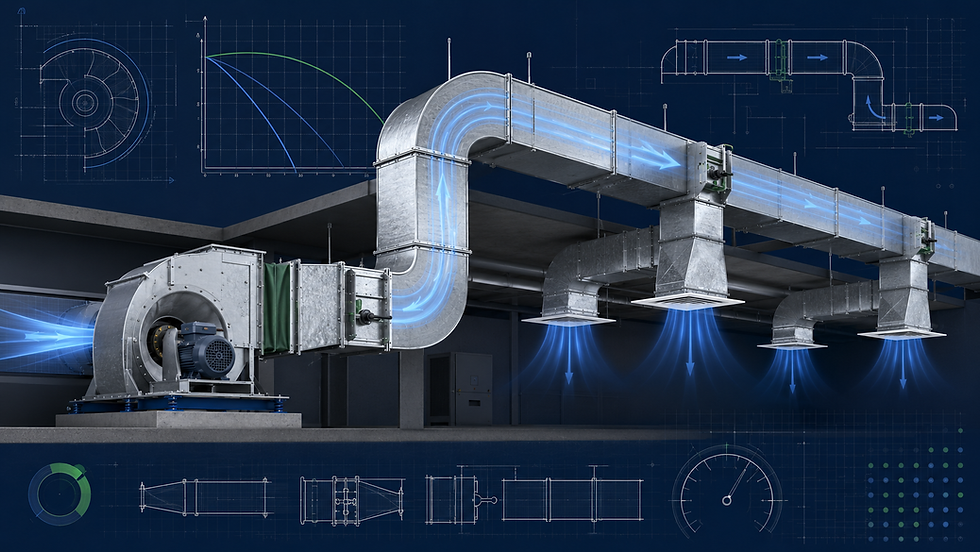
Illustrative AI-generated image. Equipment details are conceptual, not installation instructions.
SMART CONTROL • Better decisions begin with reliable sensors, compatible equipment and a commissioned system.
A home can hold its thermostat setpoint and still feel uncomfortable. A west-facing bedroom overheats before sunset. A study feels stuffy during a long call. The living room cools quickly, while an upstairs room never quite catches up. These are different problems, and they do not all have the same control solution.
Smart climate control is becoming more useful because it can combine information that a basic wall thermostat never sees. Occupancy signals, room sensors, temperature history and weather inputs can help determine when to run equipment and which conditions deserve attention. The practical opportunity is better decisions, supported by a properly designed and commissioned system.
A connected thermostat is a control layer. It cannot create missing cooling capacity, repair leaking ducts or deliver independent room airflow through hardware that has no means of controlling it.
What makes climate control genuinely smart?
Three capabilities are often bundled under the same label. Remote access lets someone change a setting from a phone. Rule-based automation follows instructions such as a weekly schedule or an occupancy trigger. Learning or predictive control uses observations or a model to adapt decisions over time. Only the last category necessarily involves learning, and predictive control itself does not always require AI.
This distinction matters when comparing specifications. Ask what the controller measures, what it learns, which outputs it can change and how a resident can override it. A useful system should explain its behaviour well enough that the owner can distinguish a deliberate energy-saving adjustment from a fault.
As one current example, Google's Smart Schedule documentation describes how the fourth-generation Nest Learning Thermostat can suggest or implement schedule changes and use occupancy-related signals. That is evidence of a particular capability in a particular product generation, not proof that every connected thermostat offers equivalent intelligence.
The real shift: from reacting to planning
A conventional thermostat generally responds when measured temperature crosses a control threshold. More sophisticated control can account for the building's response: how quickly a room warms, how long recovery takes and whether a predicted absence makes a temporary adjustment worthwhile.
Consider an illustrative household returning at 18:00. Starting cooling at 18:00 and reaching comfort later is different from choosing a start time intended to reach comfort by 18:00. A predictive approach may improve that timing as conditions change. Its success depends on reliable inputs and sufficient equipment capacity; unexpected guests, an open window or stronger solar gains can still change the outcome.
The strongest use case is often removing avoidable operation without making residents continually manage settings. However, a home already using an effective schedule may have less remaining opportunity than one conditioned at the same setting while empty. Compare proposed improvements with the household's actual baseline, not an imagined inefficient home.
Comfort needs more than one temperature reading
Room air temperature is useful, but comfort also depends on surrounding surface temperatures, air movement, humidity, clothing and activity. A sensor in a shaded hallway cannot fully represent a person sitting beside hot glazing. Moving the control sensor may improve the reference point without solving the underlying radiant or airflow problem.
Multiple sensors help reveal differences. They do not automatically create multiple controlled zones. If one central unit supplies fixed branches, selecting the bedroom sensor may extend operation until the bedroom is satisfied while overcooling another room. Ask how the system physically changes delivery before interpreting a multi-sensor dashboard as room-by-room control.
For the distribution side of this question, Nexora's guide to placing HVAC air terminals correctly connects diffuser location with room conditions and air paths. That design work remains relevant after a smart controller is installed.
Start with the load, then choose the controls
An engineer first needs to understand why each room needs heating or cooling. Orientation, glazing, shading, envelope construction, occupancy, equipment and ventilation all contribute. A control strategy based only on floor area can miss a small room with substantial solar gains or a larger room with comparatively modest demand.
The Nexora HVAC Load and Duct Sizing Professional Calculator is a relevant supporting resource for organizing room inputs, load and airflow calculations, and preliminary duct sizing. It belongs in the calculation workflow, rather than in the live thermostat control loop. Inputs and outputs still need project-specific checking.
Keep the design record readable: room loads in kW, airflow in L/s or m³/s, temperature in °C and pressure in Pa. Record design conditions and assumptions beside the numbers. A software-generated answer without those boundaries is difficult to review and even harder to compare with measurements later.
Commissioning is where the promise becomes testable
Commissioning checks whether the installed equipment, sensors and controls operate together as intended. For a home upgrade, the scope should include thermostat compatibility, sensor placement, equipment staging or modulation, airflow, condensate management, and the operation of any ventilation interface.
Ask the installer to demonstrate normal occupied operation, an absence period, recovery, a manual override and loss of connectivity. The last test is important: residents need to know which functions continue locally and how to change settings if a cloud service or home network becomes unavailable. Do not assume all devices have identical offline behaviour.
An appropriate baseline also includes duct performance. If pressure or delivered airflow is already problematic, adding more control logic can make diagnosis harder. Nexora's HVAC Duct Pressure Loss Design Suite supports organizing duct and fitting losses and fan-pressure checks. It does not replace measured airflow, manufacturer performance data or field commissioning.
Heat pumps need compatible control strategies
A setback strategy should fit the equipment. In heating operation, some heat-pump systems respond to recovery demand by engaging supplementary electric resistance heat, while others have different staging and recovery logic. Copying a deep setback from another house can therefore produce an unwanted result.
Natural Resources Canada's heat-pump guidance discusses thermostat operation and the importance of matching airflow to existing duct capacity. Review the selected equipment's instructions and control compatibility before enabling aggressive recovery or automatic changes. Variable-speed equipment also needs a supported interface to preserve its intended capabilities.
The useful question is not simply whether a thermostat can switch a heat pump on. It is whether the complete installation retains the required staging, auxiliary-heat control, operating protections and homeowner access.
Judge results with evidence, not dashboard graphics
ENERGY STAR states that certified smart thermostats demonstrate savings through independent certification using field data. Its smart thermostat guidance provides a useful evidence-based starting point. Certification is not a guarantee of a particular household's savings or proof that an AI feature alone caused them.
For a local assessment, record energy use alongside weather, occupancy and comfort complaints. Shorter compressor runtime is not automatically the same as lower energy use when equipment changes speed or auxiliary heat operates. Likewise, one mild month does not establish a permanent improvement.
A simple homeowner log can capture which room was uncomfortable, the time, the measured temperature, whether doors were closed and what the system was doing. Those observations give an installer much more useful information than “the smart thermostat does not work.”
A practical upgrade sequence
Define the problem: scheduling inconvenience, uneven room conditions, excessive operation or poor visibility. Separate comfort complaints from energy goals.
Inspect the physical system before adding controls. Confirm equipment suitability, air paths, maintenance condition and sensor locations.
Select compatible controls with understandable settings, manual override and a documented fallback. Review data collection and account access as part of the decision.
Commission the installation, record baseline conditions and revisit performance during representative weather.
For a deeper foundation, the Nexora HVAC Duct Design and Sizing Handbook provides a structured educational reference covering airflow, duct sizing, pressure losses and practical design work. Use it alongside the Nexora duct friction and static-pressure guide to connect control ambitions with the distribution system they depend on.
Better intelligence, supported by better engineering
AI can help climate control respond to changing routines and conditions. Its value grows when the system has trustworthy sensors, clear operating limits and an installation capable of delivering the requested result. The best upgrade makes the home easier to understand and operate, as well as more comfortable.
This article is educational guidance, not a final design or equipment selection. Use applicable local requirements, manufacturer instructions and a qualified project-specific assessment before changing HVAC controls or airflow arrangements.
Explore the connected HVAC series
Follow the control signal into the building with dynamic airflow and virtual zoning, then connect comfort settings to indoor air quality. For heating upgrades, see the heat-pump electrification guide.
Comments