Warehouse Loading-Door Infiltration: Separate Cooling Load from Daily Energy

A loading door can impose a short, substantial cooling and moisture load even when the warehouse’s average daily temperature looks acceptable. Two questions need separate answers: how much conditioning is needed while the exchange occurs, and how much thermal energy enters across the day? Multiplying a door area by an unexplained velocity rarely provides a defensible answer to either.
1. Establish an exchange rate you can defend
Start with measured air exchange, a suitable airflow model, or an explicitly assumed range for early design. Door dimensions alone do not determine flow. Wind, temperature difference, other openings, truck position and mechanical supply or exhaust all influence the exchange. NIST’s infiltration guidance explains these dependencies and the limits of treating large buildings as one well-mixed zone.
For a measurement study, coordinate door-state logs with weather, air-system operation and a qualified testing plan. Tracer methods depend on mixing and interpretation; a measured whole-building air-change rate can include other ventilation paths. A single doorway anemometer reading may miss simultaneous inflow and outflow across different parts of the opening.
The worked case below deliberately uses assumed incremental outdoor-air ingress associated with door operation. It is additional to the baseline ventilation already included in the load model. No claim is made that a particular door size creates this rate.
2. State the boundary and air properties
Assume a 12,000 m³ conditioned warehouse. During the chosen door-open condition, assume incremental ingress equivalent to 1.50 air changes per hour, referenced to actual incoming outdoor-air volume. Define N as this assumed rate in h⁻¹, V as warehouse volume in m³, and Q as incoming airflow in m³/s:
Q = N × V/3600 = 1.50 × 12,000/3600 = 5.00 m³/s.
The corresponding outward dry-air mass flow is assumed to balance the inflow at steady conditions. Outward actual volume need not equal inward actual volume because the air properties differ. We calculate the conditioning needed to bring the incoming stream to the specified indoor state; we do not add the outgoing stream as a second cooling load.
Use outdoor dry-bulb temperature T_o = 36°C and humidity ratio W_o = 0.0200 kg/kg dry air. Indoor conditions are T_i = 26°C and W_i = 0.0110 kg/kg dry air. Absolute pressure is 101.325 kPa. These are illustrative simultaneous states, not a local design-weather selection.
For this calculation, use moist-air enthalpy h = 1.006T + W(2501 + 1.86T), in kJ/kg dry air, and specific volume v = 0.287042(T + 273.15)(1 + 1.607858W)/p, in m³/kg dry air, with T in °C and p in kPa. The property basis and ideal-gas approximations are explained in ASHRAE’s Psychrometrics chapter.
3. Calculate instantaneous load and moisture entry
Outdoor specific volume is 0.90395 m³/kg dry air. Dry-air mass flow m_da = 5.00/0.90395 = 5.5313 kg/s.
Outdoor enthalpy is 87.5752 kJ/kg dry air; indoor enthalpy is 54.19896 kJ/kg dry air. The difference is 33.37624 kJ/kg.
Total conditioning load = m_da × (h_o − h_i) = 184.61 kW.
Net moisture entry = m_da × (W_o − W_i) × 3600 = 179.21 kg/h.
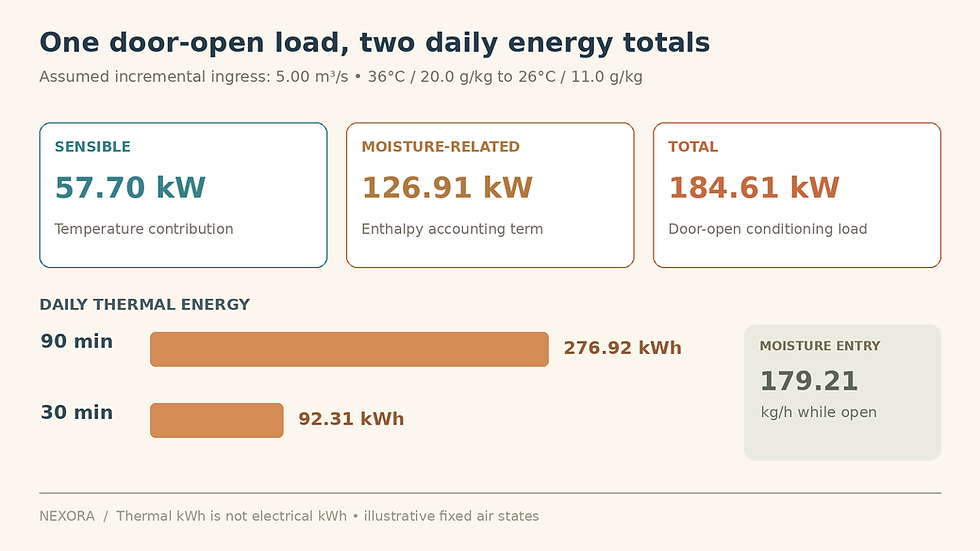
Illustrative fixed-state case. Reducing opening from 90 to 30 minutes changes thermal energy from 276.92 to 92.31 kWh; the door-open load remains 184.61 kW.
To show the sensible and moisture contributions without a residual mismatch, split the enthalpy change along a defined calculation path. First cool the incoming air at W_o, then remove moisture at T_i. The sensible term is m_da × (1.006 + 1.86W_o) × (T_o − T_i) = 57.70 kW. The remaining moisture-related term is m_da × (2501 + 1.86T_i) × (W_o − W_i) = 126.91 kW.
These terms sum to 184.61 kW. This is an accounting split of the air-state enthalpy change, not a prediction of an actual coil’s process line. It excludes detailed condensate-liquid enthalpy correction, fan heat and duct gains. Those belong in a full equipment selection.
4. Convert the door schedule into thermal energy
Suppose the stated exchange and weather persist during a total of 90 door-open minutes in one shift. The incremental thermal energy is 184.61 × 1.50 = 276.92 kWh of cooling. Moisture entry totals 179.21 × 1.50 = 268.82 kg.
A revised operating schedule reduces cumulative opening to 30 minutes under otherwise identical conditions. The totals become 92.31 kWh thermal and 89.61 kg of water vapor. The calculated reductions are 184.61 kWh thermal and 179.21 kg per shift.
The instantaneous 184.61 kW case remains unchanged. Reducing duration lowers the daily integral; it does not demonstrate a smaller exchange rate while a door is open. These kWh values are thermal, not electricity. Electrical savings require actual plant efficiency, part-load behavior, controls and the timing of the avoided load.
5. Test the uncertain input before choosing equipment
If the assumed door-related exchange lies between 0.75 and 2.25 h⁻¹, the same calculation produces 92.31–276.92 kW and 89.61–268.82 kg/h. Load varies directly with airflow in this fixed-state example. That three-to-one spread is more important than reporting enthalpy to several decimal places.
For changing conditions, calculate each interval using its own flow and air states, then sum load × elapsed hours. Log simultaneous openings rather than assuming each door acts independently. Crossflow between opposite facades may change the airflow pattern when another door opens.
ASHRAE’s nonresidential load chapter treats infiltration as part of the building load assessment. The engineer must combine this component with coincident envelope, internal and ventilation loads. Short events can be buffered by thermal storage while still creating local discomfort or humidity excursions; plant sizing cannot be decided from the daily average alone.
6. Turn the calculation into a field decision
Compare operational changes, repaired dock seals, faster closing and an engineered entrance treatment against a common baseline. Do not assign a universal effectiveness to an air curtain or seal. Verify the installed arrangement under relevant wind, vehicle and pressure conditions, and retain safe vehicle movement and required escape routes.
The minimum review record is the assumed or measured exchange rate, volume reference, air states, pressure, door schedule and uncertainty range. For the wider load-build-up and selection workflow, review the paid Cooling Load Design Handbook. Replace the illustrative ingress assumption with project evidence before committing capacity or savings.


Comments