AI-Based Humidity Control in Buildings (How Smart Dehumidification Reduces Energy Cost by 20–40%)
Updated: Sep 29
Introduction
Humidity control is still one of the most underestimated cost drivers in building HVAC design. In many projects, the design team gives full attention to dry-bulb temperature, air quantity, and equipment tonnage, yet moisture control is handled as a secondary matter. That approach is expensive. In actual projects, poor humidity control does not only create comfort complaints. It drives hidden energy waste, oversized systems, unstable chilled water operation, mold risk, poor indoor air quality, false thermostat satisfaction, and repeated tenant dissatisfaction.

The problem becomes worse in mixed-use buildings, high-occupancy spaces, fresh-air-heavy systems, tropical climates, coastal climates, natatoriums, kitchens, schools, retail, hospitals, and any building with large latent loads. Even in office buildings, the shift toward higher ventilation rates, tighter envelopes, intermittent occupancy, and energy recovery devices has made latent control more complex than older rule-of-thumb methods assumed.
The traditional response has often been simple: cool the air harder and reheat it later. That works, but it is frequently an energy penalty disguised as humidity control. Smart dehumidification changes the logic. Instead of treating every hour as a peak condition and every space as thermally identical, AI-based humidity control uses data, prediction, adaptive control, and equipment staging intelligence to remove moisture only when and where needed. The result can be a measurable reduction in energy cost, commonly in the range of 20–40% when compared with poorly optimized conventional operation in moisture-sensitive buildings.
The engineering case is straightforward. Latent load is dynamic. Ventilation air conditions vary hour by hour. Occupancy is not constant. Building use changes through the day. Coil behavior depends on leaving air temperature, entering wet-bulb, chilled water temperature, face velocity, and valve control stability. Fixed sequences cannot respond efficiently to that complexity. AI-based control can.
This article takes a consulting-grade engineering view of the subject. It will explain the psychrometric fundamentals, system architecture, control logic, comparison of design approaches, decision criteria, calculation methods, real project economics, failure modes, and future trends. It will also challenge a common industry assumption: that good humidity control requires permanent low supply air temperatures and significant reheat energy. In many actual buildings, that assumption is outdated.
Engineering Insight 1In actual projects, humidity complaints often appear even when the thermostat reads 23–24°C. The issue is not sensible temperature. The issue is uncontrolled latent load, usually from ventilation air, infiltration, poor coil control, or oversized equipment cycling. (AI-Based Humidity Control in Buildings)
Fundamentals
Why humidity matters beyond comfort
Relative humidity affects far more than thermal sensation. High indoor humidity can cause:
Condensation on diffusers, piping, glazing, and ceilings
Mold growth in concealed spaces and soft finishes
Reduced perceived cooling quality
Odor persistence
Degradation of paper, wood, electronics, and stored goods
Poor occupant acceptance of setpoint temperatures
Greater risk in healthcare and laboratory spaces
Instability in pressurization and air distribution systems
For most commercial buildings, a practical indoor target is usually between 45% and 60% RH, with many premium applications designed closer to 50% RH. However, relative humidity alone is not the best control variable. From an engineering perspective, dew point or humidity ratio is more stable and meaningful, especially when temperature shifts.
Sensible load versus latent load
HVAC designers typically divide cooling load into:
Sensible load: heat that changes dry-bulb temperature
Latent load: moisture that changes humidity ratio
A building may satisfy sensible load while failing latent load. That is why a space can feel cold and clammy at the same time.
Latent load sources include:
Outdoor ventilation air
Infiltration
Occupants
Wet processes
Building moisture release
Kitchens, laundry, pools, spas, and wash areas
Intermittent door opening and pressure imbalance
Practical psychrometric basis
Humidity control should be understood using humidity ratio, dew point, enthalpy, and coil leaving conditions.
Humidity ratio (AI-Based Humidity Control in Buildings)
Humidity ratio WWW is the mass of water vapor per mass of dry air, usually in kg/kg dry air. For engineering calculation, it is often easier to convert from psychrometric software or tables.
Typical values:
Indoor design at 24°C DB and 50% RH: around 0.0093 kg/kg
Outdoor hot-humid at 35°C DB and 60% RH: around 0.0214 kg/kg
That difference is the source of large latent load.
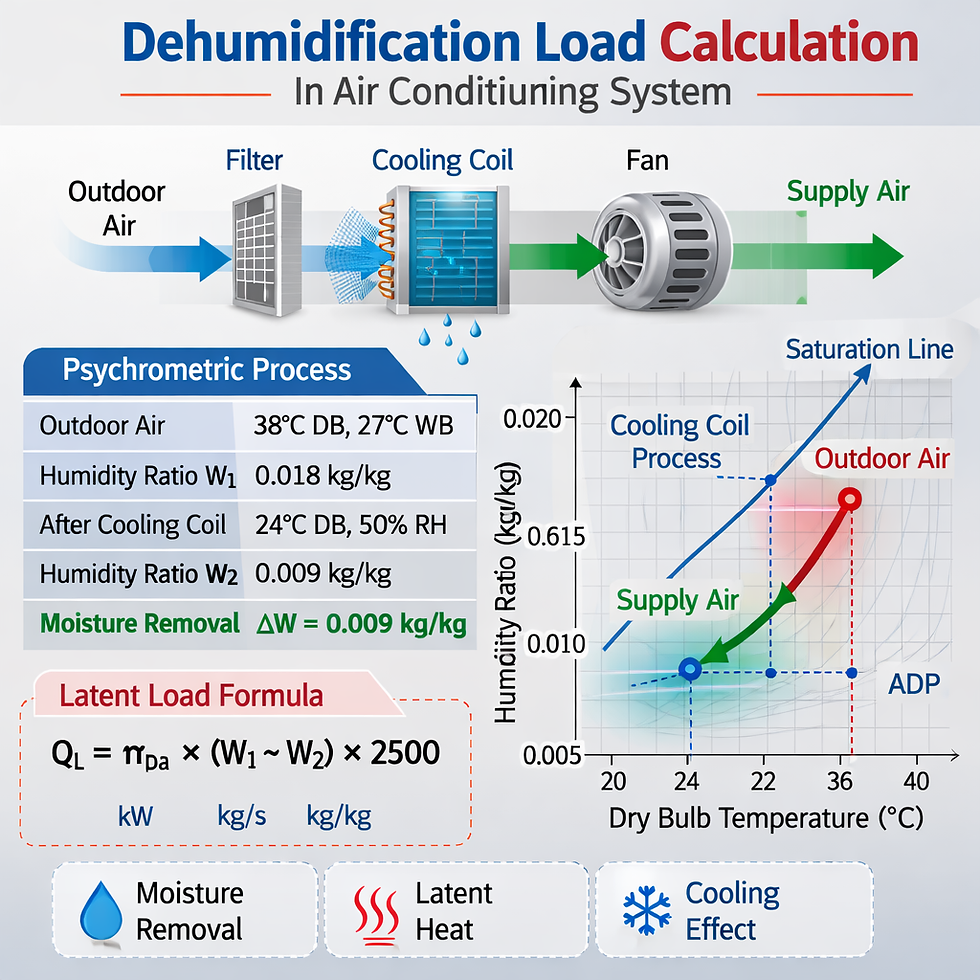
Latent load equation
A practical SI form is:
QL=m˙air × hfg × ΔW
Where:
QL = latent cooling load, kW
m˙air = mass flow rate of dry air, kg/s
hfg = latent heat of vaporization, approximately 2500 kJ/kg
ΔW = humidity ratio difference, kg/kg dry air
For quick HVAC work, many engineers use psychrometric software for greater accuracy, but the governing physics remains this.
Why dew point matters
Space RH can mislead control logic because RH changes when dry-bulb changes, even if moisture content stays nearly constant. Dew point reflects actual moisture content more directly. In actual projects, controlling space dew point rather than only RH improves stability and avoids overreaction during temperature drift.
The coil’s role in dehumidification
A cooling coil dehumidifies only when its surface temperature is below the entering air dew point.
Once condensation begins, latent removal occurs. This means dehumidification depends on:
Entering air condition
Coil surface temperature
Chilled water supply temperature
Coil row depth
Face velocity
Valve authority and controllability
Air bypass factor
Runtime stability
An oversized coil with poor valve control may fail to provide stable latent removal during part-load conditions. Likewise, a variable air volume system with reduced airflow can unintentionally worsen coil behavior if sequencing is not correct.
Engineering Insight 2From site experience, many “humidity problems” are actually control problems, not equipment capacity problems. The coil is present, but the control sequence never keeps it cold long enough or stable enough to remove moisture effectively.
Concept and System Architecture
Unique engineering angle of this article
The unique engineering angle here is this: AI-based humidity control should not be viewed as a premium software overlay. It should be treated as a moisture-specific optimization layer across ventilation, chilled water, zone control, and reheat logic.
The economic value comes not from “AI” as a label, but from preventing conventional systems from operating blindly against latent load.
What AI-based humidity control really means
In practical terms, AI-based humidity control uses:
Real-time sensors: temperature, RH, dew point, airflow, CO2, valve position, chilled water temperature, occupancy
Weather inputs: outdoor dry-bulb, wet-bulb, dew point, forecast
Historical patterns: occupancy, complaints, energy use, moisture trends
Predictive logic: pre-dehumidify before occupancy, reset supply conditions, coordinate outdoor air and reheat
Equipment optimization: stage DOAS, chillers, pumps, coils, reheat, desiccant wheel, exhaust, return air control
Fault detection: sensor drift, stuck valves, poor coil performance, unstable static pressure, abnormal compressor cycling
This is more than basic BMS logic. A traditional BMS typically reacts to present conditions using static setpoints. AI-based control predicts conditions and selects the least-energy response.
Typical system architecture
A practical smart dehumidification architecture can include the following layers.
Building layer
Space temperature and RH sensors
High-risk humidity zones monitored by dew point
Occupancy and scheduling inputs
Pressure sensors for critical spaces
Complaint logging or FM feedback integration
Air-side layer
DOAS with dedicated latent treatment
AHUs with chilled water or DX cooling coils
VAV or CAV terminal units
Energy recovery with bypass capability
Reheat coil or sensible trim capability when needed
Water-side layer
Chilled water supply temperature reset
Pump speed control
Coil valve position feedback
Condenser water and plant optimization where applicable
AI / analytics layer
Weather forecast ingestion
Occupancy pattern learning
Space moisture load prediction
Adaptive setpoint optimization
Fault detection and diagnostics
Energy KPI dashboard
Control action layer
Outdoor air pretreatment level
Coil leaving air temperature reset
Zone reheat enable/disable
Supply airflow optimization
Chilled water temperature reset bounds
Pressurization correction
Alarm prioritization
Technical Explanation
Conventional humidity control logic
Conventional humidity control usually depends on one or more of the following:
Fixed supply air temperature
Space thermostat with humidity alarm only
Low cooling coil leaving air temperature during occupied mode
Terminal reheat when space overcools
Manual seasonal adjustment of setpoints
Conservative ventilation and no prediction layer
This works acceptably in stable climates and simple buildings, but becomes inefficient in dynamic conditions.
AI-driven humidity control logic
AI logic improves performance by asking better questions:
Is the moisture load coming from outdoor air, infiltration, or occupancy?
Is the problem localized or building-wide?
Can the system reduce humidity by pre-coiling outdoor air instead of overcooling all zones?
Should chilled water be reset lower only during specific latent hours?
Can zone reheats be minimized by prioritizing dedicated outdoor air latent removal?
Will a weather forecast predict a humidity spike in the next two hours?
Is the current valve response indicating loss of coil authority?
Is the space trend showing likely RH drift before occupancy begins?
Comparison of three major approaches
Approach 1: Conventional overcooling and reheat
This is still common in many projects.
Advantages
Simple concept
Familiar to contractors and operators
Effective in critical humidity applications
Disadvantages
High reheat energy
Wasteful operation in part load
Poor zone-to-zone efficiency
Often masks ventilation design weakness
Can create unstable comfort
Approach 2: Dedicated outdoor air system with fixed control sequences
This is a significant improvement over basic overcool-reheat systems.
Advantages
Better latent separation
Lower ventilation moisture impact on terminal systems
Better pressurization and indoor air quality
Improved zone sensible control
Disadvantages
Still often uses fixed sequence assumptions
May not adapt to occupancy variability
Can miss plant-level optimization opportunities
Performance depends heavily on commissioning quality
Approach 3: AI-based smart dehumidification with predictive control
This is the most advanced operational strategy.
Advantages
Reduces unnecessary reheat and overcooling
Anticipates humidity excursions
Coordinates DOAS, AHU, chilled water, airflow, and zone control
Enables fault detection
Improves energy and comfort simultaneously
Disadvantages
Requires sensor quality
Depends on good sequence design and BAS integration
Needs operator trust and commissioning discipline
Poor data hygiene can damage outcomes
Challenging an industry assumption
A common industry assumption is: “To control humidity properly, we must always drive supply air very cold and reheat aggressively.”
That is not universally true.
In actual projects, that approach often became standard because:
Older control systems lacked predictive capability
Designers had limited sensor feedback
Ventilation loads were handled by central AHUs without dedicated treatment
Reheat was the safest fallback for avoiding clammy spaces
However, with a properly designed DOAS, dew-point-based zone monitoring, outdoor air pretreatment, adaptive chilled water reset, and predictive occupancy/weather logic, many buildings can maintain humidity targets with materially lower reheat use. The energy savings are real, especially where latent load varies significantly by hour.
The more correct engineering statement is this: Good humidity control requires precise moisture management, not permanent overcooling.
Engineering Insight 3From field experience, when a building solves latent load at the outdoor air source, zone-level reheat energy often drops sharply. Many systems are paying a reheat penalty because the ventilation strategy was never optimized.
Engineering Decision Matrix
Selecting the right control philosophy
Below is a practical decision matrix comparing three approaches.
Criterion | Overcool + Reheat | DOAS + Fixed Logic | AI-Based Smart Dehumidification |
Initial simplicity | High | Medium | Low |
Humidity performance | Medium-High | High | High |
Energy efficiency | Low | Medium-High | High |
Part-load adaptability | Low | Medium | High |
Sensor dependency | Low | Medium | High |
Commissioning importance | Medium | High | Very High |
Retrofit suitability | Medium | High | Medium-High |
Fault detection ability | Low | Low-Medium | High |
ROI potential | Low-Medium | Medium | High |
Where each approach fits
Best use for overcool + reheat
Small critical spaces
Retrofit constraints with no DOAS
Applications where energy is secondary to strict humidity stability
Best use for DOAS + fixed control
Offices, schools, hospitality, retail
New construction with moderate sophistication
Projects needing better humidity control but limited digital maturity
Best use for AI-based smart dehumidification
Large mixed-use projects
Buildings with high ventilation load variability
Premium owner-operators with energy KPI targets
Facilities where comfort complaints and moisture risks are financially significant
Campuses, healthcare, hospitality, laboratories, and humid-climate commercial assets
Step-by-Step Calculation Methodology
Design case assumptions
Let us consider a ventilation-driven latent load problem for a commercial floor.
Given
Outdoor air flow: 5000 L/s
Outdoor air condition: 35°C DB, 60% RH
Indoor condition target: 24°C DB, 50% RH
Air density: 1.2 kg/m³
Latent heat of vaporization: 2500 kJ/kg
Outdoor humidity ratio Wo: 0.0214 kg/kg
Indoor humidity ratio Wi: 0.0093 kg/kg
Step 1: Convert airflow to mass flow
5000 L/s=5.0 m3/s
m˙air = 5.0 × 1.2 = 6.0 kg/s
Step 2: Find humidity ratio difference
ΔW = 0.0214−0.0093 = 0.0121 kg/kg
Step 3: Calculate latent load from outdoor air
QL = 6.0 × 2500 × 0.0121
QL = 181.5 kW
This is only the latent portion associated with ventilation air. That is already a major load.
Step 4: Compare with a better pretreatment strategy
Suppose a dedicated dehumidification stage reduces the supply humidity ratio of outdoor air to 0.0105 kg/kg before it reaches the occupied zones.
Then:
ΔW = 0.0105−0.0093 = 0.0012 kg/kg
QL = 6.0 × 2500 × 0.0012 = 18.0 kW
The zone-side latent burden has dropped from 181.5 kW to 18.0 kW.
That does not mean the latent energy disappeared. It means the moisture removal is now managed more deliberately and efficiently at the system level rather than forcing downstream zones to suffer.
Step 5: Estimate energy impact of poor control
Assume a conventional system uses excessive reheat to maintain comfort after overcooling. Let extra reheat demand equal 80 kW during humid operating hours, 10 hours/day, 300 days/year.
Energy = 80×10×300 = 240,000 kWh/year
At an electricity cost equivalent of 0.12 USD/kWh:
Annual cost = 240,000×0.12 = 28,800 USD/year
That is reheat penalty alone, excluding fan, chiller, unstable control, and complaint-related indirect costs.
Step 6: Estimate AI optimization savings
If AI-based control reduces reheat and unnecessary dehumidification energy by 30%:
Savings=28,800×0.30=8,640 USD/year
In real projects, total HVAC savings can be significantly higher because the system also improves chilled water reset, fan control, and outdoor air conditioning logic.
Step 7: Include fan and plant-side savings
Assume improved control also reduces:
Fan energy by 25,000 kWh/year
Chiller plant energy by 60,000 kWh/year
At the same tariff:
(25,000+60,000)×0.12=10,200 USD/year
Total annual energy saving:
8,640+10,200=18,840 USD/year
This example already supports a strong business case before even pricing moisture-damage risk reduction.
Read related articles :
Psychrometric Calculations in HVAC Design
Real Project Example
Project profile
Consider a mid-size premium office building in a coastal hot-humid region.
Gross floor area: 18,000 m²
Occupancy: 1 person per 10 m² average peak
System: central chilled water AHUs with VAV, plus treated outdoor air unit
Existing issue: frequent comfort complaints during shoulder seasons and early morning occupancy
Indoor complaint condition: 23°C to 24°C but 65–70% RH in perimeter and meeting rooms
Measured problem hours: approximately 1,200 hours/year
Existing operation: fixed low supply air setpoint and uncontrolled terminal reheat response
Baseline findings
Site review showed:
Outdoor air dew point often exceeded design assumptions during morning hours
Space RH sensors were limited and poorly located
Chilled water reset logic increased supply temperature too early
AHU control focused on dry-bulb only
CO2-based ventilation reset was active, but humidity effect was ignored
Terminal reheats operated frequently to offset overcooling
Retrofit intervention
The building owner implemented:
Additional calibrated space RH/dew point sensors in critical zones
Outdoor air dew point monitoring
AI-based predictive control layer integrated with BAS
Dynamic coil leaving air temperature reset
Smart DOAS control for outdoor air moisture removal
Chilled water reset limited by humidity risk instead of temperature only
Reheat lockout optimization during low-latent conditions
Fault detection for stuck valves and sensor drift
Measured building data
Before optimization
Annual HVAC energy: 2,450,000 kWh
Estimated humidity-control-related waste: 420,000 kWh/year
Comfort complaints related to “cold and sticky” conditions: 94 cases/year
Average indoor RH during humid periods: 63–68%
After optimization
Annual HVAC energy: 1,960,000 kWh
Energy reduction: 490,000 kWh/year
Comfort complaints reduced to 19 cases/year
Indoor RH during humid periods maintained around 50–56%
Reheat valve operating time reduced by about 42%
Chilled water reset became more stable without sacrificing latent performance
Financial result
Assume blended electricity rate:
0.11 USD/kWh
Annual energy saving:
490,000×0.11=53,900 USD/year
Assume implementation cost:
Sensors and field devices: 18,000 USD
BAS integration and logic programming: 24,000 USD
Analytics / AI layer: 22,000 USD
Commissioning and tuning: 11,000 USD
Total:
75,000 USD
Simple payback:
75,000/53,900=1.39 years
That is approximately 16.7 months.
What changed technically
The biggest improvement did not come from adding more cooling capacity. It came from controlling the existing capacity correctly. The DOAS removed more moisture before it entered the zones. The AI layer anticipated humidity spikes from weather forecast and occupancy schedule. Chilled water reset no longer compromised latent control at the wrong time. Terminal reheat was no longer compensating for upstream control inefficiency.
Engineering Insight 4In actual projects, owners often ask for a bigger coil or lower thermostat setpoint when humidity complaints appear. That is usually the wrong first move. The first step should be to understand where moisture is entering, how the coil is behaving, and whether the control sequence is working against itself.
Design Considerations
Climate and weather profile
AI-based humidity control is most valuable in:
Hot-humid climates
Coastal regions
Monsoon climates
Buildings with strong diurnal weather variation
Sites with high infiltration potential
In dry climates, latent control may still matter in niche applications, but the economic case is less universal.
System selection strategy
The right architecture depends on load profile.
Office and mixed-use towers
A DOAS plus intelligent AHU and zone control is usually effective.
Hotels
Guest rooms benefit from occupancy-linked moisture logic. Corridors, lobbies, restaurants, and kitchens require separate treatment priorities.
Hospitals and labs
Humidity control should be conservative, but AI can still optimize plant and sequence behavior while protecting strict limits.
Schools and universities
Intermittent occupancy makes prediction valuable. Preconditioning before first bell can reduce morning RH excursions.
Sensor strategy
Bad humidity control often starts with bad sensing. Requirements include:
Quality RH sensors with periodic calibration
Proper sensor placement away from direct diffusers and exterior walls
Outdoor dew point sensing
Valve and damper position feedback
Airflow verification where latent performance depends on coil face conditions
Engineering judgement on chilled water reset
One of the most common mistakes is aggressive chilled water temperature reset that saves plant energy while silently damaging latent performance. Engineers should always set humidity-aware lower and upper bounds. Plant efficiency should not be optimized in isolation from indoor moisture behavior.
Commissioning needs
AI does not remove the need for commissioning. It increases it.
Commissioning should verify:
Sensor accuracy
Coil leaving temperature stability
Valve authority
Actual outdoor air flow
Sequence transition during occupied/unoccupied modes
Response to humidity alarm events
Reheat lockout and release logic
Pressurization performance
Cost and ROI
CapEx versus OpEx
Owners often hesitate because AI-based systems appear to add controls cost. The correct way to evaluate them is not as software decoration, but as operational risk reduction and energy optimization.
Typical cost items:
Sensors and gateways
BAS integration
Analytics platform or AI engine
Commissioning and tuning
Staff training
Typical savings streams:
Reduced reheat energy
Lower chiller energy
Reduced fan energy
Fewer comfort complaints
Lower mold/remediation risk
Better equipment life due to stable operation
Reduced after-hours troubleshooting
Invest X, save Y logic
Consider a building with annual humidity-control-related waste of 150,000 USD. If smart dehumidification reduces that by 25%:
Savings=37,500 USD/year
If implementation cost is 60,000 USD:
Payback=60,000/37,500=1.6 years
If moisture-related maintenance and complaint management also drop by 8,000 USD/year, effective payback improves further:
60,000/45,500=1.32 years
This is why premium owners increasingly consider intelligent humidity control not as a luxury, but as a building-performance measure with commercial return.
Failure Scenario and Troubleshooting
Typical failure scenario
A commercial building reports high humidity in conference rooms and perimeter areas during early morning and mild-weather days. Operators observe that chilled water temperature is reset upward during these periods because sensible load is low. At the same time, ventilation continues, occupancy ramps up, and outdoor dew point remains high.
Space dry-bulb stays acceptable, but RH rises above 65%.
Root cause chain
Chilled water reset based only on sensible load
Inadequate latent priority in DOAS
No predictive response to weather dew point
Space RH sensors too sparse
Reheat acting only after zones are already overcooled
Operators relying on thermostat data only
Troubleshooting framework
Check sensor reliability
Compare field values with calibrated handheld instruments.
Review psychrometric trend
Plot outdoor dew point, space RH, chilled water temperature, coil leaving air temperature, valve position, and reheat valve position.
Verify ventilation flow
Excess outdoor air or leakage can overwhelm latent control.
Review sequence of operation
Does humidity have true priority, or only alarm status?
Check valve authority and coil performance
A coil that never reaches intended leaving condition cannot dehumidify as modeled.
Test predictive logic
If humidity spike is visible every morning, reactive control is already too late.
Engineering Insight 5From site experience, one of the fastest ways to diagnose humidity instability is to trend outdoor dew point and chilled water supply temperature on the same timeline. When chilled water resets upward while dew point stays high, the building is often being set up to fail.
Optimization Strategies
Prioritize latent control at the ventilation source
Treat outdoor air moisture before it becomes a zone problem. This is usually the highest-value strategy.
Use dew point as a primary moisture metric
RH is useful for display and alarms, but dew point or humidity ratio is better for stable control.
Combine prediction with occupancy patterns
If meeting rooms always spike after 9:00 AM, start moisture control before the spike.
Limit reheat intelligently
Reheat is sometimes necessary, but it should be the last efficient step, not the default answer.
Protect chilled water reset with humidity constraints
Reset for plant efficiency, but never beyond the point where latent performance collapses.
Integrate fault detection
AI is especially valuable when it identifies:
Sensor drift
Stuck dampers
Leaking valves
Coil fouling
Abnormal compressor or fan cycling
Separate critical and non-critical zones
Do not control the whole building to the most sensitive room unless required. Use zoning discipline.
Advanced Insights
Future systems
The next wave of smart humidity control will likely combine:
AI sequence optimization
Digital twins of psychrometric performance
Forecast-driven control
Occupancy vision systems or secure people-counting integration
Dynamic tariff response
Hybrid desiccant plus cooling coil strategies
Self-tuning control loops
AI plus decarbonization
As buildings decarbonize, the penalty of wasteful electric reheat becomes more visible. Smart dehumidification supports lower-energy electrified HVAC strategies by minimizing unnecessary simultaneous cooling and reheating.
Engineering trend to watch
More projects will move toward humidity-aware plant control, where chilled water temperature reset, pump speed, and air-side latent requirements are optimized together instead of as separate silos. That is where substantial additional savings remain untapped.
Engineering Diagrams and Figures


Read related articles :
Sizing equipment on a live project? The Cooling Load Design Handbook walks through the full design chain - envelope and internal loads, latent load, airflow, coil duty and equipment selection - with worked examples.
FAQ
What is the main difference between temperature control and humidity control?
Temperature control manages sensible heat. Humidity control manages moisture content. A space can meet temperature setpoint and still feel uncomfortable if latent load is not controlled.
Why do some buildings feel cold but still humid?
Because the system is lowering dry-bulb temperature without removing enough moisture, or because overcooling and reheating are masking poor latent control.
Is AI-based humidity control only for large buildings?
No. Large buildings gain the most absolute savings, but medium commercial buildings, hotels, schools, and specialized facilities can also benefit.
Can AI-based control work with existing BMS platforms?
Yes, if the BAS allows sufficient points integration, trending, and supervisory control logic. Retrofit feasibility depends on controls architecture.
What sensor is most important for smart dehumidification?
There is no single sensor, but outdoor dew point sensing and reliable space humidity sensing are both critical.
Is relative humidity enough as a control variable?
Not always. Dew point or humidity ratio is usually better for stable moisture control because it is less influenced by temperature swings.
Does smart dehumidification always require a DOAS?
No, but a DOAS greatly improves the ability to manage ventilation latent load efficiently. Without it, optimization options are narrower.
What is the most common design mistake?
Treating humidity as a secondary alarm instead of a primary control objective in humid climates or high-ventilation buildings.
Can chilled water reset damage humidity performance?
Yes. If reset is based only on sensible conditions, coil latent performance may collapse during humid hours.
How much energy can actually be saved?
In poorly optimized systems, 20–40% HVAC energy reduction related to dehumidification strategy is achievable. The exact figure depends on climate, system type, and baseline inefficiency.
Is reheat always bad?
No. Reheat is a valid tool, especially in critical spaces. The problem is using it excessively because upstream moisture control is poor.
How does AI help beyond normal BAS logic?
AI can predict moisture events, learn occupancy patterns, detect faults, and optimize multiple control variables together instead of relying on static reactive sequences.
What building types should consider this first?
Hotels, healthcare, laboratories, schools, mixed-use towers, retail centers, natatoriums, and
any building with high outdoor air or latent sensitivity.
Is the ROI usually attractive?
Often yes, especially where reheat energy, comfort complaints, or moisture-related operational issues are high. Payback in the 1–3 year range is realistic in many retrofit cases.
Should the design engineer specify AI control from day one?
For premium projects, yes. It is better to specify sensing, point lists, integration logic, and commissioning expectations early rather than trying to retrofit blindly later.
Conclusion
AI-based humidity control is not about adding fashionable software to an ordinary HVAC system. It is about correcting a long-standing weakness in building operation: the tendency to manage moisture with blunt, energy-intensive methods. Smart dehumidification works because it recognizes that latent load is dynamic, weather-dependent, occupancy-dependent, and system-dependent. When the building responds intelligently, it can maintain indoor humidity targets more reliably while cutting reheat waste, reducing plant inefficiency, and preventing comfort complaints.
In actual projects, the strongest results come when engineers stop treating humidity as a secondary symptom and start treating it as a primary design and operational variable. The building then becomes easier to control, more comfortable to occupy, and less expensive to run. For developers and asset owners, that is not just a technical improvement. It is a financial one.
The real question is no longer whether buildings can control humidity. The real question is this: how much longer can premium buildings afford to control humidity inefficiently?
Author’s Note
This article is intended for engineering guidance based on practical design experience and industry standards. All calculations and recommendations should be verified against project-specific requirements, applicable codes, and site conditions before implementation.


Comments