Stop Guessing Pipe Sizes: Introducing the MEP Pipe Design & Sizing Handbook
Updated: 7 days ago
Every MEP engineer has been there — a tight deadline, a pipe size decision with real cost and safety consequences, and nothing but scattered code PDFs, half-remembered formulas, and a spreadsheet someone else built five years ago.
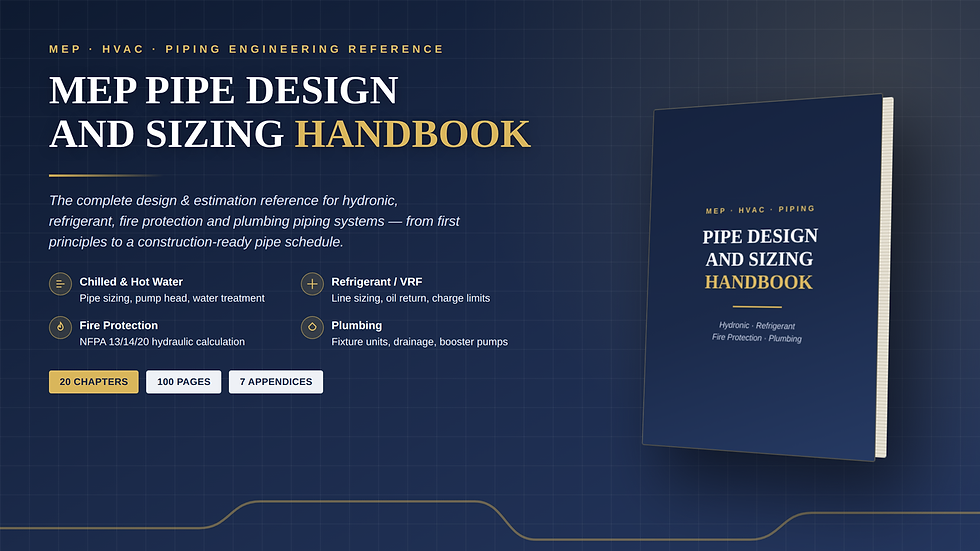
We published the MEP Pipe Design & Sizing Handbook — a 100-page, 20-chapter reference built to fix exactly that problem.
What's Inside
One system covering every major piping discipline in a building, from first-principles fluid mechanics to a construction-ready pipe schedule:
Chilled water, condenser water & heating hot water — flow derivation, ASHRAE chart sizing, pump head calculations, water treatment
Refrigerant piping (DX & VRF/VRV) — line sizing, oil-return velocity, elevation limits, refrigerant charge safety
Fire protection — full NFPA 13/14/20 hydraulic calculation method, worked example, fire pump fundamentals
Plumbing — fixture-unit sizing, booster pumps, drainage design, storm water
Why It's Different MEP Pipe Design & Sizing Handbook
This isn't a textbook that stops at theory. Every chapter carries the governing formula, the code reference, a worked numerical example, and a Design Note — the real-world mistake this exact calculation prevents.
Whether you're sizing your first chilled water riser or reviewing a junior engineer's tender package, this is the reference you keep open on a second monitor — not the one you skim once and shelve.
What You Get
Every governing formula explained, not just stated
Worked examples you can follow line by line
3 real case studies — riser sizing, VRF elevation limits, fire water supply verification
7 practical appendices: unit conversions, pipe dimension tables, a formula quick-reference sheet, glossary, calculation templates, and a design-review checklist
Built on ASHRAE, ASME B31.9/B31.5, NFPA 13/14/20/24, IPC/UPC, EN 12828/13480, and Qatar Construction Specifications (QCS)
Get Your Copy
Instant download. PDF + editable Word version included. 100 pages of pure, applicable engineering — no filler.


Comments