How to Prevent Cold-Air Dumping from Ceiling Diffusers
Updated: 3 days ago
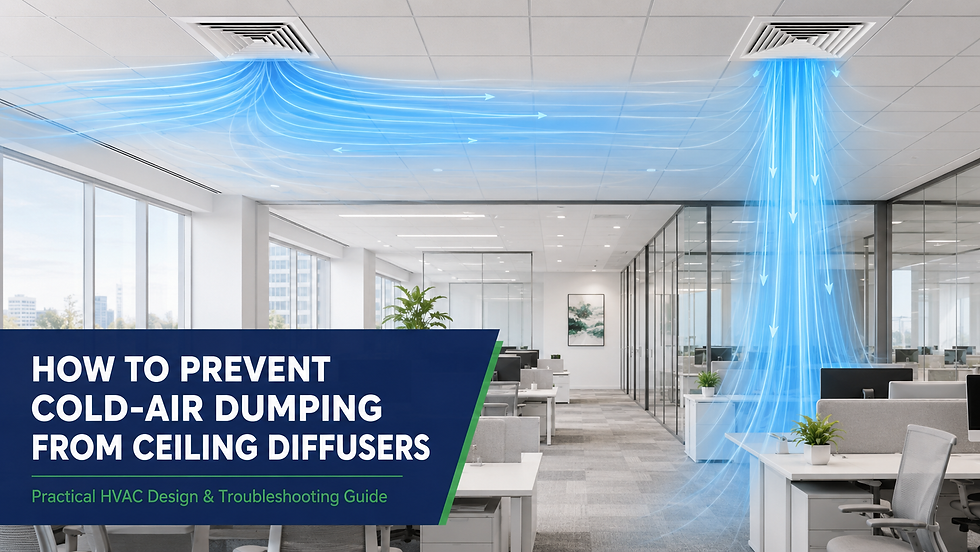
Cold-air dumping is a common air-distribution problem in air-conditioned buildings. It occurs when cool supply air discharged from a ceiling diffuser loses its horizontal momentum too quickly and falls directly into the occupied zone. Occupants may experience cold drafts, uneven temperatures and discomfort even when the room thermostat indicates that the desired temperature has been achieved.
The problem is often blamed on low supply-air temperature. However, cold-air dumping is usually caused by a combination of diffuser selection, insufficient airflow, poor diffuser placement, excessive system turndown, incorrect neck connections or unsuitable control strategies. (How to Prevent Cold-Air Dumping from Ceiling Diffusers)
This article explains why cold-air dumping occurs and how HVAC designers, contractors and commissioning teams can prevent it.
1. What Is Cold-Air Dumping?
A ceiling diffuser is normally designed to discharge supply air horizontally along the ceiling. The air jet should remain attached to the ceiling, travel a calculated distance and gradually mix with room air before entering the occupied zone.
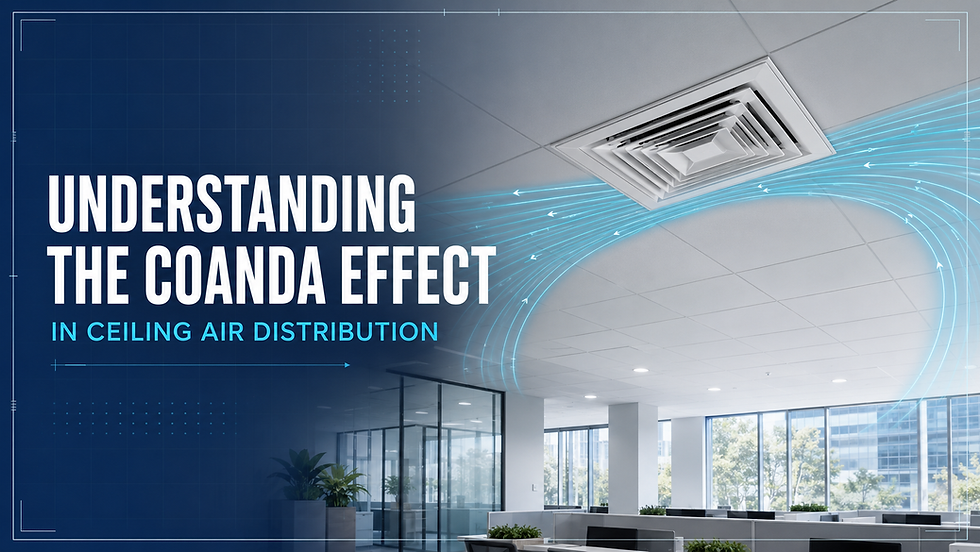
This ceiling attachment is commonly associated with the Coanda effect. When the diffuser is properly selected and installed close to a flat ceiling, the supply-air jet entrains nearby room air and tends to remain attached to the ceiling surface.
Cold-air dumping occurs when this attachment is lost too early. The cold supply air, which is denser than the surrounding room air, then descends rapidly into the occupied zone.
Download the full design guide PDF with detailed calculations, fan sizing, code compliance, and real project insights. Built for HVAC engineers and MEP consultants. (How to Prevent Cold-Air Dumping from Ceiling Diffusers)
For detailed calculations, project-specific design, and authority-compliant solutions, contact our engineering team.
Email : info@nexoradesign.net
Phone : +94 76 720 5408
Web : www.nexoradesign.net
Read related blogs
Understanding the Coandă Effect in Ceiling Air Distribution
How to Select Supply-Air Diffusers Using Throw, Drop and Spread
Condensate Drain Pipe Insulation: Types, Applications, Advantages, and Disadvantages
Water Supply Pipe Insulation: Types, Applications, Advantages and Disadvantages
Chilled-Water Pipe Insulation: Types, Applications, Advantages and Disadvantages
How to Design an Outdoor Cooling System for a Park
HVAC Duct Insulation: Types, Applications, Advantages and Disadvantages
Want the complete workflow? The HVAC Duct Design & Sizing Handbook connects airflow, diffuser and grille selection, duct sizing methods, pressure-loss calculations and fan ESP across 25 chapters, with worked office, villa and AHU examples.

Comments