Flexible Duct Design: Maximum Length, Sag and Pressure-Loss Effects
Updated: 3 days ago
Flexible ductwork is widely used in HVAC systems because it is lightweight, quick to install and capable of connecting rigid duct branches to ceiling diffusers without complex fabricated fittings. However, its apparent simplicity often leads to poor design and installation practices.
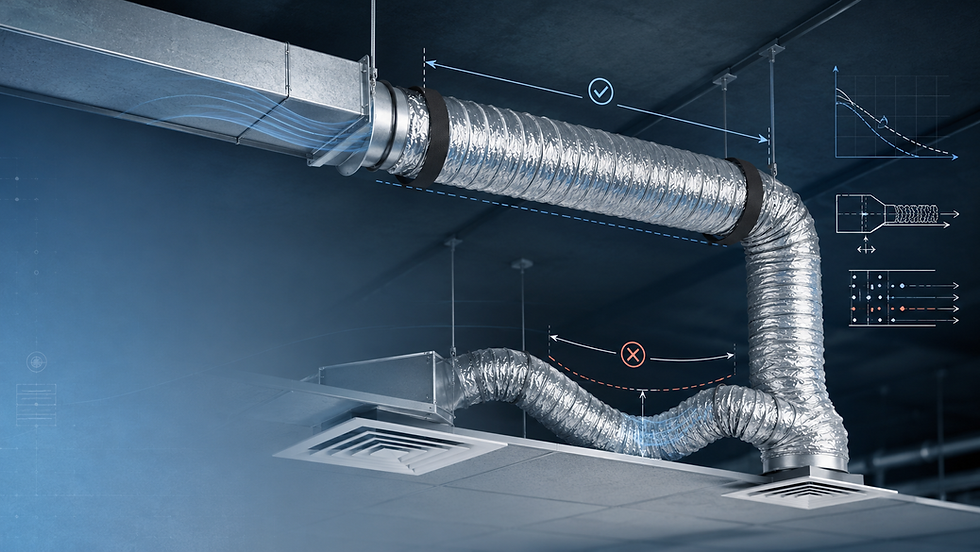
A flexible duct may have the correct nominal diameter and still fail to deliver the required airflow because it is too long, insufficiently stretched, sharply bent, compressed, pinched or inadequately supported. These defects increase pressure loss, reduce terminal airflow, raise fan energy consumption and make air balancing difficult.
Effective flexible-duct design therefore requires more than selecting a diameter. The designer must control: (Flexible Duct Design: Maximum Length Sag and Pressure-Loss Effects)
Installed length
Straight-line compression
Vertical and horizontal sag
Bend geometry
Download the full design guide PDF with detailed calculations, fan sizing, code compliance, and real project insights. Built for HVAC engineers and MEP consultants. (Flexible Duct Design: Maximum Length, Sag and Pressure-Loss Effects)
For detailed calculations, project-specific design, and authority-compliant solutions, contact our engineering team.
Email : info@nexoradesign.net
Phone : +94 76 720 5408
Web : www.nexoradesign.net
Read related blogs
Return-Air Grille Sizing: Face Velocity, Noise and Pressure-Loss Limits
How to Prevent Cold-Air Dumping from Ceiling Diffusers
Understanding the Coandă Effect in Ceiling Air Distribution
How to Select Supply-Air Diffusers Using Throw, Drop and Spread
Condensate Drain Pipe Insulation: Types, Applications, Advantages, and Disadvantages
Water Supply Pipe Insulation: Types, Applications, Advantages and Disadvantages
Chilled-Water Pipe Insulation: Types, Applications, Advantages and Disadvantages
Want the complete workflow? The HVAC Duct Design & Sizing Handbook connects airflow, diffuser and grille selection, duct sizing methods, pressure-loss calculations and fan ESP across 25 chapters, with worked office, villa and AHU examples.
Comments