💧 Selecting Moisture Eliminators for High-Velocity Cooling Coils
Updated: 3 days ago
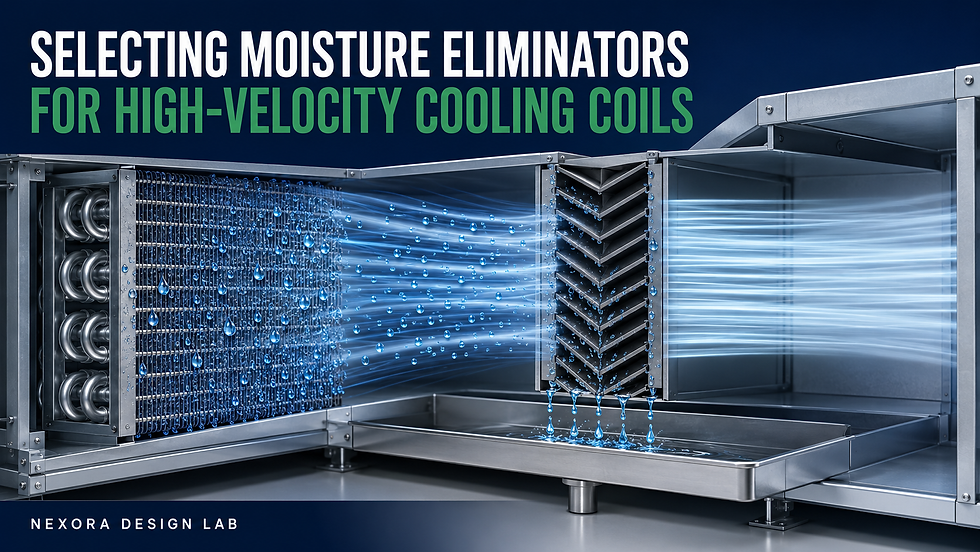
When air passes through a wet cooling coil at high velocity, condensate can be pulled from the coil surface and carried into downstream ducts, filters and equipment. This can cause corrosion, water leakage, microbial growth, damaged filters and increased maintenance.
A moisture eliminator helps prevent this problem by forcing the air through specially designed vane profiles. Water droplets strike the vanes, combine into larger drops and drain into the AHU condensate pan while the treated air continues downstream.
However, selection should never be based on coil face velocity alone. Engineers must consider:
✅ Maximum and minimum airflow
✅ Average and local coil face velocity
✅ Droplet-removal efficiency
✅ Eliminator free-area velocity
✅ Clean and wet pressure drop
✅ Condensate and drainage capacity
✅ Profile orientation and module height
✅ Corrosion-resistant materials
✅ Cleaning and maintenance access
✅ Fan power and available ESP
For wet cooling coils without confirmed carryover data, a face velocity of approximately 2.0–2.5 m/s can be used as an initial screening range. It is not a universal limit. The final decision must be supported by coil and eliminator manufacturer performance data. (Selecting Moisture Eliminators for High-Velocity Cooling Coils)
Try the Cooling Load Design Handbook
Download the full design guide PDF with detailed calculations, sizing, code compliance, and real project insights. (Selecting Moisture Eliminators for High-Velocity Cooling Coils)
For detailed calculations, project-specific design, and authority-compliant solutions, contact our engineering team.
Email : info@nexoradesign.net
Phone : +94 76 720 5408
Web : www.nexoradesign.net
Read related blogs
How Dirty Filters Change Airflow, Fan Power and Cooling Capacity
Pre-Filters, Fine Filters and HEPA Filters: Where Each One Belongs
How to Calculate the Correct Condensate Trap for Negative-Pressure AHUs
AHU Drain-Pan Design: Slope, Trap Depth and Overflow Protection
How to Select an AHU Cooling Coil: Rows, Fins and Face Velocity
HVAC Water Treatment: Preventing Scale, Corrosion and Biological Growth
Hydraulic Decoupling in Chilled-Water Plants Explained
Sizing equipment on a live project? The Cooling Load Design Handbook walks through the full design chain - envelope and internal loads, latent load, airflow, coil duty and equipment selection - with worked examples.


Comments