Designing HVAC Plenums Without Creating Turbulence and Noise
Updated: 3 days ago
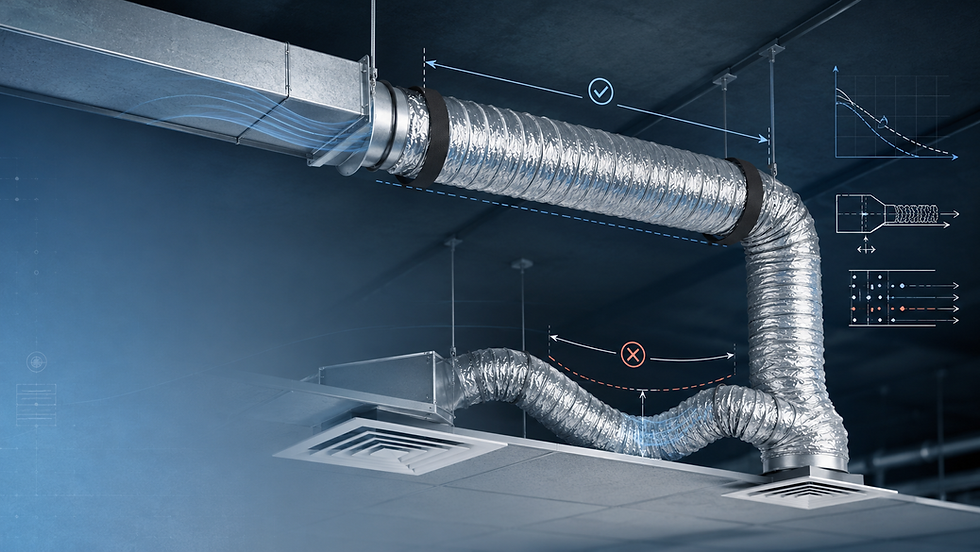
HVAC plenums are often treated as simple sheet-metal boxes used to connect a fan, air-handling unit, duct branch, grille or diffuser. In reality, a plenum is an aerodynamic component that can significantly affect airflow distribution, fan performance, pressure loss, energy consumption and indoor noise.
A properly designed plenum slows and redistributes the air, converts part of the velocity pressure into static pressure and supplies reasonably uniform airflow to the connected ducts or terminals. A poorly designed plenum can do the opposite: create high-velocity jets, recirculation zones, unstable pressure, excessive damper noise, vibration and uneven airflow distribution. (Designing HVAC Plenums Without Creating Turbulence and Noise)
ASHRAE recommends designing air-distribution systems to minimise flow resistance and turbulence because turbulent fittings and dampers can generate significant low-frequency noise. Plenums are also commonly used between fans and main ducts to smooth turbulent airflow and provide acoustic attenuation.
This article explains how HVAC plenums should be sized, configured and connected so that they distribute air quietly and efficiently.

Download the full design guide PDF with detailed calculations, fan sizing, code compliance, and real project insights. Built for HVAC engineers and MEP consultants. (Designing HVAC Plenums Without Creating Turbulence and Noise)
For detailed calculations, project-specific design, and authority-compliant solutions, contact our engineering team.
Email : info@nexoradesign.net
Phone : +94 76 720 5408
Web : www.nexoradesign.net
Read related blogs
Return-Air Grille Sizing: Face Velocity, Noise and Pressure-Loss Limits
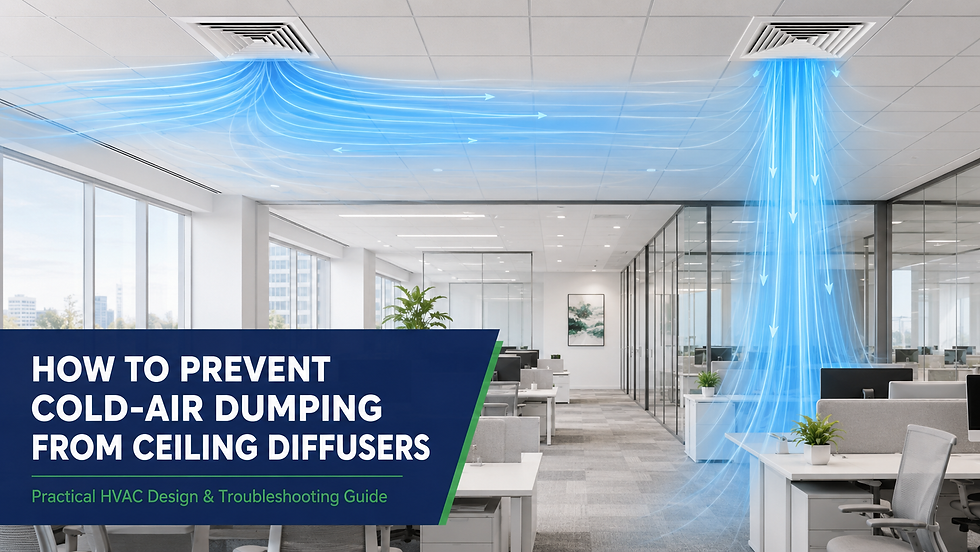
How to Prevent Cold-Air Dumping from Ceiling Diffusers
Understanding the Coandă Effect in Ceiling Air Distribution
How to Select Supply-Air Diffusers Using Throw, Drop and Spread
Condensate Drain Pipe Insulation: Types, Applications, Advantages, and Disadvantages
Water Supply Pipe Insulation: Types, Applications, Advantages and Disadvantages
Chilled-Water Pipe Insulation: Types, Applications, Advantages and Disadvantages
Want the complete workflow? The HVAC Duct Design & Sizing Handbook connects airflow, diffuser and grille selection, duct sizing methods, pressure-loss calculations and fan ESP across 25 chapters, with worked office, villa and AHU examples.

Comments